
Which of the following is the correct order of hierarchy of medieval Europe?
- Dukes — Barons — Knights — Peasants
- Barons — Earls — Feudal Lords — Peasants
- Earls — Dukes — Knights — Barons
- Barons — Dukes — Knights — Lords
Answer
Dukes — Barons — Knights — peasants
Reason — In the feudal structure, the King granted estates to Dukes and Earls, who distributed part of their land to the lesser lords called Barons, below them came the Knights, and at the base were the peasants who cultivated the land.
Which of the following was NOT a result of the Fall of Constantinople?
- Discovery of new trade routes
- Crusades
- Decline of Feudalism
- Revival of learning
Answer
Crusades
Reason — The Fall of Constantinople in 1453 led to the discovery of new trade routes, the decline of feudalism and the revival of learning.
............... refer to the religious expeditionary wars with the goal of restoring the Church’s access to holy places in and near Jerusalem.
- Crusades
- Brisades
- Black wars
- Agnar
Answer
Crusades
Reason — The Crusades were the religious expeditionary wars fought with the goal of restoring the Church's access to holy places in and near Jerusalem.
Where did the Renaissance first begin?
- England
- India
- Italy
- France
Answer
Italy
Reason — The Renaissance first began in Italy as it was the seat of the Roman Empire with its historical remains, received Greek scholars and manuscripts after the Fall of Constantinople, and had wealth accumulated from trade with the East.
Which of the following is incorrect?
- Leonardo Da Vinci : The Last Supper
- Donatello : Pieta
- Machiavelli : The Prince
- William Shakespeare : King Lear
Answer
Donatello : Pieta
Reason — The 'Pieta' was sculpted by Michelangelo. Donatello made the bronze statue of David. The other three pairings are correctly matched.
What was the Copernican Revolution?
- Proof that the earth revolves around the sun.
- Proof that the earth was the centre of the universe.
- Proof of close connection between medicine and chemists.
- Proof of circulatory movement of blood in the body.
Answer
Proof that the earth revolves around the sun.
Reason — Copernicus formulated the heliocentric model placing the sun, and not the earth, at the centre of the universe, proving that the earth revolves around the sun. This triggered the Copernican Revolution.
Interest in man, his interests, his nature and his life on earth is referred to as
- Spirituality
- Theology
- Humanism
- Reformation
Answer
Humanism
Reason — The Renaissance created an interest in man, his interests, his nature and his life in this world, which developed humanism — a shift in concern from divine matters to human ones.
(A) Renaissance, which means rebirth or revival, was a complex transitional movement that began in Europe in the 14th century in Italy and lasted till 17th century.
(R) Many Greek and Roman scholars shifted to Rome and revived the learning of Greek classics and paved the way for Renaissance.
- (R) contradicts (A)
- (R) is the reason for (A)
- (A) is true but (R) is false.
- (A) and (R) are independent of each other.
Answer
(R) is the reason for (A)
Explanation — Constantinople fell into the hands of the Turks in 1453. The Roman and Greek scholars were forced to shift to Rome and other parts of Europe with their manuscripts. They spread their new spirit and ideas, wherever they went. The revival of the learning of Greek classics paved the way for the Renaissance.
(A) The disintegration of the feudal order in Europe ushered in a new social and economic order.
(R) The new order led to new developments in art, literature, philosophy and science and contributed to the rise of Renaissance.
- (R) contradicts (A)
- (A) is the reason for (R)
- (A) is true but (R) is false.
- (A) and (R) are independent of each other.
Answer
(A) is the reason for (R)
Explanation — The disintegration of the feudal order in Europe gave rise to peace which further helped to promote growth of learning. The new order thus, led to new developments in art, literature, philosophy and science and contributed to the rise of Renaissance.
(A) The wealthy merchants of Italy patronised the artists and literary figures for the revival of classical culture and literature.
(R) The opening of new trade routes between the East and the West led to the revival of feudalism in Europe.
- (R) contradicts (A)
- (R) is the reason for (A)
- (A) is true but (R) is false.
- (A) and (R) are independent of each other.
Answer
(A) is true but (R) is false.
Explanation — The opening of new trade routes between the East and the West during the Age of Discovery led to an increase in commerce and the rise of a merchant class.
(A) Renaissance led to the use of local languages instead of Latin.
(R) During Renaissance, the authors dwelt on spiritual themes.
- (R) contradicts (A)
- (R) is the reason for (A)
- (A) is true but (R) is false.
- (A) and (R) are independent of each other.
Answer
(A) is true but (R) is false.
Explanation — During the Renaissance, literature shifted from Latin to local vernacular languages, making written works far more accessible to the general public. Additionally, creative themes moved away from purely religious topics to focus broadly on human potential and achievements.
(A) Renaissance led to the Reformation Movement in England and Europe.
(R) During the Renaissance period, there occurred a division of the Church into two sects - Catholics and the Protestants.
- (R) contradicts (A)
- (A) is the reason for (R)
- (A) is true but (R) is false.
- (A) and (R) are independent of each other.
Answer
(A) is the reason for (R).
Explanation — During Renaissance, people became critical of the Church and insisted on the reform of the Church. This led to the division of the Church into two sects — Catholics and the Protestants leading to the Reformation Movement in England and in Europe.
What is meant by the term 'Renaissance'?
Answer
The term 'Renaissance' means rebirth or revival. It stands for a complex transitional movement in Europe between medieval and modern times beginning in the 14th century in Italy and lasting into the 17th century.
Mention any two causes of the Renaissance.
Answer
Two causes of the Renaissance were:
- Capture of Constantinople — Constantinople, the capital of the Eastern Roman Empire fell into the hands of the Turks in 1453. This forced the Roman and Greek scholars to shift to Rome and other parts of Europe with their manuscripts. These genius scholars spread their new spirit and ideas, wherever they went paving the way for Renaissance.
- Decline of Feudalism — Decline of Feudalism in the 13th and 14th centuries provided an impetus to free thinking and favoured the growth of new learning. It led to new developments in the spheres of art, literature, philosophy and science and contributed to the rise of Renaissance.
What was the result of the victory of the Turks over Constantinople?
Answer
As the capital of the Eastern Roman Empire, Constantinople was the epicenter of classical culture, housing priceless Greek and Roman manuscripts. When the city fell to the Turks in 1453, its brilliant, humanistic scholars fled to Europe, making Rome the new center of Greek learning. By disseminating their manuscripts and rational, liberal ideas across the continent, these scholars revived public interest in classical philosophy, science, art, and literature, directly paving the way for the Renaissance.
The decline of feudalism led to the rise of Renaissance. Give two reasons.
Answer
The two reasons for the rise of Renaissance with decline of feudalism were:
- The decline of feudalism provided an impetus to free thinking.
- The peace and freedom that prevailed after the decline of feudalism favoured the growth of New learning.
Mention any two factors that led to the growth of the spirit of enquiry among the people of Europe.
Answer
Two factors that led to the growth of the spirit of enquiry among the people of Europe were:
- Role of original thinkers — Bold medieval scholars like Roger Bacon, Abelard, and Thomas Aquinas challenged rigid church dogmas by encouraging independent thought. They revolutionized intellectual discourse by prioritizing rational reasoning over blind faith.
- Development of science — Medieval scholars fostered a scientific attitude by urging the observation of nature, which led to numerous discoveries. This growth of science successfully nurtured a spirit of inquiry and a rational, scientific temper.
How did the invention of the printing press bring in a new awakening in Europe?
Answer
In the Middle Ages, books were scarce and inaccessible to ordinary people. The invention of the printing press transformed Europe by mass-producing affordable books, making knowledge widely accessible. Scholars could easily study printed texts rather than tedious manuscripts, fundamentally shifting public attitudes and sparking a new intellectual awakening across the continent.
Mention any two consequences of geographical explorations.
Answer
Two consequences of geographical explorations are:
- The geographical discoveries led to the establishment of trade between Europe and the East.
- They also paved the way for the process of colonisation of Asia and Africa.
Renaissance artists tried to depict life on canvas and stone. With reference to this statement, describe the progress in the art of painting.
Answer
Rejecting rigid medieval rules, Renaissance painters established exceptionally high standards by adopting new techniques like frescoes, oil paints, and woodcuts. By studying optics, geometry, and anatomy, they mastered accurate perspective and captured realistic human gestures and expressions. Driven by a humanistic, secular approach, they created extraordinarily lifelike masterpieces that transformed the art world.
Mention the impact of the Renaissance in the field of English literature.
Answer
The biggest impact of the Renaissance on literature was the use of local languages instead of Latin. The themes of writing also changed. Instead of focusing only on religion and heaven, authors began writing about human beings and their real-life problems. This period produced many famous English writers, poets, and playwrights, including Geoffrey Chaucer, Thomas More, Francis Bacon, and William Shakespeare.
Many factors contributed to usher in the spirit of Renaissance, which had far-reaching consequences for the entire world. In this context, write short notes on:
(a) Capture of Constantinople.
(b) Decline of Feudalism.
(c) Invention of the Printing Press.
Answer
(a) Capture of Constantinople — Constantinople, the capital of the Eastern Roman Empire, was a major hub of classical culture and home to priceless ancient texts. When the city fell to the Turks in 1453, its brilliant, humanistic scholars fled to Western Europe with their manuscripts, turning Rome into a new center of Greek learning. By spreading their rational, liberal ideas, these scholars revived public interest in classical philosophy, science, art, and literature, directly paving the way for the Renaissance.
(b) Decline of Feudalism — Feudalism was a rigid, land-based system that organized medieval European society through a strict hierarchy of mutual obligation and military defense. The King granted estates to high lords (Dukes and Earls), who subdivided land to lesser lords (Barons and Knights) in exchange for allegiance and military service, while peasants cultivated the fields. Because this graded structure opposed social mobility, personal freedom, and equal rights, it stifled progress.
However, the decline of feudalism in the 13th and 14thcenturies brought peace and freedom, sparking a wave of independent thinking. This liberation fostered the growth of "New Learning," driving major advancements in art, literature, philosophy, and science that ultimately triggered the Renaissance.
(c) Invention of the printing press — The printing press, invented by Gutenberg in 15th century Germany and later introduced to England by Caxton, transformed Europe by enabling the mass production of books. Previously, hand-written manuscripts were rare, expensive, and out of reach for ordinary citizens.
By making the Bible, classical literature, and educational texts affordable and widely available, the printing press rapidly spread knowledge. Scholars benefited from easily readable texts, which democratized education, shifted public attitudes toward life, and sparked a major intellectual awakening across Europe.
Renaissance brought in a spirit of enquiry among the people of Europe. In this context, answer the following question:
(a) Explain briefly the role of original thinkers in promoting the spirit of enquiry among the people of Europe.
(b) How did the development of science create the spirit of enquiry?
(c) What was the role of Crusades in ushering in the spirit of enquiry?
Answer
(a) During the Medieval Age, the Church discouraged original thinking and called upon scholars to put faith in the Church dogmas. However, original thinking could not be suppressed for a long time and certain bold and independent thinkers criticised the Church and asked the people to develop their own thinking. They developed a spirit of enquiry and a sense of curiosity among the people. They taught human beings to know the Why and How of things. Thinkers like Roger Bacon, Abelard, Thomas Aquinas revolutionised the thought process and laid stress on reasoning.
(b) Certain medieval scholars showed a scientific attitude and asked their students to observe things in nature. This brought in many new inventions and discoveries. Development of science created the spirit of enquiry and scientific temper. Roger Bacon contemplated the use of horseless carriages and flying machines. Copernicus proved that the Earth moves around the Sun. Galileo invented the telescope. These inventions broadened the mental outlook of the people and put an end to the old beliefs and traditions.
(c) The Crusades were the religious expeditionary wars with the goal of restoring the Church's access to holy places in and near Jerusalem. They brought the people of Europe into direct contact with the people of Asia. The Crusades brought to Western Europe ideas from the East. It widened their outlook on life. People began to rely on reason rather than on blind faith.
Renaissance or rebirth brought about drastic changes in art, literature and science. In this context, write short notes on the following:
(a) Leonardo Da Vinci
(b) William Shakespeare
(c) Nicolaus Copernicus
Answer
(a) Leonardo Da Vinci — Leonardo Da Vinci was a great painter, sculpture, musician and a scientist. Da Vinci's interests ranged far beyond fine arts. He studied nature, mechanics, anatomy, physics, architecture and weaponry. He saw science and art as complementary rather than distinct disciplines, and thought that ideas formulated in one realm could, and should, inform the other. He spent a great deal of time immersing himself in nature, testing scientific laws, dissecting bodies (human and animals) and thinking and writing about his observations. In the early 1490s, Da Vinci started documenting about four broad themes — painting, architecture, mechanics and human anatomy. He created thousands of pages of neatly drawn illustrations. His paintings of the 'Virgin of the Rocks', 'The Last Supper' and 'Mona Lisa' are great masterpieces of art.
(b) William Shakespeare — He was an English playwright, poet, and actor, widely celebrated as England's national poet and the "Bard of Avon." His remarkable body of work includes 38 plays, 154 sonnets, and several narrative poems.
His theatrical career evolved through distinct phases:
- Early Works: Focused primarily on historical dramas like Richard II and Henry V, alongside the romantic tragedy Romeo and Juliet.
- Comedies: Celebrated early hits including A Midsummer Night's Dream and Twelfth Night.
- Tragedies: Masterpieces written after 1600, such as Hamlet, King Lear, Othello, and Macbeth.
By capturing the fundamental emotions and complexities of eternal human nature, Shakespeare’s work successfully transcends culture and time, retaining a powerful universal appeal.
(c) Copernicus — Nicolaus Copernicus was a mathematician and astronomer. He formulated a model of the universe that placed the Sun rather than the Earth at the centre of the universe. The publication of this model in his book 'De revolutionibus orbium celestium' (On the Revolutions of the Celestial Spheres), just before his death in 1543, is regarded as a major event in the history of science, triggering the Copernican Revolution. He introduced the Heliocentric theory. This also led to a series of discoveries by scientists like John Kepler, Galileo and Isaac Newton.
Study the given picture and answer the following questions:
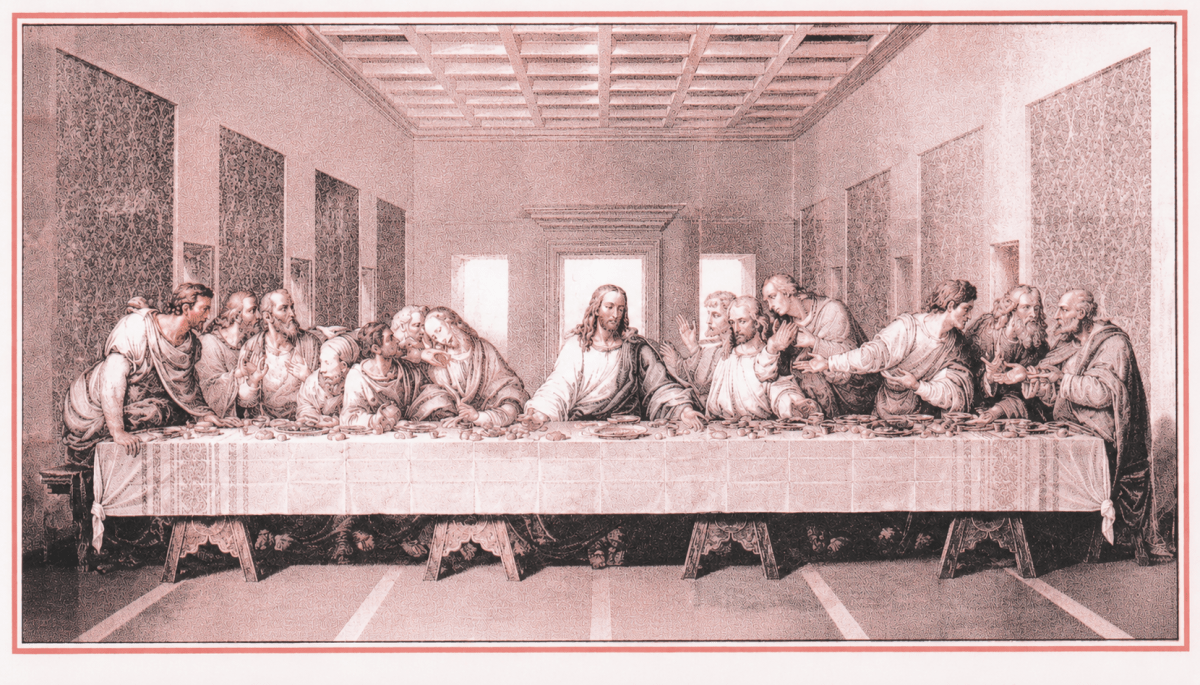
(a) Identify the painting and name the artist who made it. Name another famous painting by the same artist.
(b) Write a short note on the Renaissance paintings.
(c) What changes occurred in art as a result of the Renaissance spirit in Europe?
Answer
(a) The given painting is 'The Last Supper' by Leonardo Da Vinci. 'Mona Lisa' is the other famous painting by him.
(b) Renaissance paintings marked a shift from religious and symbolic art of the Middle Ages to being more realistic and life-like and had a humanistic secular approach. The Renaissance painters adopted new artistic methods such as frescoes for wall pictures, oil colours and woodcuts. They studied optics and geometry and used their knowledge to develop perspective in their paintings. These paintings depicted scenes from the Bible, mythology, and daily life.
Some of the greatest paintings of the time were: Virgin of the Rocks, The Last Supper and Mona Lisa by Leonardo Da Vinci, Last judgement and The Fall of Man by Michelangelo, and Sistine Madonna by Raphael.
(c) During the Renaissance, artists broke away from medieval rules and traditions. They introduced new techniques such as frescoes for wall paintings, oil colours, and woodcuts. By studying optics and geometry, they developed perspective, giving depth and realism to their work. Knowledge of human anatomy helped them depict natural gestures and expressions accurately. Free from the rigid control of the Church, Renaissance painters embraced a humanistic and secular approach, creating highly artistic and lifelike paintings.
In sculpture, the revival of classical antiquity had a profound impact. Some artists copied Greek and Roman masterpieces, while others produced original works that rivalled ancient creations.
In the face of technological advancements like AI, do we need to have a 'New Renaissance' today to foster a period of significant intellectual and creative advancement similar to the historical Renaissance? Give reasons to support your answer.
Answer
Yes, in the face of technological advancements like AI, we need a 'New Renaissance' to foster a period of significant intellectual, cultural, and creative advancement, much like the historical Renaissance revitalized arts and sciences.
Merging Technology with Human Values: Just as the Renaissance balanced reason with humanism, a new renaissance would help integrate AI and other technologies with ethics, empathy, and human values to ensure they serve humanity rather than replacing it.
Creative Exploration: The Renaissance encouraged artistic expression and exploration. In a similar way, today’s artists, writers, and thinkers can use AI as a tool for new forms of creativity and storytelling, expanding the boundaries of imagination.
Revival of Critical Thinking: With the overload of information and misinformation, a renewed focus on education, logic, and critical thinking — much like the Renaissance focus on classical learning — is necessary for an informed and responsible society.
Democratization of Knowledge: Just like the invention of the printing press made knowledge accessible, AI can be harnessed to make education and information more widely available, reducing gaps between different sections of society.
Interdisciplinary Collaboration: The Renaissance celebrated polymaths like Leonardo da Vinci who bridged art and science. Today, we need collaboration across disciplines — between coders, philosophers, artists, and scientists — to face challenges in society and environment.
Thus, a new renaissance can help us use technological tools wisely, promote creativity and critical thought, and ensure a more just and enlightened future.
Imagine that you went to Rome during the period when the Renaissance movement was at its peak. Describe the spirit of Renaissance among the artists, scientists, authors and the masses.
Answer
If I visited Rome during the peak of the Renaissance, I would step into a vibrant world rediscovering ancient Greek and Roman culture. Here is what I would observe among different groups:
Artists — I would see creators breaking away from rigid medieval styles to make lifelike art. By studying geometry and human anatomy, they master realistic perspective using new techniques like oil paints and frescoes. I would marvel at works by giants like Michelangelo, Leonardo da Vinci, and Raphael.
Scientists — I would notice scholars reviving ancient knowledge through observation and experiments rather than blind faith. Their breakthroughs in astronomy, math, and anatomy are quietly setting the stage for a major scientific revolution.
Authors — I would find writers moving away from strictly religious topics to focus on human life and real-world struggles, creating a movement called Humanism. Instead of Latin, they write in local languages so regular people can read their works. I would enjoy classics by Dante, Petrarch, and Boccaccio.
Masses — I would witness huge social shifts among everyday people. With the printing press making books affordable, knowledge is spreading fast. As the absolute power of the Church and feudal lords weakens, a rising middle class of traders and lawyers is thriving and demanding peace and stability.
How, according to you, the spirit of enquiry has been an important factor in the growth and development of human civilisation? Give examples to support your answer.
Answer
The spirit of inquiry, the simple desire to know "why" and "how" has always driven human progress. Here is how it has shaped our world:
- Science and technology — The urge to solve everyday problems led to game-changing breakthroughs like electricity, the steam engine, telescopes, and lifesaving vaccines.
- Philosophy and critical thinking — By asking big questions about life and right versus wrong, thinkers helped us learn to analyze facts, spot logical errors, and build better laws and governments.
- Cultural and social progress — Questioning old traditions sparked new styles of art and music. It also fueled movements like the 18th-century Enlightenment, which championed reason, science, and individual rights over absolute control by the church or rulers.
- Exploration and discovery — Curiosity drove brave travelers to find new lands and cultures across the globe. Today, that same spirit drives us to explore outer space, send rockets to distant planets, and walk on the moon.
Ultimately, this constant curiosity helps us break past old limits and endlessly discover what human beings are capable of achieving.
Do you think industrialisation would have been possible without Renaissance? Give reasons to support your answer.
Answer
No, I don't think industrialization would have been possible without the Renaissance. The Renaissance was a vital period of new thinking and inventions that laid the groundwork for the scientific progress needed for the industrial age.
During the Renaissance, we saw major advances that later became the backbone of industry:
- Metalworking: New ways of working with metals allowed us to eventually produce the large amounts of steel needed to build strong machines, engines, and factories.
- The Printing Press: This invention allowed us to mass-produce books and share technical knowledge quickly with people all over the world.
- Better Ships: Improved ship designs made it possible to travel farther and carry more goods, which kickstarted global trade.
Without these breakthroughs, the technology and infrastructure we needed for factories and machinery simply wouldn't have existed. For me, the Renaissance was a necessary first step that opened the door to the Industrial Revolution.
Compare and contrast the events in Europe with what was happening in India at the time of Renaissance.
Answer
The Renaissance period in Europe began in the 14th century and lasted till the 17th century. During this period, India saw the rule of the Delhi Sultanate and the Mughal empire. Both regions were marked by significant changes and developments during this period, which would have a lasting impact on their respective histories and cultures. A comparative study of the different aspects of each region's history and development is presented below:
- Political and Social Context — In Europe, the Renaissance was a period of significant political and social change, with the rise of powerful monarchies and the emergence of a new middle class. The Protestant Reformation, which began in the 16th century, also challenged the authority of the Catholic Church and led to significant religious and social disruption. In contrast, India during this time was witnessing a fusion of the Indian traditions with the Turkish culture which led to the emergence of a new composite culture incorporating the best elements of the two.
- Cultural and Intellectual Development — The Renaissance in Europe was characterized by a renewed interest in classical learning, art, and literature, and by the emergence of humanism, which emphasized the value of human reason and creativity. This led to significant advancements in fields such as science, mathematics, and philosophy. In contrast, India during the period saw the emergence of new literary forms, such as the development of Urdu poetry, the Bijak, Padavali. The Bhakti movement, Sufism and introduction of Christianity greatly influenced the culture, art and literature.
- Architecture — During the Renaissance period, European and Indian architecture witnessed significant transformation, but with notable differences. European architecture was characterized by the use of classical forms and motifs such as columns, arches, and domes. In contrast, Indian and Islamic architecture mingled to give rise to a new type of Indo-Islamic architecture characterised by spaciousness, massiveness, majesty and width. Some significant buildings built in Europe during the Renaissance period were St. Peter's Basilica, the Duomo of Florence and the Palace of Versailles. In India, magnificent monuments like Qutub Minar, Taj Mahal, Red fort were constructed during this period.
- Economic Development — Europe during the Renaissance saw significant economic growth and development, with the emergence of new industries and trade networks, and the development of the first modern banking and financial systems. In contrast, India during this period was characterized by a decline in trade and industry, as the country was increasingly dominated by European colonial powers.
- Scientific and Technological Advancements — The Renaissance in Europe saw significant advancements in science and technology, including the development of new scientific theories and the creation of new technologies such as the printing press, which allowed for the spread of knowledge and information on a mass scale. In contrast, India during this period saw relatively little scientific and technological development, although there were some significant advancements in fields such as mathematics and astronomy.