
How did society and state organise themselves prior to 1000 CE?
Answer
Before 1000 CE, Indian society and states developed gradually. Early Vedic society was organised through units such as the kula (family), grāma (village), viśha (a group of villages), and jana (clan or people), with the rājā serving as the chief protector and assemblies such as the sabhā and samiti participating in public affairs. Later, territorial janapadas and mahājanapadas emerged, including monarchies as well as gaṇas or saṁghas. Over time, larger states and empires such as the Mauryas, Guptas, and Cholas developed more organised and multi-level systems of administration, while dharma influenced social and political life.
How did states and societies emerge and spread to different parts of the Indian subcontinent?
Answer
States and societies emerged and spread across the Indian subcontinent through the following developments:
- Early Vedic society developed in the Sapta-Sindhu region and was organised into kinship-based janas or clans.
- During the later Vedic period, Vedic culture expanded into the Ganga plains, which became a major centre of settlement and political activity.
- Between 1000 and 600 BCE, janas gradually developed into territorial janapadas.
- Agricultural growth, iron tools, trade and increasing populations led to more complex societies and administrative systems.
- By about 600 BCE, sixteen mahājanapadas emerged. Magadha became the most powerful and eventually contributed to the rise of the Mauryan Empire.
- Northern India included both monarchies and republican states (gaṇas/saṅghas).
- In the Deccan and South India, states such as the Satavāhanas, Cholas, Pandyas and Cheras emerged and expanded.
- From the 3rd to 10th centuries CE, regional kingdoms and empires such as the Guptas, Chālukyas, Pallavas, Pālas and Cholas flourished across the subcontinent.
- Trade routes, ports and guilds connected different regions and helped spread goods, people, ideas and cultural practices.
How did the ideas of dharma and chakravarti samrāṭ help create unity in social values and governance, and promote the idea of the Indian subcontinent as one political entity?
Answer
The ideas of dharma and chakravarti samrāṭ contributed to unity in social values and political thought:
- Dharma provided ideals of duty, righteous conduct, justice and social order.
- It guided individuals and rulers in performing their duties and maintaining social harmony.
- The chakravarti samrāṭ represented the ideal of a universal or paramount ruler exercising authority over a vast territory.
- Concepts such as Jambudvīpa and Bhāratavarṣa, and rituals such as the Aśvamedha, reflected wider ideas of territorial and political unity.
- Together, these ideas helped promote a shared conception of the subcontinent as a connected cultural and political space, although it was rarely under a single ruler.
How did different social, administrative, and occupational groups take shape over time and come together culturally?
Answer
Different social, administrative and occupational groups developed over time and interacted through trade, political institutions and shared cultural practices.
Social groups
- The Puruṣa Sūkta of the Ṛigveda mentions the four varṇas i.e., Brāhmaṇas, Kṣatriyas, Vaiśyas and Śūdras. Over time, numerous jātis and communities developed, often associated with occupation, locality, kinship and social practices.
- Terms such as kula, grāma, gotra and jana reflected different forms of family, lineage, settlement and community organisation.
Administrative groups
- As states expanded, rulers were assisted by officials, ministers and local administrators.
- Different kingdoms developed their own administrative systems, including officials at provincial, urban and village levels.
- In the Chola period, village assemblies and committees called variyams managed local matters such as irrigation and temple affairs.
Occupational groups
- Early Vedic evidence shows that occupations were not always rigidly fixed.
- Artisans, traders and merchants formed guilds or śreṇīs, which regulated economic activities.
- Sangam literature mentions groups such as Arasar (kings), Vanigar (traders and merchants), Velar (farmers), and Antanar (brāhmaṇas), while the Pattinappalai describes merchants, salt-makers, fishermen, artisans, agriculturists, and warriors interacting actively.
Coming together culturally
- Ideas such as dharma, religious traditions and shared cultural practices connected different communities.
- Trade routes, ports, guilds and centres of learning brought people from different regions and occupations into contact.
- Religious and devotional traditions, including Bhakti, further encouraged cultural interaction and helped create connections across regions.
In previous grades, you have read that the name ‘Bharata’ first appears in the Ṛigveda. It is used in reference to the ‘Bharata jana’, or the people who were ruled by the family of the Bharatas. What does this tell us about how early communities identified themselves and their rulers?
Answer
Early communities identified themselves mainly through kinship and clan ties. The term ‘Bharata jana’ shows that people associated their identity with the clan or family to which they belonged and with the ruling family that led and protected them. Thus, rulers were seen primarily as chiefs of their jana, rather than rulers of a fixed territorial state.
As you read the chapter, follow the timeline at the bottom of each page. Notice the important events, changes, and connections across time. Think about which event interests you the most and why. By the end of the chapter, share one event you would like to explore further and document:
- What happened?
- When did it happen?
- Why do you think it matters?
Answer
Event that interests me the most and why
The event that interests me the most is the establishment of Nalanda University (427 CE). It interests me because Nalanda became an important centre of higher learning and reflects India's long tradition of education and knowledge.
Event to explore further: Rise of the Gupta Empire
- The Gupta Empire emerged as a powerful empire in northern India and became known for achievements in administration, science, mathematics, literature, and art.
- The Gupta Empire ruled from 320 CE to 550 CE.
- It matters because the Gupta period witnessed significant progress in culture, learning, science, and governance, making it an important phase in Indian history.
Kārurahaṁ tato bhiṣhagupalaprakṣhiṇī nanā ǀ
Nānādhiyo vasūyavo'nu gā iva tasthimendrāyendo pari srava ǀǀ
— Ṛigveda 9.112.3
I am a poet; my father is a physician, my mother is a grinder of corn; having various occupation, desiring riches we remain (in the world) like cattle (in the stalls).
Read the verse given above and discuss it in groups. As you do so, think like historians—look for clues in the source and use them to understand what life may have been like.
While discussing, keep these questions in mind:
(i) What does the source tell us? (evidence)
(ii) What can we understand from it? (interpretation)
(iii) What might it not tell us? (limits of the source)
Now answer the following:
What occupations are mentioned in the family described in the verse? What does this indicate about the nature of occupations in Vedic society?
How does the above verse challenge the idea that social status and occupation were fixed by birth?
What different occupations do you find in contemporary society?
After the discussion, compare your group's responses with those of another group and note the similarities and differences in interpretation. Did all groups interpret the source in the same way? What does this tell us about how historians use evidence to understand the past?
Answer
Thinking like a historian
(i) Evidence :
The verse describes a family in which the son is a poet, the father a physician, and the mother a grinder of corn. It also mentions their desire for wealth.
(ii) Interpretation :
It suggests that different members of a family could follow different occupations in Vedic society and that such diversity was considered normal enough to be recorded in a hymn.
(iii) Limits of the source :
The verse describes only one family and does not show how common such occupational diversity was or whether occupations could be freely changed.
1. Occupations and what they indicate
The occupations mentioned are poet, physician and grinder of corn. This suggests that occupations were not always strictly hereditary and that different members of a family could have different occupations.
2. Social status and occupation
The verse challenges the idea of fixed hereditary occupations because the three members of one family followed different occupations. However, one verse cannot establish that the entire society was occupationally flexible.
3. Contemporary occupations
Modern society has many occupations, including teachers, doctors, engineers, farmers, scientists, lawyers, soldiers, artisans, businesspeople and software professionals. Many of these are chosen on the basis of education, interest, and ability rather than family background.
Comparing interpretations
Different groups may interpret the verse differently. This highlights why historians must analyze limited evidence carefully, compare sources, and consider multiple possible explanations. Because a single source can support more than one reasonable reading, historians must weigh competing interpretations and revise their conclusions when new evidence emerges.
Compare your school life with the life of a student in a gurukula in early India. Think about aspects such as daily routine, subjects studied, relationship with teachers, discipline, and living arrangements. What advantages and challenges do you think each system of education might have for students?
Answer
Comparison between the life of a student in a gurukula in early India and that of a student in a modern school:
| Aspect | Gurukula in Early India | Modern School |
|---|---|---|
| Daily Routine | Lived with the guru, combining study, personal service, meditation, and physical tasks. | Attends classes during fixed hours and returns home daily. |
| Subjects Studied | Vedas, grammar, logic, ethics, astronomy, math, archery, and practical arts. | Modern languages, science, mathematics, social studies, and computing. |
| Relationship with Teachers | Personal, mentor-mentee bond; student lived as a family member. | Professional guide within an academic framework. |
| Discipline | Centered on self-control, moral character, and reverence for the teacher. | Governed by institutional rules and codes of conduct. |
| Living Arrangements | Residential, inside the teacher's household (gurukula). | Lives at home with family. |
Gurukula — advantages and challenges: It encouraged close mentorship, discipline, practical learning, and character development. A challenge was that students had to live away from their families and learning depended greatly on the facilities and expertise available in a particular gurukula.
Modern school — advantages and challenges: It provides access to a wider range of subjects, specialised teachers, books, laboratories, and technology. Challenges may include less individual attention and greater academic pressure.
In modern democracies, heads of government exercise power but are bound by constitutions and parliaments, which function as representative bodies that check the powers of elected leaders. Do the roles of the rājā and the assemblies in Vedic times suggest a similar principle? Can we say that systems of governance in Indian history—since their early institutionalised forms—were guided by the idea of ensuring people's participation in the political process?
Answer
Yes, the roles of the rājā and Vedic assemblies suggest an early tradition of consultation in governance, though they were not equivalent to modern parliaments. The sabhā and samiti provided forums where members of the community could discuss public and political matters, while the rājā remained the chief ruler.
These institutions show that the ruler's authority was not entirely independent of community consultation. However, the evidence does not justify calling Vedic governance democratic or claiming universal political participation. It is more accurate to say that consultation and collective participation were features of some early Indian political institutions.
Texts such as the Mahābhārata and the Arthaśhāstra describe the king's duties as protecting people and ensuring justice. Why do you think it was important for rulers to protect people and ensure justice? What do these descriptions tell us about ideas of governance and the relationship between rulers and subjects during that period?
Answer
It was important for rulers to protect their people and ensure justice because security, order and fair administration were essential for the well-being and prosperity of the kingdom. Protection from external threats and internal disorder enabled people to live, work and conduct trade safely.
These descriptions show that kingship was viewed as a responsibility as well as a position of authority. Rulers were expected to govern according to dharma, protect their subjects, maintain order and ensure justice. The relationship between rulers and subjects therefore involved mutual responsibilities: the ruler provided protection and good governance, while subjects supported the state through loyalty and revenue.
Thus, ancient Indian texts present good governance as being closely linked to the welfare of the people and the duties of the ruler, rather than to royal power alone.
Why do you think different rulers chose to record their inscriptions on the same stone instead of a new one? Discuss your answers with your classmates.
Answer
Different rulers may have chosen to record their inscriptions on the same stone for several reasons:
- The stone was already a recognised public site where important records had been engraved.
- Adding a new inscription beside earlier ones could show continuity with previous rulers and events.
- In the case of the Junagadh rock, later inscriptions also recorded work connected with the same Sudarshana Lake, so using the same site linked successive repairs and rulers.
- A durable stone surface helped preserve official records for a long time.
How would dividing a kingdom into provinces, districts, and villages have helped rulers manage their empires? What similarities can you identify between these administrative divisions and the system of governance in India today?
Answer
Dividing a kingdom into provinces, districts, and villages would have helped rulers manage large territories in the following ways:
- It made administration more organised and manageable.
- Responsibilities could be delegated to officials at different levels of administration.
- Provincial and district officers assisted in maintaining law and order, collecting revenue, and implementing royal policies.
- Village-level administration and assemblies managed local affairs and settled disputes.
- This system enabled the ruler to exercise effective control over different regions of the empire.
Similarities between these administrative divisions and the system of governance in India today are:
- India continues to follow a multi-level administrative structure. The country is divided into States and Union Territories, which are further divided into districts, and then into villages and towns.
- Administrative responsibilities are distributed among officials at different levels.
- Local bodies such as Panchayats and Municipalities perform functions similar to those of village assemblies in early India.
- Both systems aim to ensure efficient administration and effective governance at the local level.
Why do you think irrigational structures like dams and canals were considered so important that their construction was recorded in inscriptions?
Answer
Irrigation structures such as dams, canals and reservoirs were important because:
- They stored and supplied water for agriculture, which supported food production and settlements.
- Agriculture was a major source of state revenue, making irrigation important to the economy.
- Their construction was a form of public welfare, benefiting large sections of the population.
- Inscriptions recorded such works to commemorate rulers' achievements and their responsibility towards their subjects.
- They also recorded repairs and restoration, as seen in the Sudarshana Lake at Girnar, whose construction and later repairs are mentioned in inscriptions.
- The continued use of ancient structures such as the Kallanai (Grand Anicut) shows the long-term importance of irrigation works.
How did political organisation change from the Vedic period to the age of large empires such as the Mauryas and the Guptas? Explain the administrative system of the early Indian states.
Answer
Change in political organisation:
- In the early Vedic period, society was organised into janas or clans, and the rājā acted mainly as a chief and protector.
- Assemblies such as the Sabhā and Samiti participated in public affairs and decision-making.
- Over time, janas developed into janapadas and larger mahājanapadas based on territorial control.
- Powerful states such as Magadha expanded, leading to large empires such as the Maurya and Gupta Empires.
- As territories grew, rulers developed more organised systems of administration with officials and local institutions.
Administrative system:
- The king was assisted by ministers and officials who helped manage revenue, justice, defence, and general administration.
- Large states were divided into smaller units such as provinces, divisions, districts, and villages so that administration could be carried out at different levels.
- In the Satavāhana period, administrative divisions called āḥāras were managed by amātyas, while villages were headed by a grāmika.
- In later kingdoms, provinces were known by names such as bhuktis in the north and maṇḍalas in the south, with further subdivisions below them.
- Village assemblies and local officers managed many everyday matters, allowing large territories to be governed more effectively.
Describe the role of the king, important officers, and the methods used to govern large territories.
Answer
Role of the king
- From the 6th century BCE onwards, rulers were known by titles such as rājā, mahārāja and samrāṭ.
- The king was the chief ruler and was responsible for protecting his subjects, maintaining order and administering justice.
- He was expected to govern according to dharma and promote the welfare of his people.
- The Arthaśāstra emphasises that an active king encouraged his officers to perform their duties efficiently.
- Kingship was generally hereditary, although some sources mention the election or removal of rulers, suggesting that royal authority was not always absolute.
- Kauṭilya described the state as consisting of seven elements (Saptāṅga): the king, ministers, territory, forts, treasury, army and allies.
Important officers
- The king was assisted by a council of ministers (mantri-pariṣad) that advised him and helped in administration.
- Important officials were responsible for revenue, justice, defence and other administrative functions.
- In different kingdoms, officials such as amātyas, pradeśikas and grāmikas administered provinces, districts and villages.
- Under the Guptas, officials included the mantri, military commanders and the sāndhivigrahika, who dealt with peace and war.
- The Damodarpur copper plates show that important local matters could involve representatives of bankers, traders, artisans and revenue officials.
Methods used to govern large territories
- Large kingdoms and empires were divided into provinces, districts and smaller administrative units.
- Provincial and district officials supervised administration, revenue collection and law and order.
- Local residents and important occupational groups were sometimes consulted in administrative matters.
- Villages had local institutions and, in some regions such as the Chola kingdom, village committees (variyams) managed tasks such as irrigation and temple affairs.
- Rulers granted land, including brahmadeya and agrahāra settlements, to support administration and religious institutions.
- Inscriptions and edicts were used to communicate royal orders, record grants and publicise important works across the kingdom.
After studying this chapter, what do you think were the most important features of the state and society in India before 1000 CE?
Answer
The most important features of the state and society in India before 1000 CE were:
- Political organisation evolved from kin-based janas led by a rājā into territorial janapadas and mahājanapadas, and later into kingdoms and large empires such as those of the Mauryas, Guptas and Cholas.
- Administration became more organised as states expanded, with kings assisted by ministers and officials who governed provinces, districts and villages.
- Local institutions played an important role in administration. In some regions, village assemblies and committees managed local affairs such as irrigation and temple activities.
- Consultation and participation were features of some early political institutions, as seen in the Vedic sabhā and samiti and later local assemblies.
- Dharma provided important ideals of duty, righteous conduct, justice and social order, although its interpretation varied across texts and communities.
- The idea of a chakravarti samrāṭ, along with terms such as Jambudvīpa and Bhāratavarṣa, reflected wider ideas of territorial and cultural unity, though the subcontinent was rarely under one ruler.
- Society was organised through varṇa, jāti, kinship and community groups. Occupations and social positions varied across regions and periods, and some evidence shows occupational flexibility.
- Women participated in intellectual, religious, economic and social life, but their position varied across periods and communities.
- Education and learning developed through institutions and centres such as Takṣaśilā, Nālandā, Vallabhī and Vikramaśilā, which attracted students and scholars from different regions.
- Agriculture formed the economic base, supported by irrigation and water-management systems. Trade routes, ports and guilds encouraged commerce and craft production.
- Religious life included Vedic rituals as well as the growth of devotional traditions. The Bhakti movement gained prominence through the Āḻvārs and Nāyaṉmārs.
- Despite political changes, many cultural and religious traditions continued and evolved, creating important links between different regions of India.
What do early texts such as the Ṛigveda, Arthaśhāstra, and the Mahābhārata reveal about political and social life?
Answer
The Ṛigveda
- Shows early society organized into clans (janas) like the pañchajana.
- Mentions early political assemblies (Sabhā, Samiti, Vidhata) and the role of the rājā as chief protector.
- Contains early social references (the Puruṣhasūkta hymn) and illustrates occupational flexibility within families.
- Highlights female scholars (Apālā, Ghoṣhā, Lopāmudrā) and introduces the concept of cosmic order (ṛita).
The Arthaśhāstra
- Details statecraft, public administration, and the seven elements of the state (Saptāṁga).
- Defines the territorial expanse of the subcontinent (Prithivi) from the Himalayas to the ocean.
- Outlines economic policies, tax collection (typically 1/6th of agricultural produce), and state regulation of trade and salt.
The Mahābhārata
- Focuses on governance ethics, statecraft, and royal duties in the Śhānti Parva.
- Defines dharma as that which sustains and upholds all living beings.
- Discusses the principle of samatva, or sameness, and contains early references to devotional ideas associated with Bhakti.
What can we learn from early Indian society about varṇa and the role of women?
Answer
Varṇa System
- Early Indian society recognised four broad varṇa categories—brāhmaṇas, kṣhatriyas, vaiśhyas, and śhūdras—which gradually came to be associated with particular roles and duties.
- Early Vedic evidence does not show social status as being strictly fixed by birth. The Sutta Nipāta also stresses deeds rather than birth.
- Evidence of occupational and social mobility shows that varṇa and jāti were not always rigid; rulers and occupational groups could come from diverse social backgrounds.
Role of women
- In the Vedic period, women participated in scholarly learning, rituals, social gatherings such as the sabhā, and intellectual life. Hymns are traditionally attributed to women sages such as Apālā, Viśhvavārā, Ghoṣhā, and Lopāmudrā.
- Women's position and roles changed over time, but they continued to contribute to household management, agriculture, crafts, and religious life.
- Prabhāvatī Gupta ruled as a regent and issued land grants in her own name, while Sembiyan Mahādevī supported temple building and religious institutions.
- Sangam literature mentions women engaged in planting, weeding, husking and winnowing paddy, cattle rearing, spinning, fishing, salt production, and garland selling. It also refers to women poets such as Avvaiyar and Vennikuyattiyar.
Explain how assemblies like sabhā and samiti limited the power of the rājā. Which modern institutions perform similar functions today?
Answer
Assemblies such as the sabhā and samiti helped limit the authority of the rājā in the following ways:
- During the Vedic period, the rājā was primarily a clan chief responsible for leadership, warfare and protection, rather than an absolute monarch.
- The sabhā was a smaller assembly that discussed important matters and may have had judicial functions.
- The samiti was a broader community assembly that discussed important political and public matters.
- The vidhata was another early assembly mentioned in Vedic texts, though its exact functions are not fully clear.
- These assemblies provided forums for consultation and collective decision-making, so the rājā was not necessarily free to govern solely according to his personal wishes.
- References to the election or removal of some rulers further suggest that royal authority could be subject to community or political constraints in certain contexts.
Modern institutions with similar functions
- Parliament — the Lok Sabha and Rajya Sabha debate policies, make laws and hold the executive accountable. It is broadly comparable to the consultative role of ancient assemblies, though the institutions are fundamentally different.
- Judiciary — the Supreme Court and High Courts interpret laws and protect constitutional limits, broadly comparable to the judicial functions sometimes associated with the sabhā.
- Local self-government — Gram Sabhas, Panchayats and Municipalities provide opportunities for people to participate in local decision-making.
- The Constitution — sets out the powers and limits of government and protects citizens' rights.
What do the terms varṇa and jāti refer to in early Indian society? How were they different, and what factors may have contributed to the formation of various jātis?
Answer
What the terms refer to
- Varṇa refers to the four social categories of early Indian society—brāhmaṇas, kṣhatriyas, vaiśhyas, and śhūdras. The earliest reference to these categories appears in the Puruṣhasūkta, a hymn in Book 10 of the Ṛigveda, and over time each came to be associated with specific roles and tasks.
- Jāti refers to specific social communities or groups shaped by factors such as occupation, regional identity, and marriage customs.
How they were different
- The number of varṇas was fixed at four, whereas there was no restriction on the number of jātis, and as new social groups and occupations developed, the number of jātis continued to grow.
- The division of the four varṇas was a functional one, based on a system of values in which knowledge was given the highest status, followed by political power and wealth.
- Varṇa was a broad fourfold classification of society, while jātis were more specific groups shaped by occupation, marriage practices, and regional identity.
- Neither category was always rigid, and there was considerable social mobility within and across both varṇa and jāti.
Factors that may have contributed to the formation of various jātis
- Intermarriage among the varṇas.
- Migrating communities becoming endogamous, that is, marrying within their own group.
- Territorial differences between regions.
- The continuous development of new social groups and new occupations.
Why do you think education in early India emphasised both knowledge and moral values? How might this have benefited society?
Answer
Education in early India emphasised both knowledge and moral values for the following reasons:
- Education aimed at the overall development of the individual, combining intellectual learning with character formation.
- Students were encouraged to develop values such as truthfulness, humility, self-discipline, patience and control of the senses.
- Education taught students to live according to dharma, including duties towards parents, teachers and society.
- Knowledge was considered incomplete without good character and ethical conduct.
- Students studied subjects such as the Vedas, grammar, logic, philosophy, mathematics, medicine and astronomy, along with physical training and practical skills.
- The guru–śiṣya tradition placed importance on the teacher as both an educator and a moral guide.
This emphasis benefited society in several ways:
- It helped develop individuals who were knowledgeable, disciplined and socially responsible.
- It encouraged ethical conduct and social harmony.
- It supported responsible administration. For example, the Uttaramerur inscriptions show that ethical qualifications were considered important for members of village assemblies.
- It helped preserve and transmit knowledge and cultural traditions across generations.
- Values such as respect for nature and other living beings could encourage social and environmental responsibility.
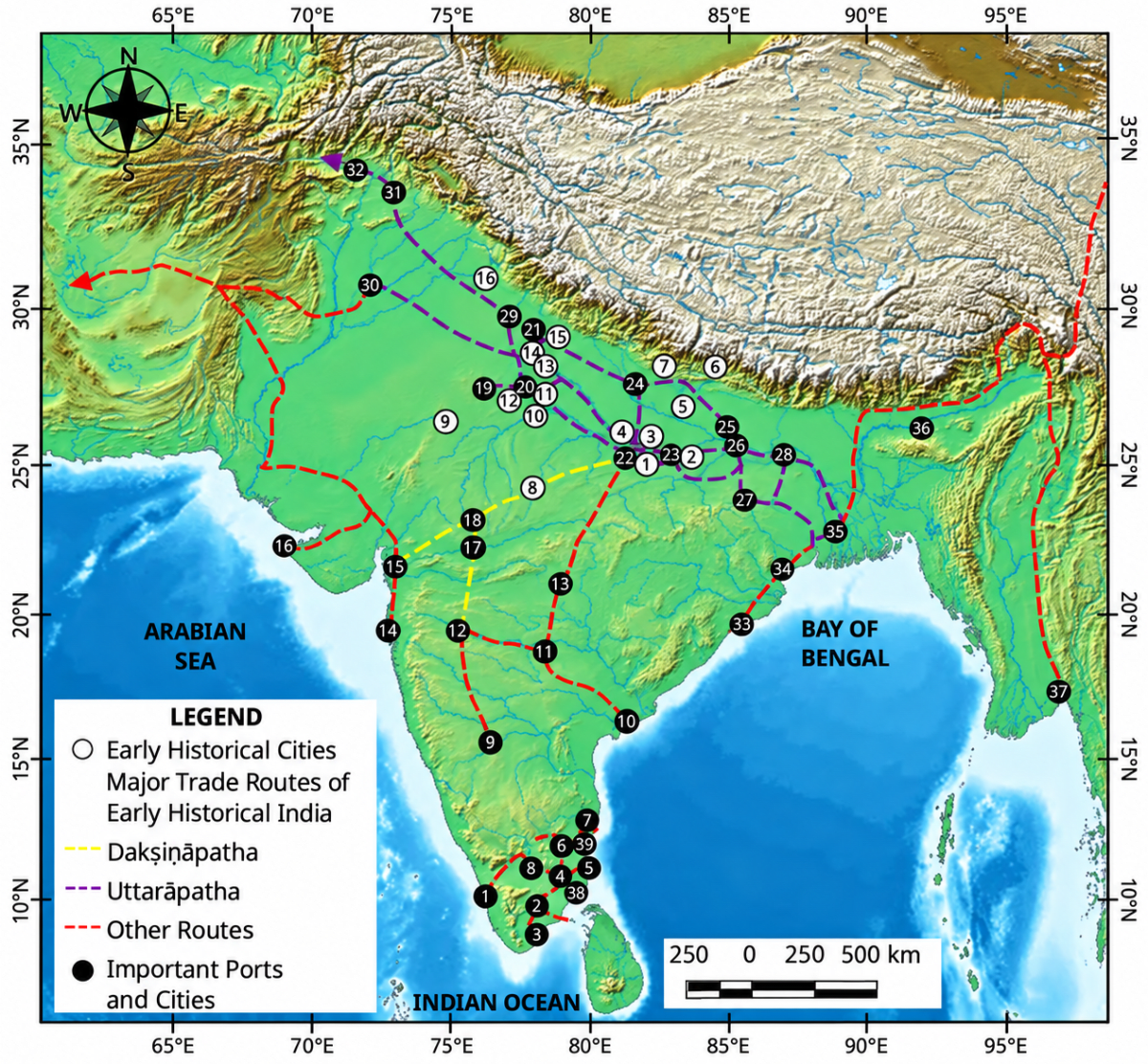
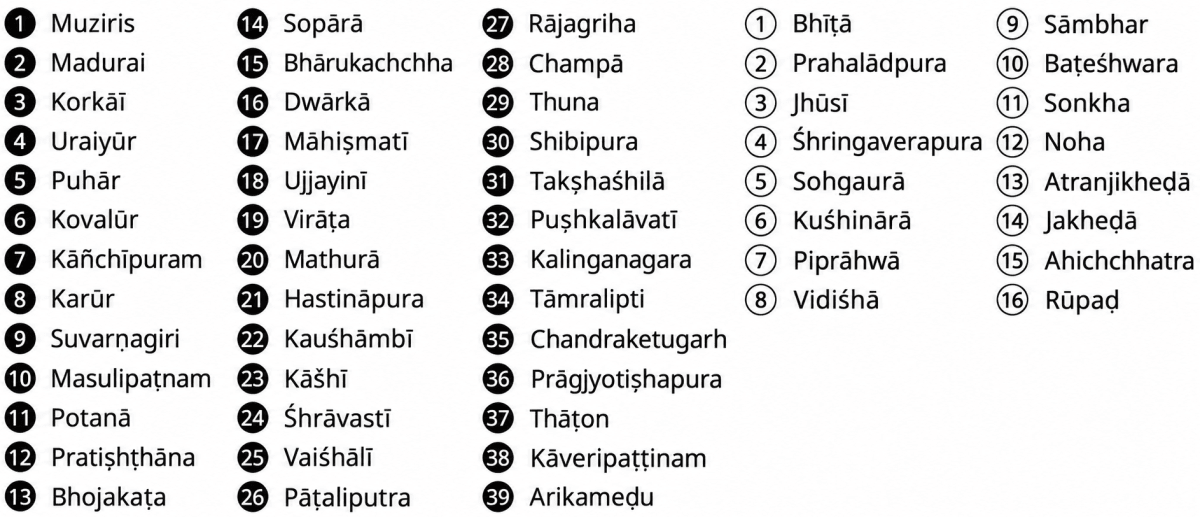
Look at the major trade routes of early India (Fig 5.12). How do you think these routes helped people in the exchange of goods, skills, beliefs, and cultural practices.
Answer
The major trade routes of early India helped in the exchange of goods, skills, beliefs and cultural practices in several ways:
- These routes connected cities, ports and different regions, making the movement of people and goods easier.
- Merchants used them to exchange agricultural products, textiles, metals, gems and other goods, promoting trade and economic growth.
- The movement of merchants, artisans and travellers encouraged the exchange of skills, knowledge and techniques.
- Travellers and religious teachers helped spread religious ideas, beliefs and cultural practices across different regions.
- Interaction between communities encouraged the exchange of languages, customs, art and ways of life.
- The Uttarāpatha connected important northern centres such as Takṣaśilā, Hastināpura, Kauśāmbī, Pāṭaliputra and Tāmralipti, facilitating exchanges across northern India.
- The Dakṣiṇāpatha connected centres such as Ujjayinī, Pratiṣṭhāna, Vātāpi, Kāñchipuram and Madurai, strengthening links between northern and southern India.
- Overland routes connected inland centres with coastal ports such as Muziris, Kāveripaṭṭinam and Arikameḍu, linking inland and maritime trade and facilitating contact with regions beyond India.
What might have been the advantages and challenges of ruling a large empire in the absence of modern communication systems?
Answer
Advantages
- A large empire controlled extensive territory and resources, providing revenue from agriculture, trade and other economic activities.
- Control over major trade routes and ports encouraged commerce and increased state revenue.
- Greater resources enabled rulers to undertake large public works, including irrigation and water-management projects.
- A large empire could provide greater security across its territories and protect important trade routes.
- Control over a vast territory increased the prestige and authority of rulers and supported ideals such as the chakravarti samrāṭ.
- Links between distant regions encouraged the exchange of goods, skills, ideas and cultural practices.
Challenges
- Without modern communication, orders, information and revenue travelled slowly, causing delays in administration.
- Kings could not directly supervise distant regions and therefore had to depend on provincial and local officials.
- Distant frontiers were difficult to defend, and powerful local officials or subordinate rulers could challenge central authority.
- Obtaining reliable information about crop failures, disorder and local conditions in distant areas was difficult.
- Governing regions with different languages, customs and traditions made administration more complex.
How rulers dealt with these challenges
- They developed multi-layered administrative systems, dividing large territories into provinces, districts and smaller units.
- Kings relied on ministers and officials to administer distant regions.
- Officials sometimes consulted important local groups, such as bankers, traders and artisans, in administrative matters.
- Local institutions and village assemblies helped manage local affairs, reducing the need for direct royal supervision.
- Rulers used inscriptions and edicts, such as Aśoka's rock edicts, to communicate royal messages and policies across their territories.
Many ideas about governance come from texts composed by scholars and advisors of the king. What might be some limitations of relying only on such sources?
Answer
Some limitations of relying only on such sources are:
- They often describe how a king should govern rather than how government actually worked, so they may present ideals rather than everyday practice.
- Many such texts reflect the views and interests of learned or elite groups, and may not represent the experiences of all sections of society.
- They provide limited information about the lives of farmers, artisans, labourers, women and other ordinary people.
- Their dates and layers of composition are sometimes uncertain, and some texts were transmitted orally before being written down, making their historical context difficult to determine.
- A text from one region or period may not accurately describe conditions elsewhere in India.
- Some texts may idealise royal authority or good governance, rather than record actual political practices.
- Therefore, historians compare literary texts with inscriptions, coins, archaeological evidence and literature from different traditions to obtain a more complete picture of the past.
Read the source and answer the questions:
The Nāśhik cave inscription (2nd century CE) of Uṣhavadāta records:
"Uṣhavadāta, son of Dinika, son-in-law of king Nahapāna … has bestowed this cave on the Saṁgha generally; he has also given a perpetual endowment, three thousand—3000 kāhāpaṇas, which, for the members of the Saṁgha of any sect, and any origin dwelling in this cave, will serve as cloth money and money for outside life (kuśhaṇa); and those kāhāpaṇas have been invested in guild dwelling at Govadhana—2000 in a weavers' guild, interest one pratika (monthly) for the hundred, (and) 1000 in another weaver's guild, interest three quarters of a paḍika (monthly) for the hundred."
(a) What does this source tell us about the economic role of guilds?
(b) Why were guilds trusted with money deposits?
(c) Identify the donor and the donees from the given source.
Answer
(a) What this source tells us about the economic role of guilds
- The inscription shows that guilds could receive and invest large sums of money and pay interest on them.
- Uṣhavadāta's endowment of 3,000 kāhāpaṇas was deposited with two weavers' guilds at Govadhana, i.e., 2,000 with one and 1,000 with another.
- The interest from these deposits was used to meet the needs of the Buddhist Saṁgha living in the cave.
- This shows that guilds were well-organised economic institutions involved not only in craft production but also in managing financial endowments.
(b) Why guilds were trusted with money deposits
- Guilds were established and organised associations of people belonging to particular occupations.
- Their collective organisation and economic importance made them suitable for managing long-term endowments and paying regular interest.
- The inscription shows that they were trusted to preserve the principal and provide income for the intended beneficiaries.
(c) The donor and the donees
- Donor: Uṣhavadāta, son of Dinika and son-in-law of King Nahapāna.
- Donees: The Buddhist Saṁgha for whom the cave and endowment were provided.
- The two weavers' guilds at Govadhana were not donees; they received the deposited money and paid interest on it.
Mark and locate on the map of India the following important centres: Pāṭaliputra, Nāśhik, Ujjayinī, Vikramśhila, Kānchipuram, Mathurā, Rājgṛiha.
Answer
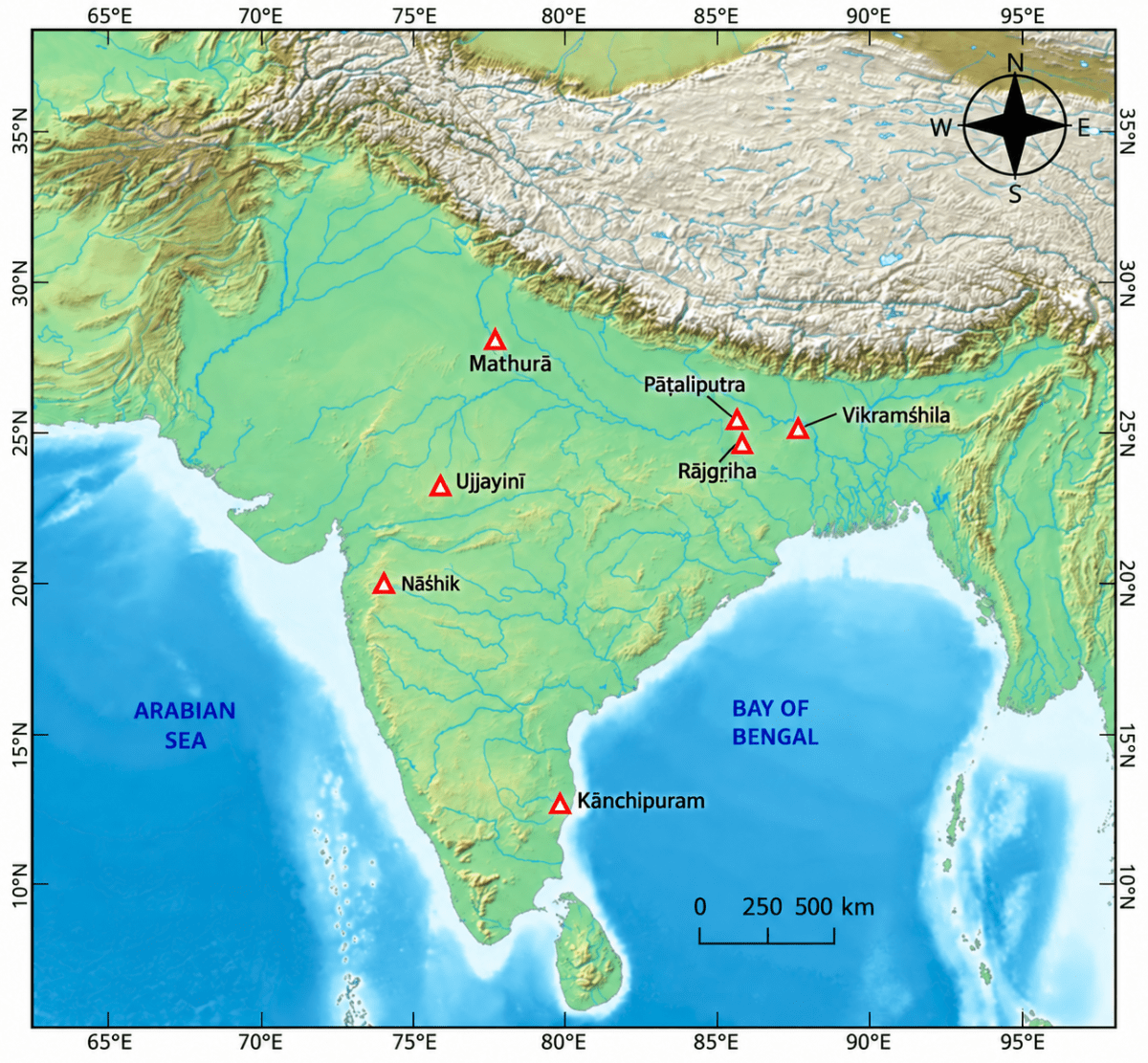
Mark the following centres on an outline map of India using the chapter maps (Fig 5.10 and Fig 5.12) as a guide:
| Centre | Present-day location | Importance as mentioned in the chapter |
|---|---|---|
| Pāṭaliputra | Patna, Bihar | An early historical city on the Uttarāpatha and the seat of power of Magadha, from which the Mauryan Empire arose. |
| Nāśhik | Nāśhik, Maharashtra | Site of the Nāśhik cave inscription (2nd century CE) of Uṣhavadāta, which records endowments deposited with weavers' guilds. |
| Ujjayinī | Ujjain, Madhya Pradesh | An early historical city on the Dakṣhiṇāpatha and also a centre of learning. |
| Vikramśhila | Bhagalpur district, Bihar | A university established between 783 and 820 CE and an advanced centre of learning. |
| Kānchipuram | Kanchipuram, Tamil Nadu | A prominent centre of learning and a city linked by trade routes; the Uttaramerur inscription is located in this district. |
| Mathurā | Mathurā, Uttar Pradesh | An early historical city on the trade routes and an important hub of textile production. |
| Rājgṛiha | Rajgir, Bihar | An early historical city of the Magadha region marked among the important cities on the trade route map. |
Points to keep in mind while marking:
- Pāṭaliputra, Rājgṛiha, and Vikramśhila lie in the middle and lower Ganga plains in the east.
- Mathurā lies in the upper Ganga–Yamuna region in the north.
- Ujjayinī lies in central India and Nāśhik in the western Deccan.
- Kānchipuram lies in the far south, near the eastern coast of peninsular India.