
Why are elections essential to a democratic system?
Answer
Elections are essential to democracy because they allow citizens to choose representatives who make decisions on their behalf. Periodic elections make elected representatives accountable to the people, as non-performing representatives can be replaced. Elections also promote equality, representation and legitimacy by giving eligible citizens an equal opportunity to participate in choosing their government.
How do electoral systems and rules shape political representation and fairness?
Answer
An electoral system determines how votes are converted into seats and therefore influences political representation and fairness.
- First-Past-The-Post (FPTP): Each constituency elects one candidate, and the candidate receiving the most votes wins, even without securing more than 50% of the votes. India uses FPTP for Lok Sabha and State Legislative Assembly elections.
- Majority/Two-Round System: A candidate must secure more than 50% of the votes to win; if no candidate does so, a second round may be held between the leading candidates.
- Proportional Representation (PR): Seats are allocated according to the proportion of votes received. In India, Rajya Sabha, Presidential and Vice-Presidential elections use proportional representation by means of the single transferable vote.
- Electoral rules: Delimitation determines constituency boundaries and the allocation of seats, helping ensure fair representation of the population.
Thus, electoral systems and rules determine how votes are translated into political representation and help shape the fairness of elections.
What role do institutions and laws play in ensuring free and fair elections?
Answer
Constitutional institutions and laws provide the framework needed to keep elections free, fair and transparent.
- Election Commission of India (ECI): The ECI supervises, directs and controls elections. It prepares and revises electoral rolls, decides election schedules, registers political parties, allocates symbols and takes measures to make voting inclusive.
- Delimitation Commission: It determines the number of seats and fixes constituency boundaries so that representation is as equal as possible.
- Representation of the People Act, 1950: It deals mainly with the allocation of seats, delimitation of constituencies and the preparation and revision of electoral rolls.
- Representation of the People Act, 1951: It regulates the conduct of elections, nomination of candidates, campaigns, voting procedures, electoral offences, corrupt practices and election disputes.
- Other safeguards: The Model Code of Conduct, EVMs, VVPATs, voter-awareness programmes and accessibility measures help make the electoral process transparent, inclusive and trustworthy.
What challenges do elections face in practice, and how can these challenges affect democracy?
Answer
Elections face several practical challenges, including misinformation and fake news, voter intimidation, unfair inducements, difficulties in accessing polling facilities, and disputes or errors in the electoral process.
- Misinformation and fake news can mislead voters and influence their choices.
- Intimidation and unfair practices can prevent voters from making free choices.
- Accessibility issues may make it difficult for some citizens to exercise their right to vote.
- Errors or disputes in the electoral process can reduce public confidence in elections.
If these challenges are not addressed, trust in electoral institutions may weaken and the democratic value of elections may be reduced. The ECI uses measures such as the Model Code of Conduct, EVMs, VVPAT and voter-awareness programmes to strengthen the electoral process.
Thus, free and fair elections require an inclusive, impartial and trustworthy electoral process.
Different democracies use different electoral systems. Make groups of 5–6 students. Each group will select six countries from different continents. Prepare and present a case study on the type of electoral system(s) operating in those countries, and discuss their latest election results of those countries.
Answer
This is a group activity. A sample case study is given below. Election results change over time, so the latest official results should be checked before presentation.
| Country (Continent) | Electoral System | Latest Election and Result |
|---|---|---|
| United States of America (North America) | The President is chosen indirectly through the Electoral College. Members of the House of Representatives are elected from single-member districts; election rules for Congress are governed by federal and state law. | Presidential election, November 2024 — Donald Trump won the presidency. |
| Brazil (South America) | The President is elected by a majority system; if no candidate gets more than 50% of valid votes, a second round is held. The Chamber of Deputies uses proportional representation. | Presidential election, October 2022 — Luiz Inácio Lula da Silva won the second round. |
| Germany (Europe) | The Bundestag uses a mixed-member proportional system in which voters cast a constituency vote and a party-list vote. | Federal election, February 2025 — CDU and CSU together won the largest number of seats in the Bundestag. |
| South Africa (Africa) | The National Assembly is elected mainly through proportional representation, and the President is elected by the National Assembly. | General election, May 2024 — no party won a majority; the ANC remained the largest party and a Government of National Unity was formed. Cyril Ramaphosa was re-elected President by the National Assembly. |
| Japan (Asia) | The House of Representatives uses a parallel system combining single-member constituencies and proportional-representation blocks. | General election, February 2026 — the Liberal Democratic Party (LDP) won 315 of the 465 seats at the election. |
| Australia (Australia/Oceania) | The House of Representatives uses preferential voting, while the Senate uses proportional representation through the single transferable vote. Voting is compulsory for enrolled voters. | Federal election, May 2025 — the Australian Labor Party was returned to government. |
Points for discussion: Different systems convert votes into seats in different ways. In plurality systems, a candidate may win without receiving more than half the votes. Proportional representation links the distribution of seats more closely to party vote shares, while majority systems require the successful candidate to secure a majority after counting or transfer of votes.
Sources checked for the sample: U.S. Federal Election Commission (2024 results); Tribunal Superior Eleitoral, Brazil (2022); Federal Returning Officer, Germany (2025); Electoral Commission/Parliament of South Africa (2024); Japan election data published by IPU Parline from the Ministry of Internal Affairs and Communications (2026); Australian Electoral Commission (2025). The examples should be updated from official sources before classroom presentation.
Do you know what ETPBS is?
ETPBS stands for Electronically Transmitted Postal Ballot System. It enables service voters to cast their vote on an electronically received postal ballot from their preferred location, which is outside their originally assigned voting constituency.
Find out who are classified as service voters and who can vote using ETPBS?
Answer
Service voters: Under the Representation of the People Act, 1950, the following categories are treated as service voters:
- Members of the Armed Forces of the Union.
- Members of a force to which the provisions of the Army Act, 1950 have been made applicable.
- Members of an Armed Police Force of a State who are serving outside that State.
- Persons employed under the Government of India in a post outside India.
The spouse of a service voter who ordinarily resides with the service voter is also entitled to the postal-ballot facility.
Who can vote using ETPBS: Service voters enrolled in the service-voter part of the electoral roll can receive their postal ballot electronically through ETPBS. They download and print the ballot, mark their vote and return it to the Returning Officer according to the prescribed procedure. Eligible classified service voters may also opt for proxy voting.
Find out the number of State parties and Registered Unrecognised Political Parties (RUPP). You may visit the website of ECI.
Answer
1. State parties:
There are 67 recognised State Parties in India. These parties mainly contest elections in particular states, represent state or regional interests, organise public opinion and may form the government or opposition in a State. Examples include Dravida Munnetra Kazhagam (DMK) — Tamil Nadu, Biju Janata Dal (BJD) — Odisha and Telugu Desam Party (TDP) — Andhra Pradesh.
2. Registered Unrecognised Political Parties (RUPPs) The ECI notification dated August, 2025 listed 2,520 RUPPs. These are parties registered with the ECI but which have not secured enough votes or seats to qualify as recognised National or State Parties. They can contest elections, field candidates and present their programmes and policies to voters. RUPPs include parties that have not secured the required percentage of votes or have never contested elections since registration. Examples include Aabaad Party — Telangana, Aadarsh Bharat Nirman Dal — Haryana and Aadarsh Mithila Party — Bihar.
The year 1967 witnessed an end to the era of single-party dominated elections in India and an era of alliances began. Even though various states witnessed politics of alliance starting from 1967, it was in 1977 that various political parties formed an alliance as the Janata Party against the backdrop of the National Emergency (1975–1977). The Janata Party formed the first coalition government at the national level, which was popularly known as the Janata Government. Since the late 1990s, the National Democratic Alliance (NDA), led by the Bharatiya Janata Party (BJP), and the United Progressive Alliance (UPA), led by the Indian National Congress (INC) until the UPA's dissolution in 2023 and subsequent reconstitution as the Indian National Developmental Inclusive Alliance, have been the major political alliances in Indian elections.
Find out the name and the composition (number and name of the national and state parties) of the alliances that won in the following elections to the Lok Sabha.
| Year | Alliance Won | National parties | State parties |
|---|---|---|---|
| 1977 | |||
| 1999 | |||
| 2004 | |||
| 2009 | |||
| 2014 | |||
| 2019 | |||
| 2024 |
Answer
The composition of alliances keeps changing as parties join and leave, and the recognition status of a party (national or state) also changes over time. The table below gives the main constituents of the winning alliance in each election. Students should verify the details from the Statistical Reports on the ECI website.
| Year | Alliance Won | National parties | State parties |
|---|---|---|---|
| 1977 | Janata Party (with allies) | The Janata Party was formed by the merger of Congress (O), Bharatiya Jana Sangh, Bharatiya Lok Dal and Socialist Party. | Shiromani Akali Dal and other regional parties supported or allied with the Janata formation. |
| 1999 | National Democratic Alliance (NDA) — about 24 parties | Bharatiya Janata Party (BJP); Janata Dal (United). | Janata Dal (United), Shiv Sena, Biju Janata Dal, Dravida Munnetra Kazhagam, Shiromani Akali Dal, Samata Party, All India Trinamool Congress, Indian National Lok Dal, Jammu & Kashmir National Conference and other State Parties. |
| 2004 | United Progressive Alliance (UPA) — about 14 parties, with outside support of the Left parties | Indian National Congress (INC); Nationalist Congress Party (NCP). | Rashtriya Janata Dal (Bihar), Dravida Munnetra Kazhagam and Pattali Makkal Katchi (Tamil Nadu), Telangana Rashtra Samithi (Andhra Pradesh), Jharkhand Mukti Morcha (Jharkhand), Lok Janshakti Party (Bihar), Indian Union Muslim League (Kerala), Jammu & Kashmir PDP, MDMK, Republican Party of India (A), etc. |
| 2009 | United Progressive Alliance (UPA) — about 10 parties | Indian National Congress (INC); Nationalist Congress Party (NCP). | All India Trinamool Congress (West Bengal), Dravida Munnetra Kazhagam (Tamil Nadu), Jammu & Kashmir National Conference, Jharkhand Mukti Morcha (Jharkhand), Indian Union Muslim League and Kerala Congress (M) (Kerala), Viduthalai Chiruthaigal Katchi (Tamil Nadu), etc. |
| 2014 | National Democratic Alliance (NDA) — about 29 parties | Bharatiya Janata Party (BJP). | Shiv Sena (Maharashtra), Telugu Desam Party (Andhra Pradesh), Lok Janshakti Party and Rashtriya Lok Samta Party (Bihar), Shiromani Akali Dal (Punjab), Apna Dal (Uttar Pradesh), Swabhimani Paksha (Maharashtra), Pattali Makkal Katchi (Tamil Nadu), Naga People's Front (Nagaland), All India N.R. Congress (Puducherry), National People's Party (Meghalaya), etc. |
| 2019 | National Democratic Alliance (NDA) — about 20 parties | Bharatiya Janata Party (BJP). | Shiv Sena (Maharashtra), Janata Dal (United) and Lok Janshakti Party (Bihar), Shiromani Akali Dal (Punjab), AIADMK (Tamil Nadu), Apna Dal (S) (Uttar Pradesh), AJSU Party (Jharkhand), National People's Party (Meghalaya), Nationalist Democratic Progressive Party (Nagaland), Mizo National Front (Mizoram), Sikkim Krantikari Morcha (Sikkim), etc. |
| 2024 | National Democratic Alliance (NDA) — about 38 parties | Bharatiya Janata Party (BJP); National People's Party (NPP). | Telugu Desam Party and Jana Sena Party (Andhra Pradesh), Janata Dal (United), Lok Janshakti Party (Ram Vilas) and Hindustani Awam Morcha (S) (Bihar), Shiv Sena and Nationalist Congress Party (Maharashtra), Janata Dal (Secular) (Karnataka), Rashtriya Lok Dal and Apna Dal (S) (Uttar Pradesh), Asom Gana Parishad and UPPL (Assam), AJSU Party (Jharkhand), Nationalist Democratic Progressive Party (Nagaland), Sikkim Krantikari Morcha (Sikkim), etc. |
You will turn 18 in a few years. As a responsible citizen, you should register yourself as a voter. Find out the various steps of the procedure for registration and the list of required documents for the same. Discuss, with anyone who has just turned 18 and has registered as a voter, the ease or difficulty faced in the voter registration process.
Answer
Eligibility: An Indian citizen who is 18 years or older on one of the four qualifying dates that are, 1 January, 1 April, 1 July or 1 October, and is ordinarily resident in the constituency can register as a voter. A 17-year-old who will attain 18 on a qualifying date can submit an advance application.
Steps of the procedure for registration:
- Fill Form 6 online through the ECI voter-services portal/app or submit it offline to the ERO/AERO/BLO.
- Attach or upload the required photograph and supporting documents.
- Submit the application and keep the reference number for tracking.
- The election authorities verify the application; field verification may be carried out where required.
- After approval, the applicant's name is included in the electoral roll and an EPIC may be issued.
Documents required:
- Proof of date of birth: Birth certificate, Aadhaar card, PAN card, driving licence, Class X/XII certificate containing DOB, or Indian passport.
- Proof of ordinary residence: Any of the documents specified in the Form 6 guidelines, which may include documents in the name of the applicant, parent or spouse.
- Recent passport-size colour photograph.
What reforms have been introduced by the ECI to make voting more inclusive for the following groups?
a. People with Disabilities
b. Service Voters
c. Senior Citizens— above 85 years of age
d. Prisoners
e. Persons in preventive detention
Answer
a. People with Disabilities:
The ECI has introduced Braille-enabled EVMs, the Saksham App, wheelchair facilities and assistance at polling stations. PwDs with 40% benchmark disability can also opt for voting from home.
b. Service Voters:
The Electronically Transmitted Postal Ballot System (ETPBS) enables service voters to receive their postal ballot electronically and vote while being away from their allotted constituency.
c. Senior Citizens above 85 years:
The ECI provides an optional home-voting facility for senior citizens above 85 years of age. This facility was extended across India during the 2024 General Elections.
d. Prisoners:
Under the Representation of the People Act, 1951, a person confined in prison or in lawful police custody is not permitted to vote.
e. Persons in preventive detention:
Such persons are an exception to the above rule and are allowed to vote through postal ballot.
What are the various functions of the Election Commission of India? Which of these functions is most important for the conduct of free and fair elections? Explain.
Answer
The Constitution of India vests the Election Commission of India (ECI) with the superintendence, direction and control of elections to Parliament, State Legislatures and the offices of the President and Vice-President. Its main functions are:
- Preparing and revising electoral rolls: It supervises the preparation, verification and correction of electoral rolls so that eligible citizens can be enrolled.
- Deciding the election schedule: It announces election dates and coordinates the machinery required for polling and counting.
- Registering political parties and allocating symbols: It registers political parties, recognises parties according to prescribed criteria, allots election symbols and deals with certain disputes relating to recognition and symbols.
- Ensuring free and fair elections: It supervises polling and counting, enforces election rules and the Model Code of Conduct, deploys observers and introduces accessibility and voter-awareness measures.
Most important function: Ensuring free and fair elections is central because all the other functions support the integrity of the electoral process. Accurate electoral rolls, proper scheduling and fair regulation are meaningful only when voters can vote freely and votes are counted correctly.
Elections are the soul of a democracy. Do you agree? Why or why not?
Answer
Yes. Elections are called the soul of democracy because they enable citizens to choose their representatives and hold the government accountable.
- Choice of representatives: Citizens can elect representatives who make decisions on their behalf.
- Accountability: Periodic elections require elected representatives to seek a fresh mandate and allow voters to replace non-performing representatives.
- Representation and legitimacy: Elections provide representation and give an elected government democratic legitimacy.
- Citizen participation: Voting gives citizens an opportunity to participate in the formation of government.
However, merely holding elections is not enough. The electoral process must also be free, fair, inclusive and trustworthy.
Explain at least three differences between the national and state/regional political parties.
Answer
| Basis | National Parties | State/Regional Parties |
|---|---|---|
| Area of influence | Operates across multiple states; deals with country-wide policies. | Focuses on specific states/regions and local issues. |
| Recognition criteria | Must win 6% votes in 4+ states plus 4 Lok Sabha seats; OR 2% Lok Sabha seats across 3 states; OR be a state party in 4 states. | Must win 6% votes in state assembly plus 2 seats; OR 6% in state Lok Sabha polls plus 1 seat; OR 3% of total assembly seats. |
| Election symbol | Reserved symbol can be used by the party across India. | Reserved symbol can only be exclusively used within the specific state(s) where recognized. |
| Examples | Bharatiya Janata Party (BJP), Indian National Congress (INC), Bahujan Samaj Party (BSP), Communist Party of India (Marxist), Aam Aadmi Party (AAP) and National People's Party (NPP). | Dravida Munnetra Kazhagam (DMK) — Tamil Nadu, Biju Janata Dal (BJD) — Odisha, Telugu Desam Party (TDP) — Andhra Pradesh. |
Why should you vote? Arrange the following in the descending order of your choice. Discuss the reasons for your choice.
a. Opportunity to choose my representative
b. Makes me a responsible person
c. Opportunity to change the non-performing representative
d. Strengthens democracy
Answer
- Opportunity to choose my representative (a): Our vote is the principal means by which we exercise the right to elect those who will make decisions on our behalf. This is the most direct reason for voting.
- Opportunity to change the non-performing representative (c): Elected representatives are accountable to the people. Periodic elections allow us to replace those who have not performed, and this is possible only if we vote.
- Strengthens democracy (d): Elections give every citizen an equal voice in the formation of a government. With active citizen participation, elections become more representative and democracy becomes more robust.
- Makes me a responsible person (b): Casting a vote is a constitutional right as well as a duty of every citizen. Voting makes us conscious of our role as citizens, but this is a benefit to the individual, while the first three reasons benefit the whole society.
What is the Special Intensive Revision (SIR) initiative of the ECI? Explain the objectives and the necessity of conducting SIR.
Answer
The Special Intensive Revision (SIR) is an exercise conducted by the ECI to update, verify and correct the electoral rolls. Enumerators collect data about eligible electors, the revised roll is published, time is given to raise claims or objections, and the ECI settles them before publishing the final electoral roll.
Objectives:
- To ensure that no eligible citizen is left out of the electoral roll.
- To ensure that no ineligible person is included in the electoral roll.
- To add all eligible voters, especially young voters who have just turned 18 and may have been left out due to lack of awareness or any other reason.
- To delete the names of voters on the basis of death, change of residence, duplicate enrolment or being permanently untraceable.
Necessity: Only those whose names appear on the electoral roll can vote. An accurate and updated roll prevents eligible voters from being excluded and duplicate or ineligible entries from being misused. SIR therefore helps ensure the integrity, transparency and fairness of elections.
Match the political party name with its symbol.
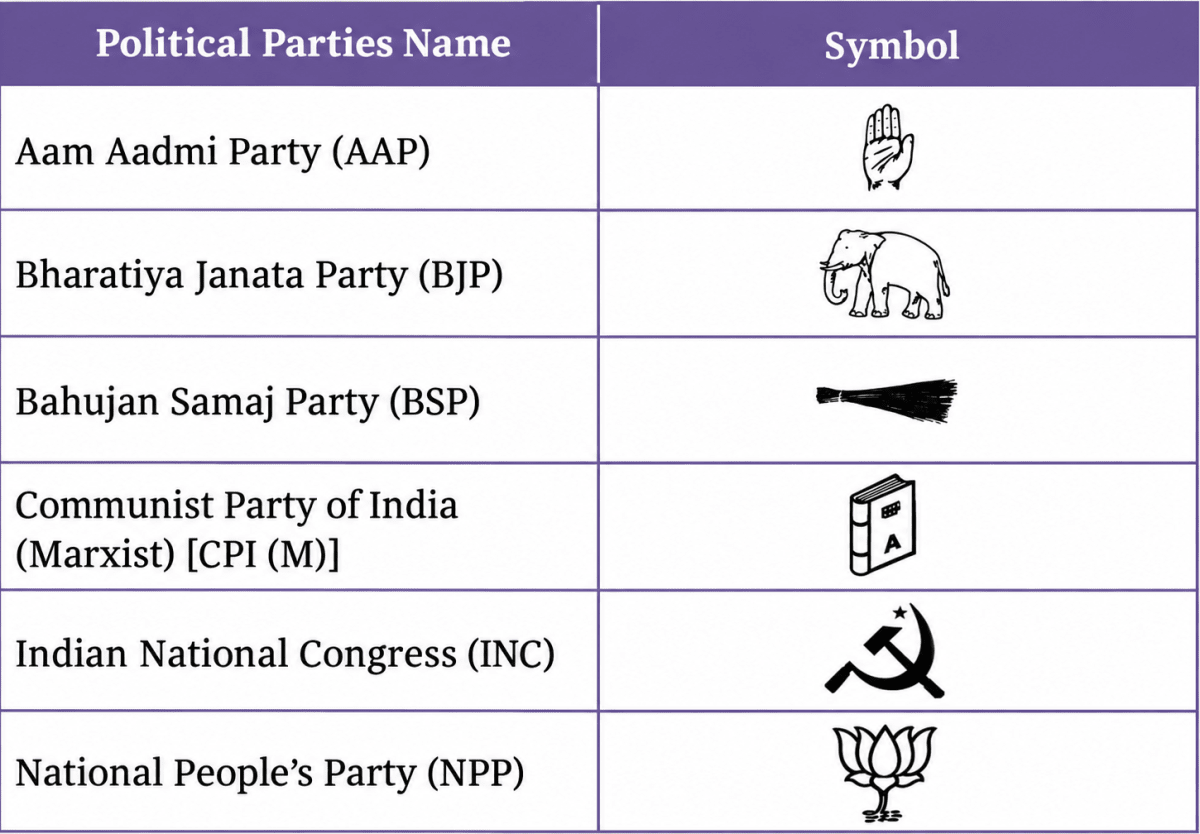
Answer
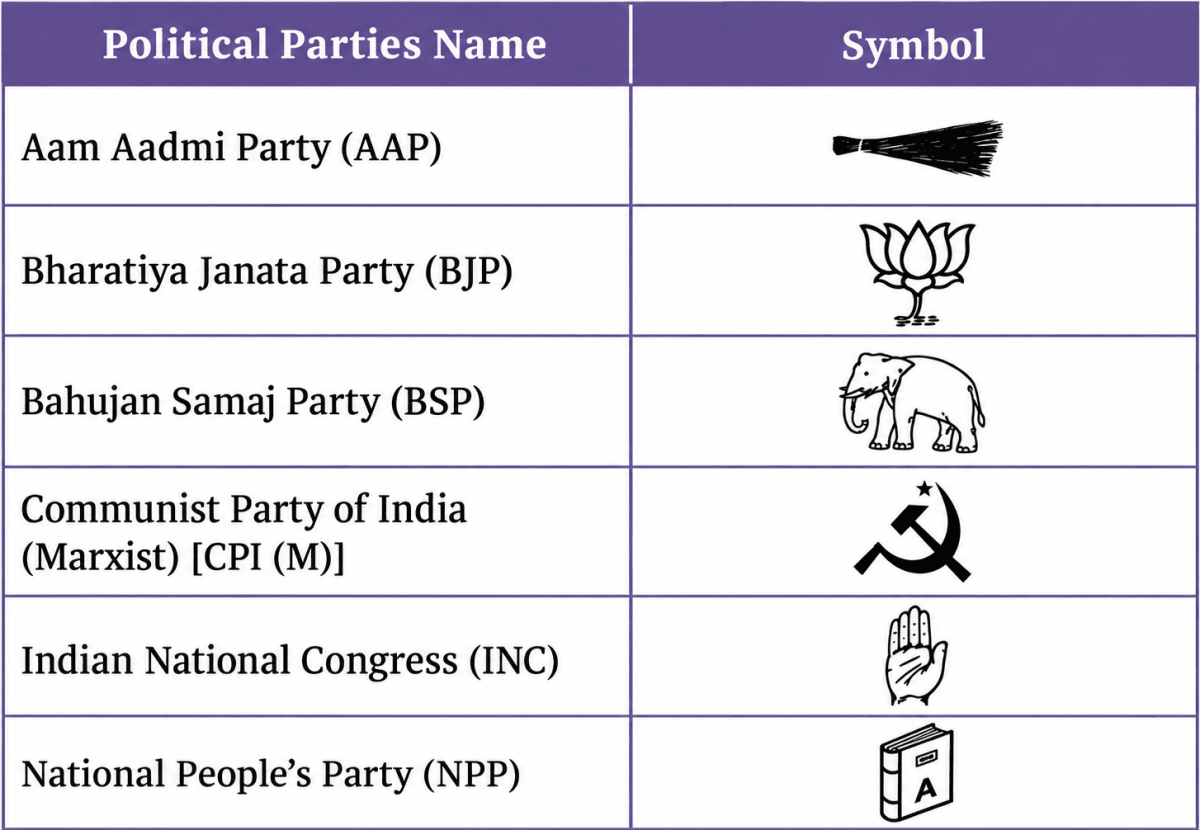
Read the case study below and answer the following questions.
Ishani and her mother were in the local market, day before the state assembly elections. She noticed wall writing and campaign posters pasted everywhere. Large groups of campaigners were distributing pamphlets and raising slogans in support of the respective candidates. Ishani has turned 18 and will be voting for the first time. She had registered to vote through the ECI's online portal. The next morning, she, along with her mother and her disabled elder brother, went to the polling station, which was well guarded by the police personnel. A wheelchair was made available to them, and volunteers guided them to the polling booth. Inside the polling booth, there were only three people who were performing all duties. Ishani had forgotten her voter ID card and Aadhaar card, but her identity was verified with an alternative document. After casting her vote, she was also able to see the VVPAT slip. While leaving, she wondered how the police personnel vote, as they must be on duty from early morning till late evening. When she went home, she narrated her entire experience to her 89-year-old grandmother, who cast her vote from home.
a. What initiatives were taken by the ECI to enable the voters to cast their vote?
b. If Ishani was allowed to vote even without carrying her Voter ID card or Aadhaar card, which other document might she be carrying that is valid for voting?
c. Cite the examples of violations of the Model Code of Conduct.
d. Give a suitable title to the passage.
e. Find out how the police and army personnel cast their votes.
Answer
a. The following initiatives of the ECI can be seen in the passage:
- Online voter registration through the ECI's portal, which enabled Ishani to register as soon as she turned 18.
- Security arrangements, with the polling station well guarded by police personnel.
- Accessibility for Persons with Disabilities — a wheelchair and volunteers to guide Ishani's disabled brother to the booth.
- Acceptance of alternative identity documents, so that Ishani could vote even without her Voter ID card.
- Voter Verifiable Paper Audit Trail (VVPAT), which let Ishani confirm that her vote was recorded correctly.
- Voting from home for senior citizens above 85 years of age, which allowed her 89-year-old grandmother to vote.
b. Ishani could have carried any other ECI-approved photo identity document, such as a passport, driving licence, PAN card, MGNREGA job card or bank/post-office passbook with photograph.
c. Examples of violations of the Model Code of Conduct in the passage:
- Wall writing and pasting posters without the required permission, amounting to defacement of property.
- Campaigners distributing pamphlets and raising slogans on the day before polling, when public campaigning must stop 48 hours before the close of the poll (the silence period).
d. A suitable title: "No Voter to Be Left Behind — Ishani's First Vote".
e. Armed Forces personnel and other eligible service voters can vote through postal ballot using ETPBS; eligible Armed Forces personnel may also opt for proxy voting. State Armed Police personnel serving outside their State are also classified as service voters. Police personnel on election duty may use a postal ballot or Election Duty Certificate, depending on the applicable arrangements.
A comparative chart of three countries is given below. Based on the information given in the chart, answer the questions.
| Country A | Country B | Country C | |
|---|---|---|---|
| Political Dimension | Written constitution, periodic elections, voting rights, party system varies from two-party to multi-party. | Written constitution, periodic elections, voting rights, one political party. | Written constitution, monarchy, no voting rights, no political party. |
| Economic Dimension | Average standard of living. | Above-average standard of living. | High standard of living. |
a. What is the difference between having a voting right in a country with a multi-party system and another with a single-party system?
b. In which of the above countries would you like to stay and why?
Answer
a. Voting Rights Difference: In a multi-party country (Country A), voting gives real choice between different ideologies and policies. In a single-party country (Country B), voting is symbolic because voters cannot change the government or pick alternative parties.
b. I would like to stay in Country A. Though its standard of living is average, it has a written constitution, regular elections, voting rights and a multi-party system. Citizens can choose their representatives, hold them accountable and change the government through elections. Countries B and C offer greater prosperity but lack political freedom, leaving citizens with little or no say in governance.
What are the challenges to conducting free and fair elections?
Answer
The main challenges to conducting free and fair elections are:
- Misinformation and fake news can mislead voters and influence their choices.
- Intimidation may prevent voters from exercising their right to vote freely.
- Large number of voters and polling stations makes election management difficult.
- Diverse geographical and socio-economic conditions create administrative challenges.
- Numerous political parties and candidates make the electoral process more complex.
On the Stage.
Elections are to be held in your school for the posts of Head Girl, Head Boy, and Sports Captain. Assume the roles of an Election Commissioner, Returning Officer, Polling Agent, Candidate, Campaigner, Polling Officer, Police Personnel, and a Journalist, and perform their roles while ensuring free, fair, and transparent elections.
Answer
The roles may be performed as follows:
- Election Commissioner: Announces the election schedule, prepares the list of eligible voters (the electoral roll of students), lays down a Model Code of Conduct for the campaign, allots symbols to candidates and supervises the whole process.
- Returning Officer: Receives and scrutinises the nomination forms of candidates, publishes the final list of candidates, arranges the ballot boxes or ballot papers, conducts the counting and declares the results.
- Candidate: Files the nomination, presents a manifesto of what he or she will do as Head Girl, Head Boy or Sports Captain, and campaigns within the rules.
- Campaigner: Makes posters and speeches in support of a candidate, but only in the permitted places and time, and stops campaigning before the silence period.
- Polling Agent: Sits in the polling booth on behalf of a candidate, checks that only students on the electoral roll vote and reports any irregularity to the Returning Officer.
- Polling Officer: Verifies the identity of each voter, marks the finger with ink, issues the ballot and maintains the record of votes cast.
- Police Personnel: Maintains order at the polling booth, ensures that no campaigning or intimidation takes place near the booth and guards the ballot boxes.
- Journalist: Reports on the campaign, interviews candidates and voters, observes the polling and counting and reports whether the election was free and fair.
The performance should show the stages of an election in order — announcement of the schedule, nominations, campaigning, polling, counting and declaration of results.
Select one national or state political party. Using authentic and reliable sources such as the Election Commission of India (ECI) website, the official website of the selected political party, and newspapers. Prepare a comparative chart of the last two State Legislative Assembly elections. The chart should include the following details for the chosen party:
a. Some promises made in the Election manifesto
b. Percentage of votes polled
c. Number of seats won
d. Number of women who contested
e. Number of women candidates elected
Present the data for both elections in a clear and comparative format, citing all sources used.
Answer
The chart can be prepared in the following format:
Name of the Party: ............... (National / State Party)
State: ...............
| Details | Assembly Election, Year .......... | Assembly Election, Year .......... |
|---|---|---|
| a. Some promises made in the election manifesto | ||
| b. Percentage of votes polled by the party | ||
| c. Number of seats won by the party | ||
| d. Number of women who contested on the party's ticket | ||
| e. Number of women candidates elected | ||
| Sources used |
Where to find the data:
- Manifesto promises — the official website of the party, and newspaper reports published at the time of the election.
- Percentage of votes polled and number of seats won — the Statistical Reports of the State Assembly elections available on the ECI website (eci.gov.in) and the results portal (results.eci.gov.in).
- Number of women who contested and elected — the Statistical Reports of the ECI, which give party-wise and gender-wise details of candidates, and the State Chief Electoral Officer's website.
Do you think 'One Nation, One Election' can improve the efficiency of the electoral process? Divide the class and discuss into two groups—one to examine its potential advantages and the other to analyse its limitations.
Answer
Group 1: Potential Advantages
- Reduces repeated election expenditure by holding major elections together.
- Saves administrative time and resources, as officials and security personnel need not be deployed repeatedly.
- Reduces frequent disruption of governance caused by repeated election campaigns and the Model Code of Conduct.
- May improve voter participation and convenience by reducing the frequency of elections.
- Allows governments to focus more continuously on governance and development.
Group 2: Limitations
- Managing simultaneous elections across India would be a very large and complex exercise.
- Early dissolution of a Lok Sabha or State Assembly may disturb the common election cycle.
- National issues may overshadow state and regional issues, reducing attention to local concerns.
- A very large number of EVMs, polling personnel and security forces would be required at the same time.
- It may require major constitutional and legal changes to synchronise the terms of different legislatures.