
The Lok Sabha has been the pulse of the vitality of Indian democracy. Mention any three exclusive powers of the Lok Sabha to justify this statement.
Answer
Three exclusive powers of the Lok Sabha are as follows:
- Motions of No-Confidence against the government can only be introduced and passed in the Lok Sabha, and not the Rajya Sabha.
- Money Bills can only be introduced in the Lok Sabha, and upon being passed, are sent to the Rajya Sabha, where it can be deliberated on for upto 14 days.
- In case of a deadlock between the two Houses over an ordinary bill, the will of the Lok Sabha normally prevails, as its strength is more than double that of Rajya Sabha.
It is the function of Parliament to exercise control over the Executive and to ensure parliamentary surveillance of administration. Mention any three ways in which the Parliament adheres to the above function.
Answer
Three ways in which Parliament exercises control over the Executive are given below:
- Interpellation during Question Hour
- By passing Vote of No-confidence
- Through Monetary Controls
The Lok Adalat is a Statutory Organisation under the Legal Services Authorities Act of 1987 and was created as an alternative dispute resolution mechanism. Analyse the role of the Lok Adalat by giving three advantages.
Answer
The Lok Adalat plays an important role as an alternative dispute resolution mechanism. Three advantages are:
- Saves time — It settles disputes speedily; if hundreds of cases can be decided in a single day, much precious time is saved.
- Saves money — It delivers inexpensive justice, sparing the parties the heavy expenses and long delays of regular litigation.
- Reduces burden on regular courts — By settling large numbers of cases, it relieves the regular law courts of much of their heavy load, enabling them to deal with more serious matters.
Highlight three ways in which India's wealth was being diverted to England.
Answer
Three ways in which India's wealth was being diverted to England are given below:
- Heavy land taxes — The peasants suffered under heavy land taxes and many of them were forced to grow jute and cotton for the factories in England.
- Unequal trade — Raw material was exported to England at cheaper rates, while goods manufactured in England were dumped into India and sold at higher prices.
- High salaries of British officers — The British officers working in India drew high salaries and were, therefore, a heavy drain on the Indian resources.
Read the excerpt given below and answer the question that follows:
A commission, without any Indian members, was sent to India to discuss constitutional reforms. The step agitated the people, and the Indian political parties boycotted the commission. When the Commission visited Lahore on October 30, 1928, Rai led the non-violent march to protest the commission.
(Source: Modern History, NCERT)
Name the movement that ensued with the commission coming to India. State any two significant impacts of the movement.
Answer
Civil Disobedience Movement.
Two significant impacts of the Civil Disobedience Movement were:
- It marked greater participation of women in politics, inspiring many to step out and join the freedom struggle.
- It inspired the youth to follow Gandhi's path of non-violence in the freedom struggle instead of using violence as a political weapon.
To benefit British industry, British rule pursued a policy of free trade in India. The nationalists were generally concerned about the lack of public investment in agriculture and argued that the British were trying to turn India into a valuable source of raw materials and a consumer of British-manufactured goods to make India an extension of the British economy.
(Source: History of Modern India by Bipin Chandra.)
Discuss how the British empire deindustrialised India.
Answer
The British Empire deindustrialised India in the following ways:
Destruction of Handicrafts — Heavy duties were imposed on Indian goods exported to Britain, while British manufactured goods entered India at very low duties. This made Indian handicrafts uncompetitive.
Import of Machine-made Goods — Cheap, machine-made British goods flooded Indian markets, causing the decline of traditional industries and ruining many artisans and weavers.
Lack of Industrial Development — The British did little to promote or modernise Indian industries. India was mainly developed as a supplier of raw materials and a market for British finished goods.
Loss of Livelihood — Displaced artisans and craftsmen were forced to depend on agriculture, increasing pressure on land and rural poverty.
Commercialisation of Agriculture — Cultivation of cash crops such as cotton, indigo and opium was encouraged to meet the needs of British industries, strengthening India’s dependence on the British economy.
The Cabinet Mission proposed a two-tier federal plan which was expected to maintain national unity while conceding the largest measure of regional autonomy.
With reference to the above, state the composition of the Constituent Assembly.
Answer
The composition of the 389 member constituent assembly would be as under:
- 296 members to be elected from the British provinces
- 93 members to be elected from the Princely States.
The members of the Constituent Assembly would be elected by the Provincial Legislative Assemblies. Adult suffrage (all eligible voters voting) for this was ruled out to avoid delay in the making of the Constitution.
When and where was the Second Round Table conference held? State the demand raised during this conference.
Answer
The Second Round Table conference was held in London in 1931. It was attended by Gandhiji as the sole representative of the Congress.
The demands raised during this conference were separate electorates for not only the Muslims but also the Depressed Classes, Indian Christians, Anglo-Indians and Europeans.
The question of Independence or setting up of a responsible Government receded into the background. The British Government refused to concede the immediate grant of dominion status.
‘The Quit India Movement made Independence of India as the only agenda of the National Movement. It proved that there could be no retreat and future negotiations could only be on the manner of the transfer of power.’
With reference to the above statement, enlist the impact of the Quit India Movement.
Answer
Impact of the Quit India Movement —
- It revealed the intensity of nationalist sentiment and the people's readiness for struggle and sacrifice on a large scale.
- It made it clear that British rule could not continue without Indian consent, forcing the issue of independence to the forefront.
- The movement saw widespread participation from all sections of society—students, workers, peasants, women, and the youth.
- It strengthened the Congress Socialist Party because of its heroic role in the movement. It's leader Jai Prakash Narayan became a legendary figure.
- Most importantly, it firmly established complete independence as the non-negotiable goal of the freedom struggle.
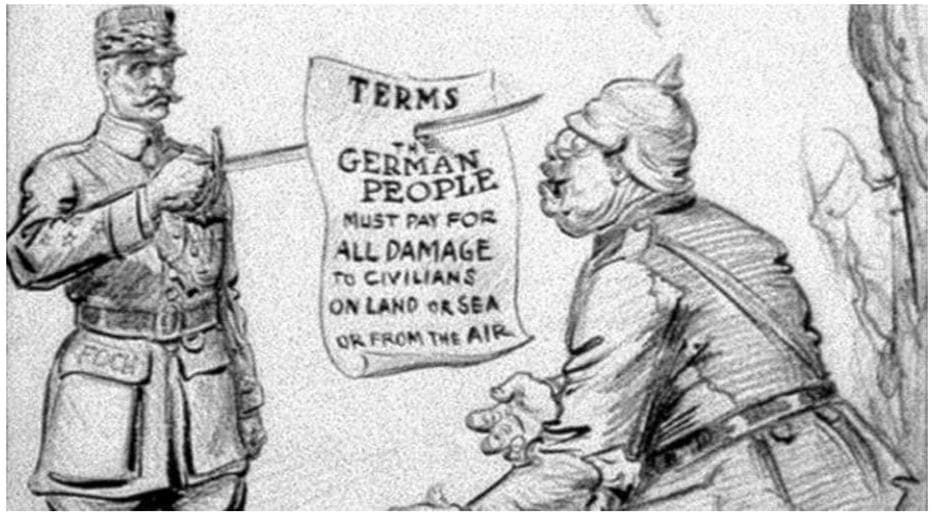
Mention any three ways in which Germany was affected by this treaty.
Answer
Three ways in which Germany was affected by this treaty are:
- The area of the Rhine Valley was to be demilitarised, and the German territory west of the Rhine was to be occupied by the Allied Troops for 15 years.
- The coal mines in the German area called Saar were ceded to France for 15 years, and the area was to be governed by the League of Nations.
- The German Army was restricted to a force of 1,00,000 soldiers and the Navy was limited to 15,000 men and 24 ships. The Air Force and submarines were banned.
Enumerate any three objectives of the movement started by newly independent countries in Asia and Africa.
Answer
Three objectives of Non-Aligned Movement are:
- To eliminate all those causes which could lead to war.
- To oppose colonialism, imperialism and racial discrimination.
- To oppose the use of force and the use of nuclear weapons.
Discuss a special power enjoyed by the permanent members of the UN Security Council that impacts the decision-making by the Council.
Answer
One exclusive power enjoyed by the permanent members of the UN Security Council that impacts the decision-making by the Council is Veto power. The negative vote of a permanent member is called a veto. The Council is powerless to act if any of the five permanent members uses the veto power.
Compare the two higher courts of our country with reference to the following:
(a) qualification
(b) age of retirement
(c) one example of each of their Original Jurisdiction.
Answer
The two higher courts of our country are the Supreme Court and the High Court.
(a) Qualification
Supreme Court : A Judge of the Supreme Court must be a citizen of India and must have been a Judge of a High Court for at least five years, or an advocate of a High Court for at least ten years, or a distinguished jurist in the opinion of the President.
High Court : A Judge of a High Court must be a citizen of India and must have worked as a judge in any court in India for not less than ten years, or must have worked as an advocate in the High Court or High Courts in India continuously for ten years.
(b) Age of retirement
Supreme Court : A Judge of the Supreme Court retires on attaining the age of 65 years.
High Court : A Judge of a High Court retires on attaining the age of 62 years.
(c) One example of each of their Original Jurisdiction
Supreme Court : A dispute between the Government of India and one or more States can be brought directly before the Supreme Court.
High Court : A case relating to State revenue and its collection can be brought directly before the High Court.
Read the following excerpt and answer the questions that follow:
As railway and transport minister, Lal Bahadur Shastri sent his resignation twice to Nehru after train accidents. Only once he was persuaded to take it back.....When it appeared that Nehru seemed inclined to accept the (second) resignation, thirty MPs appealed to Nehru not to let Shastri go. They were of the view that while Shastri should be lauded for having offered to resign, his resignation should not be accepted, as he was not personally responsible for the accident.
(a) Does Shastri’s resignation reflect Individual Responsibility or Collective Responsibility? Justify.
(b) Highlight two important differences between both types.
Answer
(a) Lal Bahadur Shastri's resignation reflects Individual Responsibility. This is because he was himself in charge of the Railway and Transport Ministry and not the entire Council of Ministers.
(b) Two important differences between Individual and Collective Responsibility are as follows:
| Individual Responsibility | Collective Responsibility | |
| 1. | The Ministers are individually responsible to the President, i.e., they hold office during the pleasure of the President and may be dismissed by him/her, on the advice of the Prime Minister even when they may have the confidence of the Legislature. | The Council of Ministers is collectively responsible to the Parliament and has to resign if it loses the confidence of the Lok Sabha. A Vote of No-Confidence against one Minister is a vote against the whole Ministry. Such a Ministry that has lost the confidence of the Lok Sabha has to resign. |
| 2. | Each Minister is answerable to Parliament for the department under his/her control. It is obligatory for him/her to answer all the questions asked by the MPs, regarding the functioning of his/her department. | All Ministers jointly share the responsibility for the government's policies and performance. The Ministers must function as a team in supporting and defending government policies inside as well as outside Parliament. |
When either of the two Houses of the Parliament of India is not in session, and if the government feels the need for an immediate procedure, the President can promulgate ............... that has the same force and effect as an act passed by parliament under its legislative powers.
What can the President promulgate? Who prepares it? Which body must approve it?
Answer
When neither of the two Houses of the Parliament of India is in session, the President can promulgate an Ordinance.
The Cabinet, led by the Prime Minister prepares and advises the President to issue the Ordinance.
The two Houses of Parliament must approve the Ordinance within six weeks from the date the Parliament re-assembles, otherwise it ceases to operate.