
Choose the correct answers to the questions from the given options.
Identify the exclusive powers of the Rajya Sabha from the following:
P: Can introduce a new All India Service
Q: Can impeach the President
R: Can never be dissolved as a whole
S: Can introduce a Money Bill
- P and Q
- R and S
- P and R
- Q and S
Answer
P and R
Reason — The Rajya Sabha has the exclusive power to declare, by a resolution supported by not less than two-thirds of the members present and voting, that it is necessary in the national interest to create a new All India Service. It is also a permanent House and cannot be dissolved as a whole; one-third of its members retire every two years.
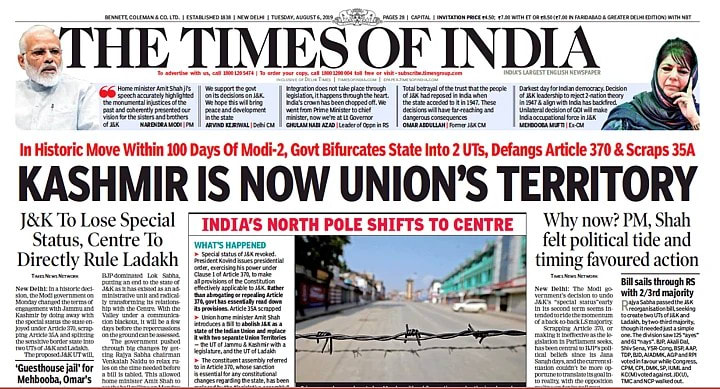
Who is authorised to make amendments related to the headline given below?
- The Supreme Court
- The President
- The Parliament
- The Prime Minister
Answer
The Parliament
Reason — The Parliament has the power to alter the boundaries or names of existing States and to form new States or Union Territories. Therefore, changes relating to the reorganisation shown in the headline are made by Parliament through the prescribed legislative procedure.
Cabinet : inner core :: ............... : junior-most ministers
- Ministers of State
- Deputy Ministers
- Council of Ministers
- State Ministers
Answer
Deputy Ministers
Reason — The Cabinet is a small body of senior leaders who hold important portfolios and form the nucleus of the administration, that is, the inner core of the Council of Ministers. Deputy Ministers form the third and lowest category of Ministers. They are junior ministers placed under senior ministers whom they assist, and they take no part in Cabinet deliberations.
Which option best describes the picture given below?

- All ministers have portfolios.
- All ministers meet frequently.
- There are three categories of ministers.
- The ministers work together like a team.
Answer
The ministers work together like a team.
Reason — The picture shows a group of people jointly fitting together the pieces of a single puzzle. This illustrates the principle of collective responsibility, under which all Ministers jointly share the responsibility for the government's policies and performance, and must function as a team in supporting and defending government policies inside as well as outside Parliament.
Choose the correct option to replace the underlined word:
The Council of Ministers is individually responsible to the Lok Sabha.
- Prime Minister
- Rajya Sabha
- President
- Speaker
Answer
President
Reason — The Ministers are individually responsible to the President, that is, they hold office during the pleasure of the President and may be dismissed by him/her on the advice of the Prime Minister, even when they enjoy the confidence of the Legislature. It is collective responsibility, and not individual responsibility, that is owed to the Lok Sabha.
Ravi, a college student, was taken into police custody without being informed of the reasons for his arrest. His family was not told where he was detained, and he was not produced before a magistrate within 24 hours. Ravi's parents filed a case in the Supreme Court requesting that the police produce Ravi before the court. Which writ will the court issue in this case?
- Habeas Corpus
- Certiorari
- Prohibition
- Mandamus
Answer
Habeas Corpus
Reason — Habeas Corpus means 'to have the body'. By issuing this writ, the Supreme Court or a High Court can get the body of a person produced before it and order his release if he has been unlawfully detained. It is thus a great safeguard for the personal freedom of a citizen, which is exactly the relief sought by Ravi's parents.
Assertion (A): The Muslim League was formed in 1906.
Reason (R): The Congress split into two factions in 1907.
- (A) is true and (R) is false.
- (A) is false and (R) is true.
- Both (A) and (R) are true, and (R) is the correct explanation of (A).
- Both (A) and (R) are true, but (R) is not the correct explanation of (A).
Answer
Both (A) and (R) are true, but (R) is not the correct explanation of (A).
Explanation — Both statements are true. The Muslim League was formed in 1906, whereas the Congress split took place at the Surat Session in 1907. Therefore, the Congress split cannot be the reason for the formation of the Muslim League.
Identify the option which shows the correct chronology of the following events:
1. The Dandi March
2. The Second Round Table Conference
3. The Simon Commission
- 3-1-2
- 1-3-2
- 3-2-1
- 2-1-3
Answer
3-1-2
Reason — The Simon Commission was appointed in 1927 and arrived in India in 1928, the Dandi March took place in 1930, and the Second Round Table Conference was held in 1931. Hence, the correct chronology is 3-1-2.
Mira notices that the children in her apartment are writing on the newly painted walls. If she decides to address this issue using methods inspired by the Early Nationalists, which approach is she MOST LIKELY to follow?
- Fight with the children
- Write a letter to the welfare association highlighting the problem
- Paint all the dirty walls
- Boycott the families of the children
Answer
Write a letter to the welfare association highlighting the problem
Reason — The Early Nationalists followed the method of Constitutional Agitation. They made use of the three P's — Petitions, Prayers and Protests — and sent memorandums and petitions to the authorities, working peacefully within the legal framework. Writing a letter to the welfare association matches this approach, whereas fighting or boycott were methods they did not approve of.
Choose the option which shows the correct match:
| Column A | Column B |
|---|---|
| 1. Militarism | A. Intense pride in one's nation |
| 2. Alliance System | B. Glorification of military power |
| 3. Nationalism | C. Division of nations into rival groups |
- 1-B, 2-C, 3-A
- 1-A, 2-B, 3-C
- 1-C, 2-B, 3-A
- 1-B, 2-A, 3-C
Answer
1-B, 2-C, 3-A
Reason — Militarism made military strength synonymous with national prestige, so every country began to increase her military power and glorify it. The Alliance System divided Europe into two hostile groups — the Triple Alliance and the Triple Entente. Nationalism, in its extreme form, meant intense pride in one's own nation and the belief that one's country is superior to others.
Which of the following organisations is connected to the given picture?

- UNESCO
- UNICEF
- WHO
- UNDP
Answer
UNESCO
Reason — The picture speaks of the importance of restoring historical monuments. UNESCO provides technical advice, assistance, equipment and funds for the preservation of monuments and other works of art, and has prepared a World Heritage List to identify the monuments and sites which are to be protected. UNICEF works for the welfare of children, WHO for health and UNDP for development.
Who among the following is NOT an Assertive Nationalist Leader?
- Bipin Chandra Pal
- Dadabhai Naoroji
- Lala Lajpat Rai
- Bal Gangadhar Tilak
Answer
Dadabhai Naoroji
Reason — Bal Gangadhar Tilak, Bipin Chandra Pal and Lala Lajpat Rai were the leaders of Assertive Nationalism, who believed in aggressively demanding political rights. Dadabhai Naoroji, the 'Grand Old Man of India', was an Early Nationalist who believed that the British were basically just and good and relied on constitutional methods.
Read the description and choose the correct option:
A major global conflict broke out in the early twentieth century, beginning in Europe and soon spreading to other parts of the world. Powerful nations formed rival alliances, and an assassination triggered widespread fighting. The war reshaped political boundaries and weakened old empires. Its immediate cause was ............... .
- Formation of alliances
- Annexation of Austria
- Imperialism
- Sarajevo Crisis
Answer
Sarajevo Crisis
Reason — The description refers to the First World War. Nationalism, imperialism and the division of Europe into rival alliances were its long term causes. Its immediate cause was the Sarajevo Crisis — the assassination of Archduke Francis Ferdinand at Sarajevo on June 28, 1914 by the secret society 'Black Hand', after which Austria declared war on Serbia.
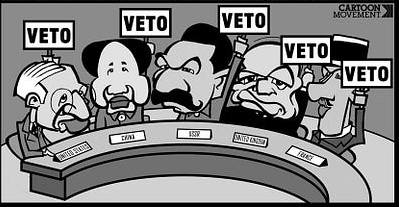
Which of the following countries will NOT be a part of the cartoon given below?
- China
- Japan
- Russia
- Britain
Answer
Japan
Reason — Veto power is enjoyed by the five permanent members of the United Nations Security Council. Japan is not a permanent member of the Security Council and therefore does not possess veto power.
Identify the correct pair from the given options:
- Surendranath Banerjee – Assertive Nationalist
- Raja Ram Mohan Roy – Delhi Durbar
- Dadabhai Naoroji – First President of Congress
- Jyotiba Phule – Women's Education
Answer
Jyotiba Phule – Women's Education
Reason — Jyotiba Phule was a strong advocate for the education of women and the upliftment of lower castes. He and his wife, Savitribai Phule, were pioneers in setting up schools for girls in 19th-century Maharashtra.
Connect the information given in the diagram below and identify X.

- Mahatma Gandhi
- Subhash Chandra Bose
- Bipin Chandra Pal
- Jawaharlal Nehru
Answer
Subhash Chandra Bose
Reason — After resigning from the Presidentship of the Congress in 1939, Subhash Chandra Bose laid the foundation of the Forward Bloc on May 3, 1939 to bring the entire left wing under one banner. 'Delhi Chalo' was the stirring call he later gave to the soldiers of the Indian National Army. Both are therefore associated with him.
Read the extract given below and answer the question that follows:
In India, the Supreme Court can exercise advisory jurisdiction under Article 143 of the Constitution. With regard to the President, these opinions are purely advisory.
Mention any two points about the Supreme Court that can be inferred from the given extract.
Answer
In India, the Supreme Court can exercise advisory jurisdiction under Article 143 of the Constitution. This means that:
- The Supreme Court can give its opinion on any question of law or fact of public importance as may be referred to it for consideration by the President.
- The opinion given by the Supreme Court in such a case is purely advisory and is not binding on the President.
Which category of power is being exercised by the President in the following?
- Appointment of Cabinet ministers
- Approval of a Money Bill
Answer
(a) Appointment of Cabinet ministers — Executive power.
(b) Approval of a Money Bill — Financial power.
The whole plan may not be perfect but like all plans, its success will depend on the spirit of goodwill with which it is carried out.
— Lord Mountbatten
Give two reasons for the acceptance of the above plan by the Congress.
Answer
The Mountbatten Plan was accepted by the Congress because of the following two key reasons:
- Large-Scale Communal Riots — The large-scale communal riots that engulfed the whole country convinced the Congress leaders that the only solution to the communal problem lay in the Partition of India.
- Avoidance of Civil War — The leaders felt that any further delay in the transfer of power could lead to a civil war in India. They believed that it was better to have a smaller India with a strong central authority than a larger State with a weak Centre.
Imagine you were an artisan in the year 1856. Mention any two ways in which the economic policies of the British would have affected you.
Answer
As an artisan in 1856, I would have been affected in the following ways:
- Cheap machine-made British goods were imported into India, while Indian goods faced heavy duties in England. This reduced the demand for Indian handicrafts and caused artisans to lose their livelihood.
- The annexation of Indian States led to the disappearance of royal courts and nobles who had traditionally patronised artisans. This further reduced employment and income for craftsmen.
Look at the picture given below and answer the question that follows:

Identify the leader seen in the picture. Mention any one of his contributions.
Answer
The leader seen in the picture is Bipin Chandra Pal, an Assertive Nationalist known as the 'Father of the Revolutionary Thought in India'.
One key contribution of Bipin Chandra Pal:
- Role as a Journalist: He worked for the Bengal Public Opinion, The Tribune and New India to propagate his brand of nationalism. The British Government found his writings seditious, and he was arrested and sentenced to six months' imprisonment.
Mention any two objectives of the League of Nations.
Answer
Two objectives of the League of Nations were:
- All States were to refer their mutual disputes, if any, to the League of Nations for a peaceful settlement.
- The member-States were to take necessary action as directed by the League against any State which tried to disturb world peace and order.
Mention any two ideologies of dictators.
Answer
Two ideologies of the dictators were:
- They believed in one-party, one-leader totalitarian rule.
- They believed in aggressive nationalism and regarded the State as supreme over individual rights.
The Union Legislature of India is the law-making body of the country. With reference to the Parliament, answer the following questions:
(i) Mention any three key differences in power between the Lok Sabha and the Rajya Sabha that make the Lok Sabha more influential.
(ii) Rajya Sabha adjourned sine die, overall productivity at 79 percent.
— Deccan Herald, 21 December 2023
Who can adjourn the above session? Explain the composition of this house.
(iii) Mention any four legislative powers of the Parliament.
Answer
(i) The Lok Sabha has special powers which make it more powerful than the Rajya Sabha. These special powers are:
- A Motion of No-Confidence against the government can be introduced and passed only in the Lok Sabha. If it is passed, the Prime Minister and the Council of Ministers resign collectively. The Rajya Sabha cannot remove the Council of Ministers through such a motion.
- A Money Bill can be introduced only in the Lok Sabha. The Rajya Sabha cannot reject or amend it and can only make recommendations within 14 days.
- In case of a deadlock between the two Houses over an Ordinary Bill, the decision of the Lok Sabha normally prevails in a joint sitting because of its greater numerical strength.
(ii) The Chairman of the Rajya Sabha, who is the Vice-President of India, can adjourn the House or its sitting sine die.
Composition of the Rajya Sabha —
The maximum strength of the Rajya Sabha is 250 members, of whom:
- 12 members are nominated by the President from among persons having special knowledge or practical experience in literature, science, art and social service.
- Up to 238 members represent the States and Union Territories. Seats are allocated to the States and Union Territories on the basis of their population.
(iii) Four legislative powers of the Union Parliament are:
- Matters in the Union List — Parliament has exclusive power to make laws on subjects in the Union List, such as Defence, Banking, Communications and Foreign Affairs.
- Matters in the Concurrent List — Parliament and the State Legislatures can both make laws on subjects in the Concurrent List. In case of a conflict, the Union law generally prevails.
- Residuary Powers — Parliament can make laws on subjects that are not included in the Union, State or Concurrent Lists.
- Matters in the State List under special circumstances — Parliament can legislate on subjects in the State List during a National Emergency, when the Rajya Sabha passes a resolution by a two-thirds majority in the national interest, or when two or more States request Parliament to make a law on a State subject.
The President is the nominal head of the executive and the first citizen of the country. With reference to this statement, answer the following questions:
(i) Mention any three legislative powers of the President which justify his nominal position.
(ii) Mention any three points to enumerate the financial powers vested in the President of India.
(iii) Describe the constitutional procedure to remove the President.
Answer
(i) Three legislative powers of the President which justify his/her nominal position are:
Dissolve the Lok Sabha: He/She can dissolve the Lok Sabha and order fresh elections.
Assent to Bills: Once a Bill is passed by both the Houses, it is sent to the President for his/her approval. The President may give his/her assent, or withhold the Bill or send it back to the House concerned with recommendations. If the same bill is passed again, the President has to give his/her assent.
Promulgate Ordinances: The President can promulgate an Ordinance when immediate action is necessary and both Houses of Parliament are not simultaneously in session. An Ordinance may also be issued when one House is in session. It has the same force as an Act of Parliament and must be laid before both Houses when Parliament reassembles. It ceases to operate six weeks after reassembly unless approved by Parliament.
(ii) Three financial powers of the President are:
Money Bills can be introduced only on the recommendation of the President.
The President can authorise withdrawal of advances from the Contingency Fund of India to meet unforeseen expenditure. Such expenditure should be subsequently approved by Parliament.
Every five years, the President appoints a Finance Commission comprising a Chairman and four other members to give recommendations on financial matters.
(iii) PROCEDURE FOR IMPEACHMENT OF THE PRESIDENT
In case of violation of the Constitution or grave misconduct, either House may frame charges against the President as follows:
- Resolution which is moved after at least fourteen days' notice in writing signed by not less than one-fourth of the total number of members of the House; and
- The resolution is passed by a majority of not less than two-thirds of the total membership of the House.
The other House investigates the charges and the President has the right to appear and to be represented at such an investigation.
If the President is found guilty, a resolution is passed by a majority of not less than two-thirds of the total membership of the investigating House, and the President is removed from his/her office.
The High Courts and Subordinate Courts are part of the integrated judicial system. With reference to the statement, answer the following questions:
(i) Mention three cases which fall under the Original Jurisdiction of the High Court.
(ii) Who appoints the High Court Judges? Mention any two qualifications required for a person to be appointed as a High Court Judge.
(iii) Lok Adalat brings justice to the doorstep of the common.
Justify this statement with any four points.
Answer
(i) Original Jurisdiction means the power to hear and decide cases at the first instance. Three such cases before a High Court are:
- Matters relating to State revenue and its collection.
- Cases regarding wills, divorce, marriage, company law and contempt of court, which may be brought before the High Court directly.
- Election petitions challenging the election of Members of Parliament, of a State Legislative Assembly or of other local bodies.
(ii) The Judges of a High Court are appointed by the President of India. The Chief Justice of a High Court is appointed in consultation with the Chief Justice of the Supreme Court and the Governor of the concerned State.
Two qualifications required for appointment as a Judge of a High Court are:
- He/She should be a citizen of India and should not be over 62 years of age.
- He/She should have held a judicial office in the territory of India for at least ten years, or should have been an advocate of a High Court for at least ten years.
(iii) Lok Adalat means 'People's Court'. It is an alternative dispute redressal mechanism where cases pending in a court of law, or at the pre-litigation stage, are settled amicably. It brings justice to the doorstep of the common man in the following ways:
- Spirit of compromise — Lok Adalats settle family feuds, disputes between neighbours and minor cases of assault and injury through compromise and understanding, so that both the parties feel satisfied.
- Speedy and inexpensive justice — There is no court fee. Any person can move a Lok Adalat by an application on plain paper and expect quick justice.
- Relief to other courts — They reduce the workload of the regular courts, enabling them to deal with more serious matters, and thus reduce delays in the higher courts.
- Social justice — They provide legal aid and quick justice to the weaker sections of society who cannot afford the delay or the cost involved in ordinary court procedures. Mobile Lok Adalats travel from one place to another to resolve petty cases and spread legal awareness.
Read the excerpt given below and answer the questions that follow:
The Indian Rebellion of 1857, also known as the Indian Mutiny, the Sepoy Mutiny, or the First War of Indian Independence, was a widespread uprising against British rule in India that began in May, 1857. The rebellion was sparked by the sepoys' mutiny in Meerut on May 10, 1857, and quickly spread to other parts of India. On May 10, 1857, Indian soldiers, known as sepoys, rebelled against their British officers in the town of Meerut, triggering a rebellion. The rebellion quickly spread to other parts of India with many Indian princes and soldiers joining the uprising.
— timesofindia.com, May 10, 2023 [edited]
(i) What was the immediate cause for the rebellion?
(ii) Mention any three socio-religious causes of the Revolt.
(iii) The Subsidiary Alliance proved to be disastrous to the Indian Kingdoms. Justify this statement by stating any four clauses of this alliance.
Answer
(i) The immediate cause of the rebellion was the introduction of the Enfield rifle.
- In 1856, the British decided to replace the old musket by the new Enfield rifle, the loading of which involved biting off the top greased paper of the cartridge with the teeth.
- In January 1857, a rumour spread in the Bengal regiments that the grease used on the cartridges contained the fat of the cow and the pig.
- Since the cow is sacred to the Hindus and the pig is a taboo to the Muslims, the sepoys were convinced that this was a deliberate move to defile their religions. They refused to use the cartridges and staged an uprising when they were forced to use them.
(ii) Three socio-religious causes of the Revolt of 1857 were:
- Interference with social customs — Reforms such as the Abolition of Sati (1829), the Widow Remarriage Act (1856) and the opening of Western education to girls were introduced without considering the feelings of the people, and were not welcomed by the masses.
- Apprehensions about modern innovations — People were suspicious of the railways and the telegraph. There were rumours that telegraph poles were erected to hang those who opposed British rule, and orthodox Indians resented that in railway compartments the higher and the lower castes had to sit side by side.
- Activities of the missionaries — The Charter Act of 1813 led to an increase in the number and activities of Christian missionaries. The Indians began to feel that the Government was supporting the missionaries in order to convert them to Christianity.
(iii) The Subsidiary Alliance was introduced by Lord Wellesley. Under this system, the Indian rulers who agreed to it:
- Accepted the British as the supreme power.
- Surrendered their foreign relations to the East India Company and agreed that they would not enter into any alliance with any other power and would not wage wars.
- Accepted a British Resident at their headquarters and agreed not to employ any European in their service without consulting the Company.
- Agreed to maintain British troops at their own cost.
In this manner the Indian States lost their sovereignty and virtually lost their independence, which proved disastrous for them.
Nationalism refers to the feeling of oneness that emerges when people consider themselves as one nation. With reference to the growth of nationalism, answer the following questions:
(i) Name the first President of the Congress. Mention any two objectives of the Congress.
(ii) Whether it is fiction, non-fiction, or periodical, all kinds of literature contributed at large in the national consciousness of India in pre-independence times. Mention any three points to analyse the role of the press in the growth of nationalism.
(iii) Explain any four policies of Lord Lytton that showcased his attitude of racial superiority, eventually leading to the growth of nationalism.
Answer
(i) The first President of the Indian National Congress was W.C. Bonnerjee. Two objectives of the Congress are given below:
- To promote friendly relations between nationalist political workers from different parts of the country.
- To formulate popular demands and present them before the government.
(ii) The press played an important role in the growth of nationalism in the following ways:
- It was through the press that the message of patriotism and the modern liberal ideals of liberty, freedom, equality, home rule and independence spread among the people.
- The press carried on a daily criticism of the unjust policies of the British Government and exposed the true nature of British rule in India.
- It made possible the exchange of views among different social groups from different parts of the country, and thus helped in creating a united public opinion.
(iii) Four policies of Lord Lytton that reflected his attitude of racial superiority were:
- The Vernacular Press Act (1878) — It forbade vernacular papers from publishing any material that might incite feelings of dissatisfaction against the British Government. The Act was not applicable to English newspapers.
- The Indian Arms Act (1878) — It made it a criminal offence for Indians to carry arms without a licence. This Act too was not applicable to the British.
- Reduction in the age limit for the I.C.S. examination — The maximum age for appearing in the Indian Civil Service examination was reduced from 21 to 19 years. As the examination was held in London, this made it far more difficult for Indians to compete.
- Removal of import duties on cotton textiles — This was done for the benefit of the British cloth industry at the cost of the growing Indian textile industry.
Mahatma Gandhi led the freedom movement using non-violent methods. With reference to the Gandhian movements, answer the following questions:
(i) Name the march led by Mahatma Gandhi to break the salt law. Which movement did this march lead to? In which year was that movement launched?
(ii) The movement which began with this march made a considerable impact on the social and political surroundings of the country.
Analyse this statement by mentioning any three such impacts.
(iii) Mention any four clauses of the pact which led to the suspension of this movement.
Answer
(i) The march led by Mahatma Gandhi to break the salt law was the Dandi March, which he began from the Sabarmati Ashram to Dandi on the Gujarat coast. This march led to the Civil Disobedience Movement, which was launched in 1930.
(ii) The Civil Disobedience Movement made a considerable impact on the social and political surroundings of the country in the following ways:
- It widened the base of the freedom struggle, as a large number of social groups like merchants, shopkeepers, peasants, tribals and workers in different parts of the country were mobilised for the national movement.
- It brought women out of their homes to participate in politics and made them equal partners in the freedom struggle.
- It improved the social conditions of the depressed classes, who were given entry into temples and access to wells, which was earlier denied to them.
(iii) The movement was suspended by the Gandhi-Irwin Pact, signed in March 1931. Four of its clauses were:
- The Government agreed to withdraw all ordinances and end prosecutions.
- The Government agreed to release all political prisoners, except those guilty of violence.
- The Government agreed to permit the free collection or manufacture of salt by persons near the seacoast.
- The Congress agreed to suspend the Civil Disobedience Movement and to participate in the second session of the Round Table Conference.
Observe the picture given below and answer the following questions:

(i) Which country was responsible for the bombing referred to in the headline? Mention any two consequences of the World War associated with this incident.
(ii) Explain the Policy of Appeasement which led to the Second World War.
(iii) The unfair Treaty of Versailles led to the rise of dictatorship in Germany. Mention any four clauses of this treaty to justify this statement.
Answer
(i) Japan was responsible for the attack on Pearl Harbor on December 7, 1941. Two consequences of the Second World War were:
- Defeat of the Axis Powers — Germany, Italy and Japan were defeated, bringing the war to an end.
- Formation of the United Nations — The United Nations Organisation was established in 1945 to maintain international peace and security and prevent another world war.
(ii) Appeasement meant accepting the hostile demands of an aggressive nation in order to maintain peace. Britain and France followed this policy towards Germany and Italy because they felt that the dictators had genuine grievances against the harsh Treaty of Versailles and that satisfying these grievances would preserve peace. They also wanted to check the spread of Communism and the influence of Soviet Russia. As a result, Germany was allowed to rearm, remilitarise the Rhineland and annex Austria and Czechoslovakia. This encouraged Hitler's aggression and helped lead to the Second World War.
(iii) The unfair Treaty of Versailles led to the rise of dictatorship in Germany. Four clauses of the Treaty of Versailles are:
- Germany was declared guilty of aggression and had to pay war reparation of 33 billion dollars.
- The Saar coal mines were given to France for 15 years and the area was to be governed by the League of Nations.
- The area of the Rhine valley was demilitarised and the German territory west of Rhine was to be occupied by the Allied troops for 15 years.
- The German Army was restricted to a force of 1,00,000 soldiers and the Navy was limited to 15,000 men and 24 ships. The Air Force and submarines were banned.
The United Nations Organisation aims to maintain international peace. With reference to its organs and agencies, answer the following questions:
(i) What is the composition of the International Court of Justice?
(ii) Mention any three exclusive functions of the General Assembly.
(iii) Kolkata's famous Durga Puja received the intangible heritage tag.
Which agency of the United Nations is authorised to give this tag? Mention any three other contributions of that agency in the preservation of culture.
Answer
(i) Composition of the International Court of Justice —
The Court is composed of 15 judges, each of different nationality elected to nine-year terms of office by the United Nations General Assembly and Security Council sitting independently of each other. Elections are held every three years for one-third of the seats, and retiring judges may be re-elected.
The Members of the Court do not represent their governments but are independent magistrates. The judges must possess the qualifications required in their respective countries for appointment to the highest judicial offices, or be jurists of recognised competence in international law. The composition of the Court has also to reflect the main forms of civilisation and the principal legal systems of the world.
The Court elects its President and Vice-President for a three-year term. They may, when their term expires, be re-elected. The Court has the power to appoint its Registrar.
(ii) Three functions of the General Assembly are:
- To consider and make recommendations on the principles of cooperation, in the maintenance of international peace and security.
- To consider and approve the budget of the United Nations and to apportion the contributions among members.
- To elect the non-permanent members of the Security Council, the Economic and Social Council and the Trusteeship Council, and to elect the judges of the International Court of Justice.
(iii) The United Nations Educational, Scientific and Cultural Organization (UNESCO) is the agency authorised to give the intangible cultural heritage tag.
Three contributions of UNESCO in the preservation of culture are:
- UNESCO provides technical advice and assistance, equipment and funds for the preservation of monuments and other works of art. It has prepared a World Heritage List to identify the monuments and sites which are to be protected.
- It aims to protect the world inheritance of books, works of art and rare manuscripts.
- It gives encouragement to artistic creations in literature and fine arts.