
An ordinance has to be approved by the Parliament within ............... weeks.
- Two
- Three
- Six
- Eight
Answer
Six
Reason — All Ordinances must be put up before both the Houses for their approval. Ordinances cease to operate after six weeks from the re-assembly of Parliament, unless they are approved by the Houses.
The junior category of ministers who assist senior ministers:
- Cabinet Ministers
- Ministers of State
- Deputy Ministers
- Council of Ministers
Answer
Deputy Ministers
Reason — Deputy Ministers assist the Cabinet Ministers and the Council of Ministers. They are junior ministers and are placed under senior ministers whom they have to assist.
A major natural calamity has taken place and the opposition wants the house to lay aside all other business and take up this matter of urgent importance. Which motion should the house move to allow this?
- Adjournment Motion
- No-confidence Motion
- Confidence Motion
- Censure Motion
Answer
Adjournment Motion
Reason — An Adjournment Motion means a proposal to lay aside all other business and take up a 'definite matter of urgent importance'. Such a Motion leads to the interruption of normal business of the House.
When the Supreme Court reviews any judgement made by it to remove an error, it falls under ............... jurisdiction.
- Advisory
- Revisory
- Original
- Appellate
Answer
Revisory
Reason — The Supreme Court is empowered to review any judgement or order made by it with a view to removing any mistake or error that might have crept in the judgement or order. This decision is acceptable by all courts in India.
The ............... has the power to summon the Houses of Parliament.
- Speaker
- President
- Vice President
- Chief Justice of India
Answer
President
Reason — The President has the power to summon the Houses of Parliament. There should not be a gap of more than six months between two sessions of each House.
Court of District Judge : Civil Cases :: Sessions Court : ............... Cases
- Advisory
- Criminal
- Constitutional
- Appellate
Answer
Criminal
Reason — The District Judge handles civil cases, while the Sessions Court handles criminal cases.
Formation of Congress : 1885 :: Formation of Muslim League : ...............
- 1905
- 1906
- 1907
- 1908
Answer
1906
Reason — The All-India Muslim League was set up on December 30, 1906, under the presidency of Nawab Salimullah. Aga Khan was elected as the permanent president of the Muslim League.
The plan of Partition of Bengal was proposed by ............... .
- Lord Canning
- Lord Dalhousie
- Lord Curzon
- Lord Ripon
Answer
Lord Curzon
Reason — The plan for the Partition of Bengal was formulated by Lord Curzon in 1905, who believed that such an action would weaken the nationalist movement in Bengal. It was part of the Divide and Rule policy of the British.
People protested against the ............... because it had seven British members and no Indian representation.
- Simon Commission
- Lucknow Pact
- Ilbert Bill
- Cabinet Mission
Answer
Simon Commission
Reason — The Simon Commission was composed of seven British members of Parliament and had no Indian members. This was seen as a violation of the principle of self-determination and a deliberate insult to the self-respect of Indians.
The main objective of the Assertive Nationalists was ............... .
- Constitutional agitation
- Peaceful protests
- Purna Swaraj
- Self-government under British Rule
Answer
Purna Swaraj
Reason — The main objective of the assertive nationalists was to attain Purna Swaraj from the British Government in India and establish their administration and government.
Identify the Early Nationalist leader.
- Gopal Krishna Gokhale
- Bipin Chandra Pal
- Jyotiba Phule
- Bal Gangadhar Tilak
Answer
Gopal Krishna Gokhale
Reason — Gopal Krishna Gokhale was one of the earliest and most popular nationalist leaders who played an important role in raising the consciousness of the Indian people against British rule. Mahatma Gandhi even called him as his 'political mentor'.
The Lucknow Pact was signed between ............... .
- The British and the Congress
- The Congress and the Muslim League
- The Early and the Assertive Nationalists
- The Muslim League and the British
Answer
The Congress and the Muslim League
Reason — The Lucknow Pact was signed between the Congress and the Muslim League in 1916, bringing them together on a common platform to present joint constitutional demands before the Government.
............... was one of the causes of the Quit India Movement.
- Failure of the Second Round Table Conference
- Rowlatt Act
- Mountbatten Plan
- Failure of the Cripps Mission
Answer
Failure of the Cripps Mission
Reason — The British Government in the year 1942 sent Sir Stafford Cripps to draw up a plan for India to decide its future after the war. However, this plan was not accepted by all the parties, and soon after it they started the Quit India Movement in August 1942.
The International Court of Justice has ............... judges.
- 5
- 10
- 12
- 15
Answer
15
Reason — The International Court of Justice (ICJ) has 15 judges from different countries. They are elected for nine-year terms by the United Nations General Assembly and the Security Council.
Which of these leaders was an architect of the Non-Aligned Movement?
- Joseph Stalin
- Abdel Nasser
- Winston Churchill
- Franklin Roosevelt
Answer
Abdel Nasser
Reason — President Abdel Nasser of Egypt, along with Prime Minister Jawaharlal Nehru of India and President Josip Broz Tito of Yugoslavia, were the main founders of the Non-Aligned Movement (NAM).
The immediate cause of the First World War was ............... .
- Imperialism
- Alliance System
- Sarajevo Crisis
- Arms Race
Answer
Sarajevo Crisis
Reason — The immediate cause of the First World War was the Sarajevo Crisis. The murder of Prince Archduke Francis Ferdinand at Sarajevo on 28 June 1914 led Austria-Hungary to declare war on Serbia, which soon culminated in the First World War.
Mention any two ways in which the Constitution ensures the independence of the Judiciary from the Executive.
Answer
Two ways in which the Constitution ensures the independence of the Judiciary from the Executive are:
- A Judge can remain in office till he has attained the age of 65 years. He can be removed by the President on the ground of "proved misbehaviour or incapacity."
- The Supreme Court can punish for the contempt of court if a person or authority makes an attempt to lower its authority.
State any two legislative powers of the Cabinet.
Answer
Two legislative powers of the Cabinet are:
- Amendment to the Constitution: The Cabinet is instrumental in planning and moving the Amendment to the Constitution.
- Issuing Ordinances: Cabinet also advises the President to issue ordinances when the Parliament is not in session.
Mention any two repressive policies of Lord Lytton.
Answer
Two repressive policies of Lord Lytton are:
- Vernacular Press Act — This act, enacted in 1878, forbade vernacular papers to publish any material that might incite feelings of dissatisfaction against the British Government. This act was not applicable to English newspapers.
- Arms Act — The Arms Act of 1878 made it a criminal offence for Indians to carry arms without licence. This act did not apply to British.
Give two reasons for the acceptance of the Mountbatten Plan by the Congress.
Answer
Two reasons for the acceptance of the Mountbatten Plan by the Congress were:
- Large scale communal riots engulfed the whole country. The only solution to the communal problem was the Partition of India.
- The only alternative to Partition was a Federation with a weak centre. A smaller India with a strong central authority was better than a bigger state with a weak centre.
State any two objectives of the Muslim League.
Answer
Two objectives of the Muslim League were:
- To promote, among the Muslims of India, support for the British government and to remove any misconceptions regarding the intention of the government in relation to Indian Muslims.
- To protect and advance the political rights and interests of the Muslims and to represent their needs and aspirations to the government in mild and moderate language.
Mention any two clauses of the Treaty of Versailles.
Answer
Two clauses of the Treaty of Versailles were:
- The area of the Rhine Valley was to be demilitarised and the German territory west of Rhine was to be occupied by the Allied Troops for 15 years.
- The German Army was restricted to a force of 1,00,000 soldiers and the Navy was limited to 15,000 men and 24 ships. The Air Force and submarines were banned.
Name the two alliances formed in Europe before the beginning of the First World War.
Answer
Before the First World War, the two major alliances in Europe were:
- Triple Alliance which included Germany, Austria-Hungary, and Italy.
- Triple Entente which included France, Russia, and the United Kingdom.
The Union Legislature comprises the President and the two houses of the Parliament. With reference to the Parliament, answer the following questions:
(i) Mr. Raj wants to be a member of the Lok Sabha. Mention any three qualifications required to contest elections for the Lok Sabha.
(ii) Mention any three legislative powers of the Union Parliament.
(iii) The Parliament controls the Executive. Mention any four ways in which it exercises its control.
Answer
(a) Three qualifications required to contest elections for the Lok Sabha are:
- He should be a citizen of India.
- He should be at least 25 years old.
- He should have his name in the electoral rolls in any part of the country.
(b) Three legislative powers of the Union Parliament are:
- The Parliament is the law-making body at the central level. It frames new laws and amends or repeals them, if necessary, on all the 97 Subjects of the Union List and all the Residuary Subjects which have not found a place in any of the lists.
- As far as the 47 Subjects in the Concurrent List are concerned, both the Parliament and the State Legislatures have got the right to make laws. But if any State Law comes into conflict with the Central Law, the Central Law shall prevail.
- All ordinances issued by the President must be approved by Parliament within six weeks after its session has begun, failing which an ordinance lapses.
(c) The Parliament exercises control over the Executive in the following ways:
- Question Hour: An hour a day in the daily routine of the Parliament, when in session, is reserved for asking questions from the Government. The members can ask any questions relating to the administration and policies and the Ministers are obliged to answer them.
- Vote of No-Confidence: The Council of Ministers remains in office only so long as it enjoys the confidence of the Lok Sabha. If a No-Confidence Motion is passed, the Council of Ministers must resign.
- Other Motions of Censure: The Parliament exercises its control over the Government by a number of other motions also which, if passed, amount to no-confidence. They include adjournment motions, motions of censure against a minister or ministers, rejection of a Government Bill and passing of a private member's bill against the wishes of the Government.
- Monetary Controls: The Parliament can hold the strings of the Government tight by voting a cut in the annual or supplementary budget or a cut in the salaries of the Ministers. It also appoints the Public Accounts Committee to examine the mode of government expenditure.
The President is the head of the State and exercises his / her powers on the advice of the Prime Minister and the Council of Ministers. With reference to this, answer the following questions:
(i) What are the three types of emergencies that can be proclaimed by the President?
(ii) Mention any three legislative powers of the President.
(iii) Give any two reasons to justify the need for indirect election of the President. What is the composition of the Electoral College which elects the President?
Answer
(i) An Emergency is "a sudden or unforeseen situation demanding immediate action." It is a situation in which the Head of State assumes extraordinary powers. The President can proclaim a state of Emergency in the following cases:
National or General Emergency: There is a danger of foreign aggression or danger to the peace and security of the country because of a civil war, insurgency or any other such cause (Article 352).
Breakdown of Constitutional Machinery: The Constitutional machinery in a State has broken down or there is a deadlock because of political uncertainties or otherwise (Article 356).
Financial Emergency: A set-back to the financial stability or credit feasibility of the country is likely to occur or has occurred (Article 360).
(ii) Three legislative powers of the President are:
Dissolve the Lok Sabha: He/She can dissolve the Lok Sabha and order fresh elections.
Assent to Bills: Once a Bill is passed by both the Houses, it is sent to the President for his/her approval. The President may give his/her assent, or withhold the Bill or send it back to the House concerned with recommendations. If the same bill is passed again, the President has to give his/her assent.
Promulgate Ordinances: The President can promulgate an Ordinance, which has the same status as an Act of Parliament when:
- Certain circumstances need immediate action.
- Both Houses of Parliament are not in session.
- All Ordinances must be put up before both the Houses for their approval. Ordinances cease to operate after six weeks from the re-assembly of Parliament, unless they are approved by the Houses.
- The Ordinance lapses if it is replaced by an Act of Parliament.
(iii) The President is elected by indirect elections because of the following reasons:
- If the President were to be elected directly by the people, he could become a rival centre of power to the Council of Ministers. This would be against the parliamentary system with ministerial responsibility.
- Since the membership in the two Houses of Parliament was likely to be dominated by one party, election of the President merely by a majority of members of the Union Parliament could make him a nominee of the ruling party like the Prime Minister. Such a President could not represent the constituent States of the Union.
COMPOSITION OF THE ELECTORAL COLLEGE
The President is elected indirectly by the members of an Electoral College consisting of:
the elected members of both Houses of Parliament.
the elected members of the Legislative Assemblies of the States including National Capital Territory of Delhi and the Union Territory of Puducherry.
Nominated members of Rajya Sabha and State Assemblies are not eligible to be included in the Electoral college.
The Constitution of India provides for a High Court for each State. With reference to the High Courts and Subordinate Courts, answer the following questions:
(i) Who appoints the judges of the High Court? Mention any two qualifications required for a person to be appointed as a judge of a High Court.
(ii) Mention any three cases that come under the Original Jurisdiction of the High Court.
(iii) What are Lok Adalats? Mention any three advantages of the Lok Adalats.
Answer
(a) The judges of a High Court are appointed by the President of India. Two qualifications required for a person to be appointed as a judge of a High Court are:
- He/She should be a citizen of India.
- He/She should have held a judicial office in the territory of India for at least ten years, or should have been an advocate of a High Court (or of two or more such courts in succession) for at least ten years.
(b) Two cases that come under the Original Jurisdiction of the High Court are:
- Cases relating to the enforcement of the Fundamental Rights of citizens.
- Cases relating to wills, divorce, company law, admiralty and contempt of court.
- Under the power of Judicial Review, High Court can interpret the Constitution.
(c) 'Lok Adalat' means 'the People's Court'. It is a voluntary forum where disputes are settled amicably and speedily without formal court procedures. Three advantages are:
- It settles disputes speedily and saves much time.
- It delivers inexpensive justice and saves money.
- It reduces the workload of the regular courts, and its settlements leave no bitter taste as everything is decided in an atmosphere of harmony.
The Indian Nationalists described the Great Uprising of 1857 as the First War of Independence. With reference to this, answer the following questions:
(i) Mention any three policies used by the British to expand their political power in India.
(ii) The Revolt of 1857 is also known as the Sepoy Mutiny. Mention any three military causes which led to the uprising.
(iii) Mention any four economic causes of the Revolt.
Answer
(i) Three policies used by the British to expand their political power in India are:
- By Outright Wars: To expand their territorial power in India and to safeguard their economic and political interests the British waged many wars against the Indian rulers of different states.
- By Subsidiary Alliance: Subsidiary Alliance, introduced by Lord Wellesley, was an agreement between the British East India Company and the Indian Princely States by virtue of which these states lost their sovereignty (the power of a ruler to rule independently without any outside interference) to the British.
- By Using the Doctrine of Lapse: Lord Dalhousie, the Governor-General of India, annexed many Indian States to the Company using the Doctrine of Lapse. According to this Doctrine, if an Indian ruler died without a male heir, his kingdom would lapse, that is, it would come under the Company's territory in India.
(ii) Three military causes which led to the uprising of 1857 are:
Ill-treatment of Indian soldiers: Indian soldiers were poorly paid, ill-fed and badly housed. British military authorities forbade the sepoys from wearing caste or sectarian marks, beards or turbans, and they showed disregard for the sentiments of the sepoys.
General Service Enlistment Act (1856): As per this Act, Indian soldiers could be sent overseas on duty. The Act did not take into account the sentiment of the Indian soldiers. This led to a feeling of resentment among them.
Lower Salaries: The wages of the Indian soldiers were inadequate to support their families. On the other hand, the British soldiers received more than eight times the salary of the Indian soldiers.
(iii) Four economic causes which led to the uprising of 1857 are:
- The resources from India were exploited for the benefit of the British people and the growth of industries in Britain. The raw material was exported and finished goods were imported. It ruined the Indian industries and handicrafts.
- There was a gradual decline in Indian handicrafts which now began to compete with the textiles manufactured in England. The British put pressure on the East India Company to forbid the sale of Indian textiles in England. They impose heavy export duties on India’s export of handicraft products, but allowed free export of India’s raw material to Britain and free import of British finish goods into India. Machine made British cloth was cheaper and of better quality. This eventually led to the shutting down of looms in India.
- People moved to cities to find employment, which was very difficult to get. Peasants were forced to pay tax in cash, which pushed them into the hands of the moneylenders, as the tax was collected even during the famines.
- As the Indigo trade was highly profitable to the British, the peasants were forced to cultivate only indigo in the fields chosen by the British planters. If they planted anything else, their crops were destroyed, and their cattle were carried off as punishment.
Look at the picture given below and answer the following questions:
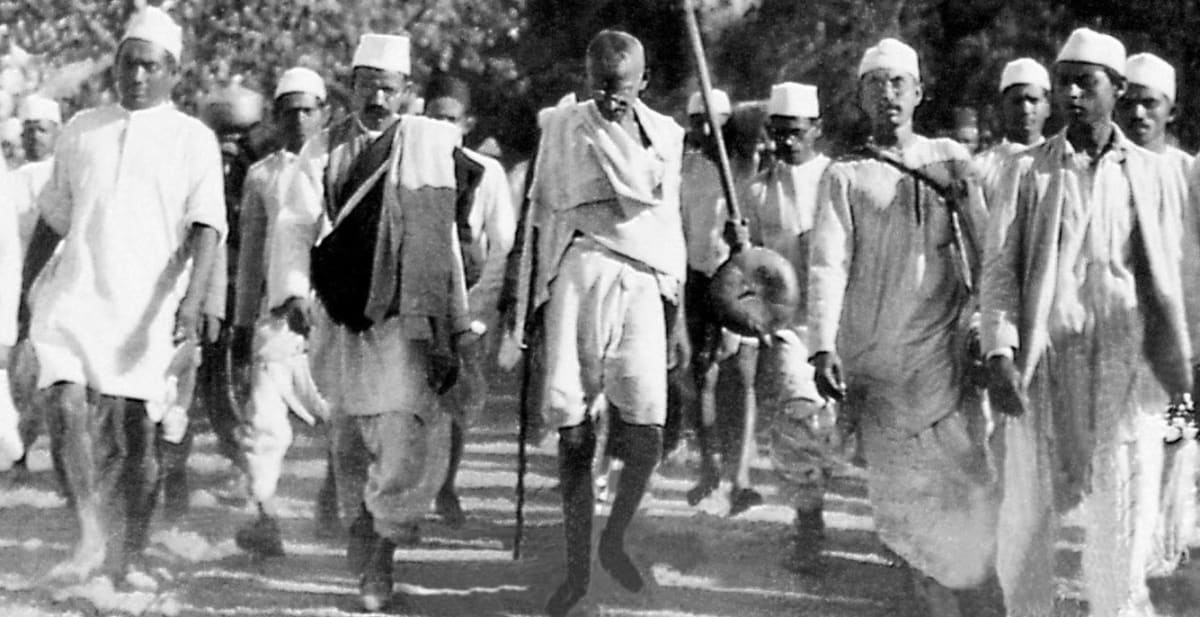
(i) Name the march being led by Gandhiji in the above picture. Which movement did this march launch?
(ii) What were the three causes of the Non-Cooperation Movement? Name the incident which led to the suspension of this movement.
(iii) Mahatma Gandhi and Lord Irwin signed a pact in 1931. Mention any two conditions that the Congress agreed to and two conditions that the British Government agreed to according to this pact.
Answer
(i) The march being led by Gandhiji in the given picture is known as the Dandi March. This march led to the beginning of the Civil Disobedience Movement of 1930.
(ii) There were three main reasons behind the Non-cooperation movement:
- Rowlatt Act: The Rowlatt Act authorised the Government to imprison any person without trial and convict him in a court. It implied:
- Arrest of a person without warrant.
- In camera trial (trial in seclusion).
- Restrictions on movements of individuals.
- Suspension of the Right of Habeas Corpus.
Gandhiji appealed to the Viceroy to withhold his consent to the Rowlatt Act. However his appeal was ignored. He started 'Satyagraha' as a challenge to the government.
Jallianwala Bagh Tragedy: Jallianwala Bagh Tragedy happened in Amritsar on April 13, 1919. On that day, peaceful gathering had assembled at Jallianwala Bagh to protest against the Rowlatt Act. Without any warning, General Dyer ordered his troops to open fire on the unarmed crowd, resulting in hundreds of deaths and thousands of injuries. It was made clear to the Indians that the British had no intention of parting with political power or sharing it with Indians.
Khilafat Movement: In the First World War Turkey was defeated and the Sultan of Turkey, who was the Caliph was deprived of all authority. The Muslim population in India started a powerful agitation known as the Khilafat Movement, under the leadership of the Ali Brothers. 'Khilafat Day' was observed on October 17, 1919 on an all-India scale. Gandhiji took the chance to unite Hindus and Muslims. Mahatma Gandhi was elected as President of the All-India Khilafat Conference in November 1919. He advised the Khilafat Committee to adopt a policy of Non-Cooperation with the Government.
Suspension of the Non-Cooperation Movement — The Non-Cooperation Movement was withdrawn by Mahatma Gandhi after the Chauri Chaura incident. Gandhiji believed in peaceful and non-violent protests, and the violent turn of events at Chauri Chaura deeply distressed him. Therefore, he withdrew the movement.
(iii) Mahatma Gandhi and Lord Irwin signed Gandhi-Irwin Pact pact in March, 1931.
Two conditions that the Congress agreed to are-
- Participation in Round Table Conference — The Indian National Congress agreed to take part in the second session of the Round Table Conference.
- Suspend Civil Disobedience Movement — The Congress agreed to suspend the Civil Disobedience Movement.
Two conditions that the British Government agreed to are-
- Withdrawal of Ordinances — The British government agreed to withdraw all ordinances and end prosecution.
- Removal of Salt Tax — The British government permitted free collection or manufacture of salt by persons near the seacoast.
The heroism of the Indians was revealed by the courage of Subash Chandra Bose and the Indian National Army. With reference to this, answer the following questions:
(i) Mention any three objectives of the Forward Bloc.
(ii) Mention any three contributions of Subash Chandra Bose.
(iii) Who was the founder of the Indian National Army? Mention any three of its objectives.
Answer
(i) Three objectives of the Forward Bloc are:
- Forward Bloc's immediate objective was liberation of India with the support of workers, peasants, youth and other organisations.
- After attaining independence, Forward Bloc would work for the establishment of a Socialist State through reorganisation of agriculture and industry on socialist lines.
- After attaining independence, Forward Bloc would work for the establishment of a Socialist State through abolition of the Zamindari system.
(ii) Three contributions of Subash Chandra Bose are:
- He led the freedom struggle outside India as the Supreme Commander of the INA. He set up the Provisional Government of Free India in Singapore.
- He declared war on Britain and the USA and acquired its first stretch of territory in India when Japan handed over Andaman and Nicobar Islands.
- The INA gave a tough fight to the British forces in the Assam hills and succeeded in capturing Ukhrul and Kohima. However, the surrender of Japan in the Second World War sealed the fate of the INA. The INA set an inspiring example of patriotism.
(iii) Netaji Subhash Chandra Bose was the founder of the Indian National Army. Three objectives of INA are:
- To organise an armed revolution and to fight the British army with modern arms.
- Since it was not possible for the Indians to organise an armed revolution from their homeland, this task must be assigned to the Indians living abroad, particularly on Indians living in East Asia.
- To organise a provisional government of Free India in order to mobilise all the forces effectively.
The world wars marked a turning point in the history of the world. With reference to this period, answer the following questions:
(i) Mention any three similarities between the ideologies of Fascism and Nazism.
(ii) State the three consequences of the Second World War.
(iii) Mention any four causes of the Second World War.
Answer
(a) Three similarities between the ideologies of Fascism and Nazism are given below:
- Both Fascism and Nazism were supporters of one party and one leader — Mussolini in Italy and Hitler in Germany.
- They were dictators through and through. No one could challenge the authority of the leader of the party. Both Mussolini and Hitler had all the military and civil powers and nobody could criticise them.
- Both Fascism and Nazism preferred the state as compared to the individual. The individual exists only for the State.
(b) Three consequences of the Second World War are given below:
- It caused a colossal loss of life and property and led to the end of dictatorship in Europe, as both Fascism in Italy and Nazism in Germany fell.
- It led to the rise of the USA and the USSR as two rival superpowers, which resulted in the Cold War.
- It led to the establishment of the United Nations Organisation (UNO) to maintain peace and security in the world.
(c) Four causes of the Second World War are given below:
- The harsh and humiliating Treaty of Versailles, which created bitterness among the Germans.
- The rise of dictatorship — Fascism in Italy and Nazism in Germany — with their aggressive and imperialist policies.
- The failure of the League of Nations to check aggression and maintain peace.
- The immediate cause was the invasion (conquest) of Poland by Hitler.
The United Nations Organisation aims to maintain international peace. With reference to its organs and agencies, answer the following:
(i) What is the composition of the Security Council? What is the term of the non-permanent members?
(ii) Mention any three functions of the General Assembly.
(iii) Give the full form of UNESCO. Mention any three of its functions.
Answer
(i) The Security Council consists of 15 members.
- It has five permanent members —
- China
- France
- Russia
- Britain
- The United States of America
- The regional representation of the ten non-permanent members is:
- Afro-Asian countries — 5
- Latin American countries — 2
- West European and other countries — 2
- East European countries — 1.
- The ten non-permanent members are elected by the General Assembly by a two-third majority for a term of two years.
- A retiring member is not eligible for immediate re-election.
- The Presidency of the Council rotates monthly, according to the English alphabetical listing of its member States.
(ii) Three functions of the General Assembly are:
- To consider and make recommendations on the principles of cooperation, in the maintenance of international peace and security.
- To consider and approve the budget of the United Nations and to apportion the contributions among members.
- To elect the non-permanent members of the Security Council, the Economic and Social Council and the Trusteeship Council, and to elect the judges of the International Court of Justice.
(iii) UNESCO stands for United Nations Educational, Scientific and Cultural Organization.
Three functions of UNESCO are:
- Removal of illiteracy by encouragement to adult education, distance-education and the open school system.
- It promotes basic research in fields like geology, mathematics, physics and oceanography. As a result, it finances engineering and technology schemes in a number of developing countries.
- It has set up regional networks, trained technicians and deals with both hardware and software aspects of informatics.