
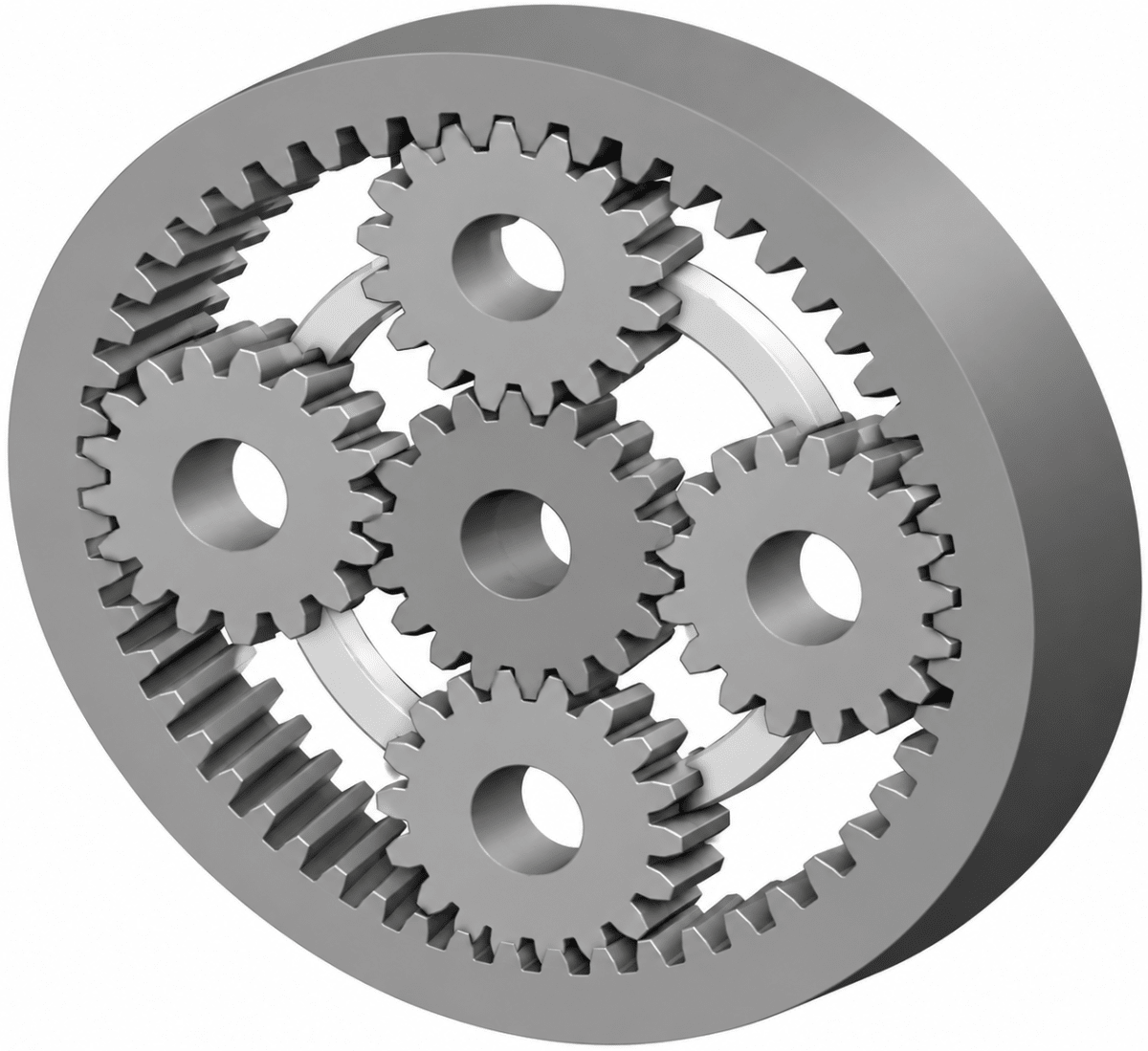
Identify the gear shown in the image given below:
- Bevel
- Worm
- Planetary
- Spur
Answer
Planetary
Reason — The figure shows a central gear surrounded by smaller gears enclosed within an outer ring, which is the arrangement of a planetary gear system. Planetary gears are frequently used in robotic arms and engines because they can transfer power very efficiently.
A city installs intelligent traffic signals that adjust signal timings based on real-time traffic flow. This is an example of:
- Traditional automation
- New Age Robotic System
- Mechanical control system
- Manual traffic regulation
Answer
New Age Robotic System
Reason — New Age Robotic Systems (NARS) are advanced systems that use sensors and artificial intelligence to sense their surroundings and take decisions on their own. Intelligent traffic signals collect real-time traffic data and change the signal timings accordingly, instead of following fixed pre-set timings.
A student is preparing a presentation on examples of New Age Robotic Systems. Which of the following should NOT be included in the presentation?
- Autonomous delivery robot
- Smart vacuum cleaner
- Collaborative robot
- Mechanical screwdriver
Answer
Mechanical screwdriver
Reason — A mechanical screwdriver is an ordinary machine. It has no sensors, controller or decision-making ability and cannot work on its own. Autonomous delivery robots, smart vacuum cleaners and collaborative robots are examples of New Age Robotic Systems.
Robots are used in ............... to monitor crop health.
- Warehouse
- Healthcare
- Agriculture
- Industrial automation
Answer
Agriculture
Reason — Robots used in the agriculture field are designed to increase efficiency, reduce costs and improve crop yields. Crop monitoring robots, such as Crop-Scout and TerraSentia, are used to monitor crop growth and health.
A robot detects the presence of an obstacle in its path. ............... sensor is used for this.
- Tactile
- Force
- Temperature
- Proximity
Answer
Proximity
Reason — Proximity sensors are non-contact sensors that detect the presence of an object when it enters the sensor's field, without touching it. Tactile and force sensors need physical contact, and a temperature sensor detects changes in temperature.
Which of the following devices is commonly found in a smart home?
- Conventional microwave oven
- Roomba vacuum cleaner
- Desktop computer
- Compass
Answer
Roomba vacuum cleaner
Reason — A home equipped with devices that help in the automation of routine tasks is called a smart home. iRobot's Roomba is a robotic vacuum cleaner that cleans floors automatically without human intervention and is a well-known example of a smart home robot.
Which software tool is commonly used by students to design and simulate robotic components virtually?
- Python
- Tinkercad
- Notepad++
- Unity
Answer
Tinkercad
Reason — Tinkercad is a freely available online software developed by Autodesk. It is used to visualise, design and create circuits, and provides 3D designs of different components, which helps in better visualisation and understanding of robotic parts.
A robotic component moves back and forth along a straight line without rotating. This movement is produced by a ............... joint.
- Revolute
- Prismatic
- Torsional
- Flexible
Answer
Prismatic
Reason — Prismatic joints are also known as linear or sliding joints. They allow the links to move in a straight line along an axis without rotating. A common example of a prismatic joint is the sliding mechanism in a drawer.
A robot designed to move on a flat surface using wheels for locomotion is a:
- Flying robot
- Legged robot
- Wheeled mobile robot
- Stationary robot
Answer
Wheeled mobile robot
Reason — A wheeled mobile robot is a robot that uses wheels for locomotion and can move autonomously or with the instructions of the user.
A spam email detection system classifies incoming emails as "Spam" or "Not Spam" based on features such as keywords, sender information and attachments. Which factor is primarily used by the system to make its decision?
- Personal preference
- Random selection
- Measured data
- Human emotions
Answer
Measured data
Reason — Machine decision-making is logical and objective. It is based on the data available to the machine and the rules or algorithms applied on it, and is not affected by emotions or personal preferences. Here, the system uses the measured data of each email, such as keywords, sender information and attachments, to classify it.
What is the first step in developing a Machine Learning system to recognise traffic signs for autonomous vehicles?
- Writing the final algorithm
- Collecting and organising data
- Making predictions
- Training the robot physically
Answer
Collecting and organising data
Reason — The first step in machine learning is data collection. To prepare a machine learning system, related data must be collected and then prepared, that is, cleaned and transformed, before an algorithm is selected and trained.
What is the first stage of the AI Project Framework?
- Data Acquisition
- Modelling
- Problem Scoping
- Evaluation
Answer
Problem Scoping
Reason — The AI Project Framework consists of five stages — Problem Scoping, Data Acquisition, Data Exploration, Modelling and Evaluation. Problem Scoping is the first stage, in which the problem is understood and defined, clear goals are set and the objectives of the AI project are outlined.
What do the 4 W's in AI problem scoping stand for?
- Who, What, Why, When
- Who, What, Where, Why
- Why, Where, When, What
- Where, Who, What, When
Answer
Who, What, Where, Why
Reason — The 4Ws Problem Canvas helps in problem scoping. It consists of four parameters — Who (the stakeholders affected by the problem), What (the nature of the problem and its evidence), Where (the context or location of the problem) and Why (why the problem is worth solving).
An AI system follows predefined IF–THEN rules and does not learn from new data. This system is best described as:
- Learning-based AI
- Supervised learning system
- Unsupervised learning system
- Rule-based AI system
Answer
Rule-based AI system
Reason — A rule-based system works only on the predefined rules written in its program. It cannot learn from its environment or from new data. Systems that learn from data, such as supervised and unsupervised learning systems, work on the basis of learning and not on fixed rules.
What will be the output of the following Python code?
x = 5
print(x + 2)
- 5
- 2
- 7
- 52
Answer
7
Reason — The variable x stores the integer value 5. In the statement print(x + 2), the + operator acts as the arithmetic addition operator because both operands are integers. So the expression is evaluated as 5 + 2 = 7.
What will be the output of the following Python code?
numbers = [10, 20, 30]
print(len(numbers))
- 2
- 3
- 20
- 30
Answer
3
Reason — The list numbers contains three elements — 10, 20 and 30. The function len() returns the number of elements present in the list, not their values.
Statement I: All machines are robots.
Statement II: Robots are only controlled manually and cannot work autonomously.
- Both statements I and II are correct.
- Both statements I and II are incorrect.
- Statement I is correct, but statement II is incorrect.
- Statement I is incorrect, but statement II is correct.
Answer
Both statements I and II are incorrect.
Reason — Statement I is incorrect because every robot is a machine, but every machine is not a robot. An ordinary machine, such as a room heater, has no sensors, controller or decision-making ability.
Statement II is also incorrect because robots can work autonomously, that is, without human intervention, as well as with the support of humans. For example, a self-driving car is an autonomous vehicle that can operate without a human driver.
Statement I: A gear system can be used to amplify force in robotic joints.
Statement II: Changing the gear ratio changes the torque and speed in the system.
- Both statements I and II are correct.
- Both statements I and II are incorrect.
- Statement I is correct, but statement II is incorrect.
- Statement I is incorrect, but statement II is correct.
Answer
Both statements I and II are correct.
Reason — Statement I is correct because gears are used in a robotic system to transmit motion and power and also to amplify force.
Statement II is also correct because the gear ratio depends on the number of teeth on the driving and driven gears. By choosing a suitable gear ratio, a robot can increase either its torque (force) or its rotational speed.
Machine decisions are influenced by emotions and personal experiences.
- True
- False
Answer
False
Reason — Machine decision-making is objective and logical. Machines make decisions using the data available to them and programmed algorithms or rules, and are unaffected by feelings or preconceived notions. Being influenced by emotions, prejudices and experiences is a characteristic of human decision-making, not machine decision-making.
In a robotic system, the controller processes sensor inputs and decides the actions of actuators.
- True
- False
Answer
True
Reason — The controller is the brain of a robotic system. It receives the input sent by the sensors, processes it using control algorithms, takes decisions and then sends control signals to the actuators, which perform the required physical action.
State any two features that enable a robot to perform tasks with minimal human intervention.
Answer
Two features that enable a robot to perform tasks with minimal human intervention are:
- Sensing — Robots are equipped with sensors that allow them to detect and respond to changes in their environment.
- Autonomy — Robots can be programmed to perform tasks automatically without requiring constant human supervision.
Mention any two features that distinguish a robot from an ordinary machine.
Answer
Two features that distinguish a robot from an ordinary machine are:
- A robot uses sensors to take input from its environment and its controller processes this input to take decisions, whereas an ordinary machine only performs a fixed task and cannot take decisions.
- A robot is programmable and can be reprogrammed to perform different tasks, whereas an ordinary machine performs a single, simple task that cannot be reprogrammed.
An automatic door opens when a person approaches it. What role does the controller play in this system?
Answer
The controller receives the signal sent by the sensor when it detects the presence of a person near the door. It processes this input, takes the decision that the door should open, and sends the required control signal to the actuator (motor), which opens the door. Thus, the controller acts as the link between the sensor and the actuator.
What is the RR mechanism in robotics? Mention one application where it is commonly used.
Answer
The RR (Revolute–Revolute) mechanism means the use of two revolute joints in series, which allows rotational movement about two axes.
Application:
The RR mechanism is commonly used in a robotic arm, where the two revolute joints are placed at the shoulder and the elbow.
"Artificial Intelligence and Machine Learning are the same." Do you agree with the statement? Justify your answer with one reason.
Answer
No, I do not agree with the statement.
Artificial Intelligence is the broader field that includes any method or algorithm that helps make machines intelligent, whereas Machine Learning is a subset of Artificial Intelligence that enables software programs to learn from historical data and predict outcomes without being explicitly programmed.
Differentiate between a Touch Sensor and a Proximity Sensor.
Answer
| Touch Sensor | Proximity Sensor |
|---|---|
| It is a contact-type sensor that detects an object only when physical contact or pressure is applied to its surface. | It is a non-contact sensor that detects the presence of an object without touching it. |
| It requires physical contact to generate a signal. | It can use sensing methods such as infrared or ultrasonic sensing to detect nearby objects without physical contact. |
The number of teeth on driven gear is 30 and on driving gear is 15. Find the gear ratio.
Answer
Given:
Number of teeth on driven gear = 30
Number of teeth on driving gear = 15
The formula for gear ratio is:
Substituting the values:
Hence, the gear ratio is 2 : 1.
An autonomous vehicle detects an obstacle and stops automatically. State any two characteristics of machine decision-making demonstrated in this situation.
Answer
Two characteristics of machine decision-making demonstrated here are:
- Logical — The vehicle acts according to the pre-programmed rules and the sensor data available to it, and stops when an obstacle is detected.
- Fast — The machine takes the decision to stop far more quickly than a human, which is very useful in such time-sensitive situations.
What is the Turing Test? What does it determine about a machine?
Answer
The Turing Test was proposed by Alan Turing in 1950. In this test, an evaluator has a conversation with a human and a machine simultaneously and checks the responses given by both.
It determines the intelligence of a machine. If the evaluator finds no difference between the responses generated by the human and the machine, then the machine is considered to have passed the Turing Test.
Why is Problem Scoping an important stage in the AI Project Framework?
Answer
Problem Scoping is important because:
- It clearly defines the problem to be solved and sets the goals and objectives of the AI project.
- It identifies the stakeholders and the context of the problem, providing direction for the later stages of the project.
A city plans to introduce autonomous buses to improve public transportation. The city also wants to use AI to analyse traffic patterns and reduce congestion.
Based on the above scenario:
(a) State one characteristic of the autonomous bus.
(b) Explain how the bus detects obstacles while moving.
(c) Mention one advantage of using AI in managing public transportation.
Answer
(a) The autonomous bus can operate on its own without human intervention, as it uses sensors and AI to take decisions according to the situation on the road.
(b) The bus is fitted with a variety of sensors, such as radar, cameras, lidar and proximity sensors, which continuously observe the surroundings. When an object comes into the sensor's field, the sensor sends this input to the controller, which processes it and instructs the actuators to slow down, stop or change lanes to avoid the obstacle.
(c) AI can analyse traffic patterns in real time and optimise signal timings and routes, which helps in reducing traffic congestion.
A company is developing an AI system to sort recyclable waste. Mention:
(a) one type of data required.
(b) one factor that can improve the accuracy of the AI model.
(c) one expected outcome.
Answer
(a) Labelled images of recyclable and non-recyclable waste materials are required as training data.
(b) Quality of training data — Using accurate and correctly labelled training data can improve the accuracy of the AI model.
(c) The system will be able to classify waste accurately into recyclable and non-recyclable categories.
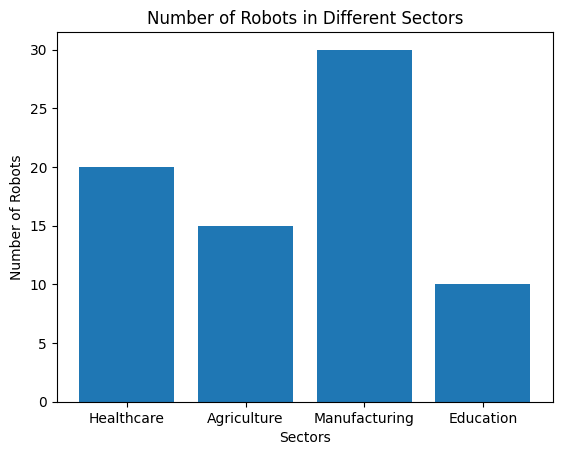
Write a Python program using the Matplotlib library to display the number of robots used in different sectors as shown below:
| Sector | Number of Robots |
|---|---|
| Healthcare | 20 |
| Agriculture | 15 |
| Manufacturing | 30 |
| Education | 10 |
The program should:
1. Import the required Matplotlib library.
2. Create suitable lists for sectors and the corresponding number of robots.
3. Plot a bar graph.
4. Label the X-axis as "Sectors".
5. Label the Y-axis as "Number of Robots".
6. Give the graph a suitable title.
7. Display the graph.
Answer
import matplotlib.pyplot as plt

sectors = ['Healthcare', 'Agriculture', 'Manufacturing', 'Education']
robots = [20, 15, 30, 10]

plt.bar(sectors, robots)
plt.xlabel("Sectors")
plt.ylabel("Number of Robots")
plt.title("Number of Robots in Different Sectors")
plt.show()
Output
A robotic arm in a packaging unit uses a motor, gears and a gripper to move heavy boxes from one conveyor belt to another.
Based on the above information, explain:
(a) any one role of gears in the robotic arm, and
(b) two ways in which changing the gear ratio can affect the force and speed of movement.
Answer
(a) The gears transmit the motion and power generated by the motor to the robotic arm and the gripper through the interlocking of gear teeth.
(b) Two ways in which changing the gear ratio affects the force and speed of movement are:
- Increasing the gear ratio, that is, using a driven gear with more teeth than the driving gear, increases the torque (force) available at the gripper but decreases the speed of movement. This is useful for lifting heavy boxes.
- Decreasing the gear ratio, that is, using a driven gear with fewer teeth than the driving gear, increases the rotational speed of the arm but decreases the torque (force). This is useful for moving lighter boxes quickly.
The employees of a company receive an email asking them to click on a link and enter their login credentials. Identify the possible cyber threat and explain any two precautions to be taken by the employees.
Answer
Cyber threat: Phishing.
In a phishing attack, the received email looks like a genuine message from a well-known or reputed organisation. It contains a link which, when clicked, takes the user to a fake website that is a clone of the original site. If the user enters their credentials there, the details are stolen by the fraudster.
Two precautions to be taken by the employees are:
- They should be wary of emails or messages that ask for personal information. If an email appears suspicious, they should not click on any link or open any attachment in it.
- They should not provide personal or login information unless they are confident that the website is genuine, and should use strong passwords and update them frequently.
Write a Python program to:
1. Create a string "Hardwork pays"
2. Print the characters from index 3 to 9
3. Convert the string str to upper case and store in str1
4. Check if the string ends with 'S'. Print a boolean value as the output.
5. Replace the word 'Hardwork' with 'Earnest work'
6. Print the new string
7. Join the word 'OFF' at the end of the string
str = "Hardwork pays"

print(str[3:10])

str1 = str.upper()
print(str1.endswith('S'))

str2 = str.replace('Hardwork', 'Earnest work')
print(str2)

str3 = ' '.join([str2, 'OFF'])
print(str3)dwork p
True
Earnest work pays
Earnest work pays OFF
A delivery robot is carrying a parcel when it detects that its usual route is blocked. Explain how the robot makes decisions to complete the delivery safely.
Answer
The delivery robot completes the delivery safely in the following manner:
- Its sensors detect the obstacle or blocked route and send this input to the controller.
- The controller processes the sensor data and selects a safe alternate path to reach the destination. If no safe route is available, the robot stops.
- The controller sends commands to the actuators to move the robot along the selected path. Updated sensor inputs provide continuous feedback so that the controller can adjust the path until the parcel is delivered safely.
Explain any three factors that influence the accuracy of a Machine Learning model.
Answer
Three factors that influence the accuracy of a Machine Learning model are:
- Quality of data — Data quality is an important factor in the success of a machine learning model. If the data has noise or wrong information, the predictions generated by the model will not be correct.
- Quantity of data — A large amount of data is required to create an accurate and precise machine learning model, as the algorithm learns the important features from this data.
- Selection of algorithm — An appropriate machine learning algorithm must be chosen according to the data and requirement. For example, if the data has labels, a supervised learning algorithm should be selected, otherwise an unsupervised learning algorithm should be used.
With the help of a neat, labelled diagram, explain the role and working of a robotic system using the following components:
- Sensors
- Controller
- Actuators
Answer

A robot is designed through the integration of sensors, a controller, actuators and a feedback system. The success of the robot depends on the proper functioning and coordination of all these components.
Sensors: Sensors are the input devices of a robot. They detect changes in the environment based on features like temperature, pressure, light, sound and distance, and convert them into signals that are sent to the controller. Commonly used sensors are proximity sensors, ultrasonic sensors, cameras and force sensors.
Controller: The controller is the brain of the robot. It receives the input from the sensors, processes it using different control algorithms and takes decisions about the action to be performed. It then generates and sends the control signals to the actuators.
Actuators: Actuators are the devices that produce the physical movement of the robot. They convert the electrical signal received from the controller into mechanical motion and move parts such as arms, legs, wheels or grippers. Commonly used actuators are electric motors and pneumatic or hydraulic cylinders.
Working: The sensors sense the environment and send the data to the controller. The controller processes this data, takes a decision and sends commands to the actuators, which perform the required physical action. The sensors then observe the resulting output or changes in the environment and send updated information to the controller as feedback. This helps the controller make corrections and keep the output in the desired range.
Discuss any three ways in which Machine Intelligence differs from traditional computer programs.
Answer
| Machine Intelligence | Traditional Computer Programs |
|---|---|
| It learns from data and improves its performance with experience. | It follows fixed step-by-step instructions written by the programmer and does not improve on its own. |
| It works on the concept of pattern recognition using a huge amount of related data. | It works on predefined rules and is suitable only for deterministic problems. |
| It can make predictions and take decisions in new or uncertain situations. | It produces a fixed and predictable output for a given input. |
State any three problems that may arise if data is not prepared properly before training a Machine Learning model.
Answer
Three problems that may arise are:
- If the data has noise or wrong information, the predictions generated by the model will not be correct, and the accuracy of the model will be low.
- If the collected data is not in a form compatible with the algorithm, the algorithm will not be able to learn the important features from it during training.
- If missing, duplicate or inconsistent data is not handled during preparation, the model may learn incorrect patterns and produce unreliable predictions.
A recycling plant wants to use Tinkercad to design its waste segregation system. With reference to the given scenario, answer the following questions:
(a) Explain two ways in which Tinkercad can help in designing the system.
(b) Mention the type of joint used for segregating wet waste and dry waste with a reason.
(c) Why should the model be visualised before it is used?
Answer
(a) Two ways in which Tinkercad can help are:
- Tinkercad provides 3D designs of different components, so the plant can design and visualise the physical parts of the segregation system, such as the bins, the sorting arm and its joints, before actually building them.
- Tinkercad is used to visualise, design and create circuits, so the sensor and motor circuit that separates the wet and dry waste can be built and simulated virtually to check whether it works correctly.
(b) A revolute joint should be used. A revolute joint, also known as a rotary joint, allows the links to rotate around an axis. This rotational movement lets the sorting arm or flap turn towards the wet waste bin or the dry waste bin as required.
(c) The model should be visualised before it is used because:
- It helps in understanding the design clearly.
- It helps to identify and correct errors in the design at an early stage.
- It confirms that the components work together as expected before the system is built, saving time and cost.
A robot is used in a bakery to decorate cakes. Explain any three features that make robots suitable for this task.
Answer
Three features that make robots suitable for decorating cakes are:
- Accuracy — Robots are capable of performing tasks with a high degree of accuracy and precision, so the decoration on every cake is neat and exactly as designed.
- Consistency — Robots can repeat the same task again and again without making mistakes, which ensures that all the cakes are decorated in a uniform manner.
- Programmability — Robots can be programmed and reprogrammed to perform different tasks, so the same robot can be used to create different decoration patterns as per the order.
State any three advantages of using robots in modern manufacturing industries.
Answer
Three advantages of using robots in modern manufacturing industries are:
- Increased efficiency — Robots can work faster and longer than humans without getting tired or needing breaks, which increases the production output.
- Increased quality — Robots perform tasks with a high degree of accuracy and precision, which reduces errors and defects in production.
- Human safety — Robots can perform dangerous tasks, such as handling toxic material, welding or working in extreme temperatures, which would otherwise put human workers at risk.
The hospital wants to upgrade the robotic assistant with AI capabilities.
Answer the following:
(a) Explain how machine learning can help the robot improve its performance over time.
(b) Explain two cybersecurity risks that may affect the robotic assistant and measure to prevent them.
(c) The robotic assistant must identify the correct medicine for each patient. Explain how AI helps the robot perform this task accurately.
Answer
(a) Machine learning can help the robot improve its performance over time in the following ways:
- It learns important features and patterns from historical hospital data.
- Its predictions and decisions become more accurate as it is trained on relevant data.
- With further training on new data, it can adapt to new situations and improve its performance.
(b) Two cybersecurity risks and preventive measures are:
- Unauthorised access — An unauthorised person may gain access to the robot's settings or patient data. This can be prevented by using strong authentication and secure passwords.
- Malware attack — Malware may corrupt the robot's software or steal patient data. This can be prevented by installing regular software updates and using trusted antivirus or antimalware software.
(c) AI helps the robotic assistant identify the correct medicine in the following way:
- It analyses the patient's information and prescription details.
- It compares the medicine label or barcode with the prescription data using a trained model.
- It identifies and dispenses the correct medicine, reducing the chances of medication errors.
Explain any three benefits of using robotics and AI in agriculture.
Answer
Three benefits of using robotics and AI in agriculture are:
- Crop monitoring — AI algorithms analyse satellite pictures, drone data and sensor data to track crop health, growth patterns and nutrient levels, which helps farmers improve pest control, fertilisation and irrigation methods.
- Precision agriculture — AI optimises the use of resources by analysing soil characteristics, weather patterns and previous crops, and uses this to design precise planting patterns and specialised irrigation schedules.
- Harvesting and sorting — Robots such as fruit picking robots can harvest fruits and vegetables with minimal damage to the crops, and AI-enabled systems sort them on the basis of size, colour and other quality indicators. This increases efficiency and reduces labour costs.
A supermarket plans to develop an AI system to identify products that are placed on the wrong shelves. State:
(a) one type of data required,
(b) one factor that can improve the accuracy of the AI model,
(c) one expected outcome of the system.
Answer
(a) Labelled images of the shelves, showing correctly and incorrectly placed products, captured through cameras installed in the supermarket.
(b) Quality of training data — Using accurate and correctly labelled training data can improve the accuracy of the AI model.
(c) The system will be able to identify misplaced products accurately.
Write a Python program that performs the following task:
1. Create a tuple having elements (50,60,70,80,90).
2. Convert the above tuple to list.
3. Sort all the elements in descending order.
4. Remove the element 80 from the above list and print the list.
5. Sort the above in ascending order.
6. Convert the final list to tuple.
7. Print the final tuple.
Answer
t = (50, 60, 70, 80, 90)

l = list(t)

l.sort(reverse=True)

l.remove(80)
print(l)

l.sort()

ft = tuple(l)
print(ft)[90, 70, 60, 50]
(50, 60, 70, 90)