
Physics
A 50 kg mass is being lifted by using a 1 metre long lever. If the length of the lever is reduced by 20%, how much more or less force is to be applied to achieve the same torque?
Force
220 Likes
Answer
In first case,
mass = 50 kg
Initial length = R = 1m
F1 = mg = 50 x 9.8 = 490 N
Torque 1 = R x F1 = 1 x 490 = 490 Nm
Now in second case,
New length = r = R - 20% x R = R - 0.2 R = 0.8 R = 0.8 x 1 = 0.8m
Let required force = F2
So,
Torque 2 = r x F2 = 0.8 x F2
According to the question,
Torque 1 = Torque 2
490 = 0.8 x F2
F2 = = 612.5N
Here, F2-F1 = 612.5 - 490 = 122.5 N
∴ Force required to produce the same torque will increase by 122.5 N
Answered By
150 Likes
Related Questions
A nut is opened by a wrench of length 25 cm. If the least force required is 10 N, find the moment of force needed to turn the nut.
A wheel of diameter 2m is shown in figure with axle at O. A force F = 2N is applied at B in the direction shown in figure.
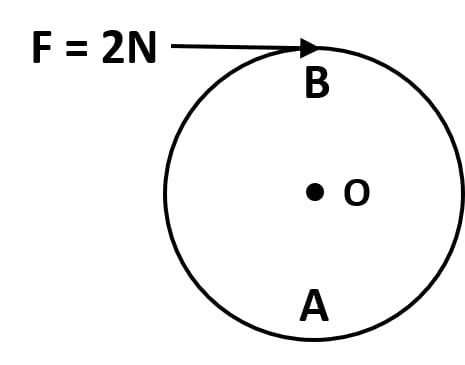
Calculate the moment of force about
(i) the centre O, and
(ii) the point A.
A mechanic applies a force of 100 N at the end of a spanner to tighten a bolt. The length of the spanner is 0.5 metres. How much torque is exerted on the bolt? If the mechanic increases the force applied by 20% but holds the spanner closer at 0.4 metres, would it result in an increase or decrease of torque?
A steering wheel of diameter 0.5m is rotated anti-clockwise by applying two forces each of magnitude 6N. Draw a diagram to show the application of forces and calculate the moment of forces applied.