Physics
A man of mass 50 kg climbs up a ladder of height 15m.
Calculate:
(i) the work done by the man,
(ii) the increase in his potential energy.
(g = 9.8 m s-2).
Related Questions
Calculate the height through which a body of mass 0.5 kg is lifted if the energy spent in doing so is 1.0 J. Take g = 10ms-2.
A boy weighing 50 kgf climbs up from the first floor at a height of 3 m above the ground to the third floor at a height of 9 m above the ground. What will be the increase in his gravitational potential energy?
(Take g = 10 N kg-1).
A block A, whose weight is 100N, is pulled up a slope of length 5m by means of a constant force F (=100N) as illustrated.
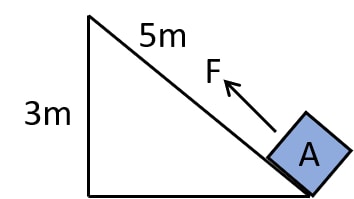
(a) What is the work done by the force F in moving the block A, 5m along the slope?
(b) What is the increase in potential energy of the block A?
(c) Account for the difference in the work done by the force and the increase in potential energy of the block.
Find the kinetic energy of a body of mass 5 kg moving with a uniform velocity of 10 m s-1.