
Physics
(a) Mention one difference between reflection of light from a plane mirror and total internal reflection of light from a prism.
(b) When an empty test tube is placed in a beaker of water and viewed from above, its surface appears as a mirror. Explain.
Refraction Plane Surfaces
5 Likes
Answer
(a) Difference between reflection of light from a plane mirror and total internal reflection of light from a prism are:
| Plane mirror | Prism |
|---|---|
| In reflection of light from a plane mirror, only a part of the light is reflected while rest is refracted and absorbed. So, the reflection is partial. | In total internal reflection of light from a prism, the entire incident light is reflected back into the denser medium. So there is no loss of light energy. |
(b) Total internal reflection occurs when light traveling through a medium with a higher refractive index (such as water) encounters a boundary with a medium of lower refractive index (such as air) at an angle greater than the critical angle. In this case, the water acts as a more optically dense medium than air.
As a result, the light reflects completely back into the water instead of passing into the air above the test tube. This reflection creates a mirror-like effect on the surface of the water inside the test tube when viewed from above, giving the appearance of a mirror.
Answered By
2 Likes
Related Questions
Suggest one effective process for the safe disposal of nuclear waste.
A boy uses monochromatic green light to find the refractive index. When a ray of monochromatic green light enters in a liquid medium from air medium as shown in the figure given below, the angle 1 is 45° and angle 2 is 30°.
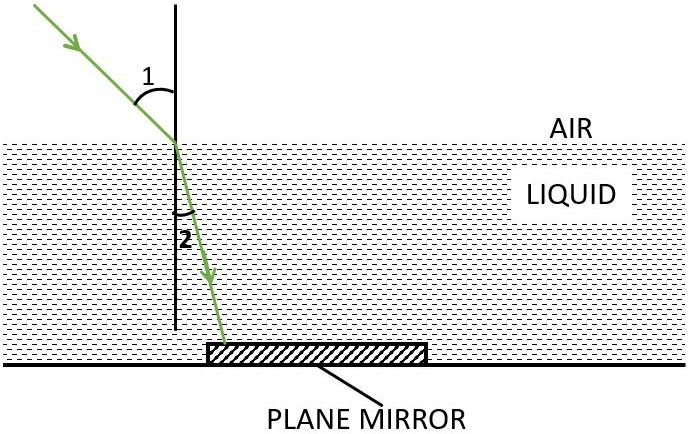
(a) Determine the refractive index of the liquid.
(b) Represent in the diagram showing the path of the ray after it strikes the mirror and re-enters air. Mark in the diagram wherever necessary.
(c) Draw the diagram again, if plane mirror becomes normal to the refracted ray inside the liquid. Name the principle used.
If a light of a single colour is passed through a liquid having a piece of glass suspended in it, so on changing the temperature of the liquid, at a particular temperature, the glass piece is not seen.
(a) At what situation, the glass piece will not be seen?
(b) Why the light of a single colour is used?
(c) How can you define the term refractive index of a medium? State whether it can be less than 1 or not.
(a) Define power of a lens.
(b) A child is using a spectacle with power of -2.5D. What is meant by the negative sign?
(c) Find the focal length of the lens used.