
Chemistry
(a) State whether the following statements are True or False.
Electrovalent compounds have low melting point.
Carbon tetrachloride will conduct electricity only in aqueous solution state.
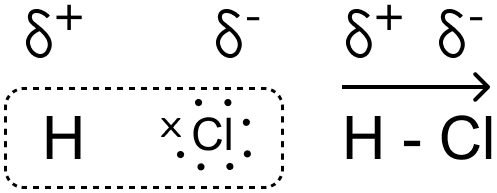
(b) Give reason - Hydrogen chloride can be termed as a polar covalent compound.
Chemical Bonding
5 Likes
Answer
(a)
False
Reason — Electrovalent compounds have a high melting point and boiling point because there exists a strong force of attraction between the oppositely charged ions, so a large amount of energy is required to break the strong bonding force between ions.False
Reason — Carbon tetrachloride (CCl4) is a liquid that does not conduct electricity because it is a non-polar covalent compound. In the case of CCl4, carbon atom shares electrons with four chlorine atoms. The electrons are shared equally between the atoms, and the molecule has no permanent dipole moment, meaning there is no separation of charge. Therefore, there are no ions present in the compound, and no free electrons to carry an electrical current.
(b) Chlorine exhibits a higher electronegativity than hydrogen, causing it to attract the shared pair of electrons towards itself in the bond. As a result, chlorine develops a slight negative charge and hydrogen develops a slight positive charge. Hence, the bond formed between hydrogen and chlorine is termed a polar covalent bond, and the compound is classified as a polar covalent compound.
Answered By
1 Like
Related Questions
X[2, 8, 8, 1] and Y[2, 8, 18, 7] are two elements. Using this information complete the following:
(a) …………… is the metallic element.
(b) Formula of the molecule of Y is ……………
(c) …………… is bad conductor of electricity.
Identify the anion present in each of the following compounds.
(a) Compound Z which on reacting with dilute sulphuric acid liberates a gas which has no effect on acidified potassium dichromate but turns lime water milky.
(b) The solution of compound L on reacting with freshly prepared ferrous sulphate solution followed by addition of few drops of concentrated sulphuric acid to the reactants along the sides of a test tube forms a brown ring at the junction of the two liquids.
(a) Neeraj observed that the stain of curry on a white shirt becomes reddish brown when baking soda is scrubbed on it, but it turns yellow again when the shirt is washed with plenty of water. What might be the reason for his observation?
(b) Write the equation for the preparation of ethanoic acid from ethanol.
Choose the correct word which refers to the process of electrolysis from A to C to match the description 1 to 3.
A : Oxidation
B : Cathode
C : An electrolyte(1) Can conduct electricity in aqueous or in molten state ……………
(2) Loss of electron takes place at anode is called ……………
(3) A reducing electrode is ……………