
Physics
A substance changes from it's solid state to the liquid state when heat is supplied to it
(a) Name the process.
(b) What name is given to heat absorbed by the substance.
(c) How does the average kinetic energy of molecules of the substance change.
Calorimetry
94 Likes
Answer
(a) The process is known as melting.
(b) The heat absorbed by the substance is called the latent heat of melting.
(c) The average kinetic energy of the molecules does not change as there is no change in temperature.
Answered By
61 Likes
Related Questions
River Ganga originates from the melting of snow of Gangotri glacier. Why does the snow of the glacier not melt at once ? Explain.
(a) What do you understand by the change of phase of a substance?
(b) Is there any change in temperature during the change of phase?
(c) Does the substance absorb or liberate any heat during the change of phase?
(d) What is the name given to the energy absorbed during a phase change?
The diagram below shows the change of phases of a substance on a temperature-time graph on heating the substances at a constant rate.
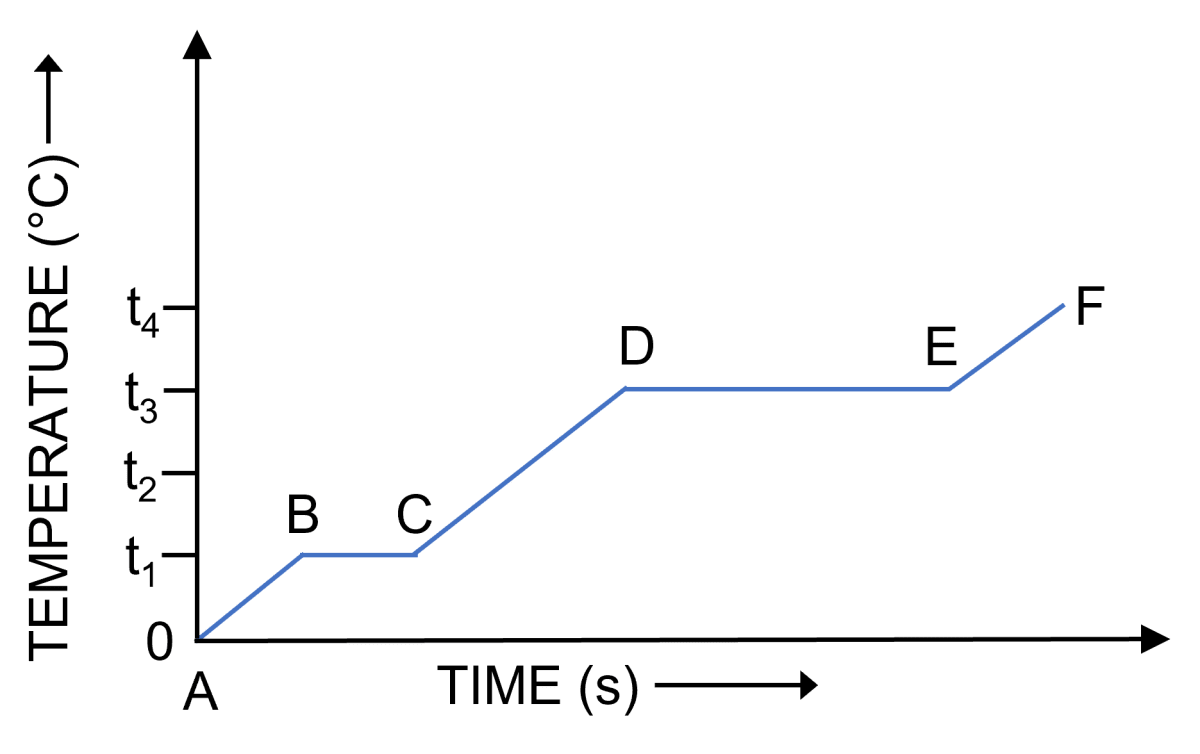
(a) What do parts AB, BC, CD and DE represent?
(b) What is the melting point of the substance?
(c) What is the boiling point of the substance?
The melting point of naphthalene is 80° C and the room temperature is 25°. A sample of liquid naphthalene at 90° is cooled down to room temperature. Draw a temperature-time graph to represent this cooling. On the graph mark the region which corresponds to the freezing process.