
Mathematics
A(-2, 4) and B(-4, 2) are reflected in the y-axis. If A' and B' are images of A and B respectively.
(i) Find the co-ordinates of A' and B'.
(ii) Assign a special name to quadrilateral AA'B'B.
(iii) State whether AB' = BA'.
Reflection
5 Likes
Answer
(i) From graph,
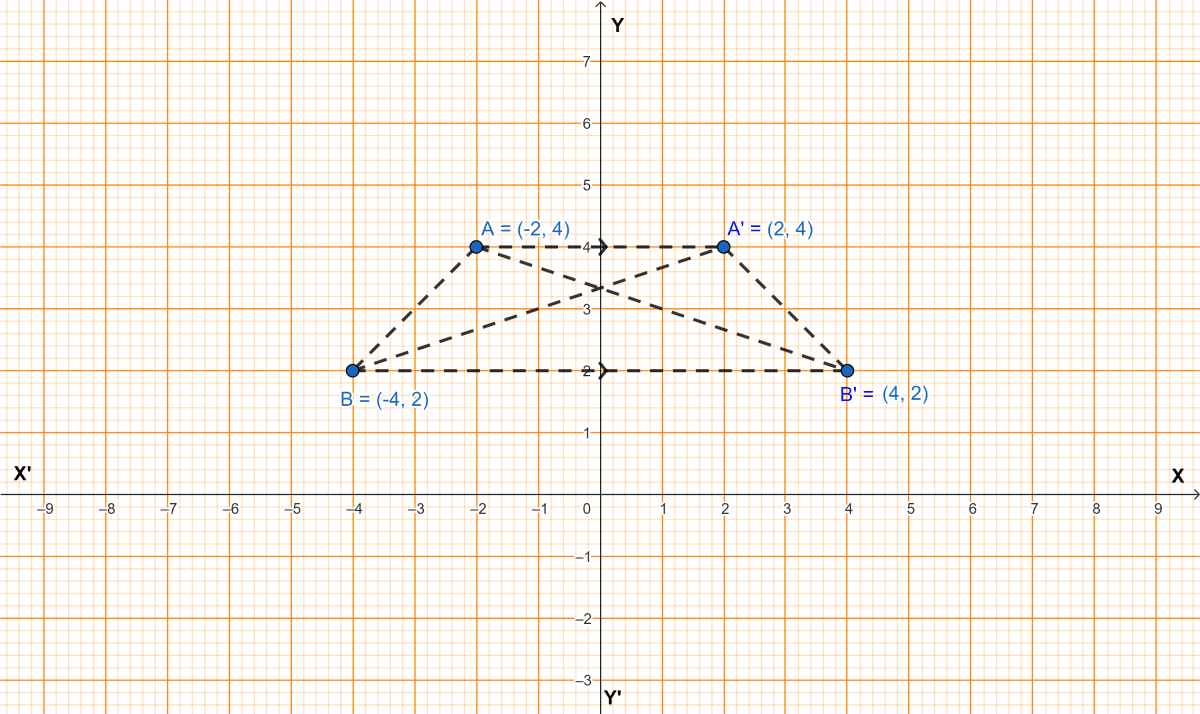
Co-ordinates of A' = (2, 4) and B' = (4, 2).
(ii) By distance formula,
Distance =
Substituting values we get :
Since, non-parallel sides are equal.
Hence, AA'B'B is an isosceles trapezium.
(iii) We know that,
In isosceles trapezium diagonals are equal.
Hence, AB' = BA'.
Answered By
2 Likes
Related Questions
A solid is in the form of a right circular cylinder with a hemispherical shape at one end and a cone at the other end. Their common diameter is 4.2 cm and the heights of the cylindrical and conical portions are 12 cm and 7 cm respectively. Find the volume of the solid.
If 2PA = 3PB, find :
(i) co-ordinates of points A and B.
(ii) equation of line AB.

Find the amount of bill for the following inter-state transaction of goods/services :
MRP (in ₹) Discount % GST % 950 32 28 1200 30 12 1500 28 18 1800 40 5 Solve the following equation by using quadratic formula :
, x ≠ 0, giving answer correct to two significant figures.