Physics
AB is an object and PQ is its real, inverted image. The lengths of AB and PQ are equal. This is possible when a lens is present between the object and its image.
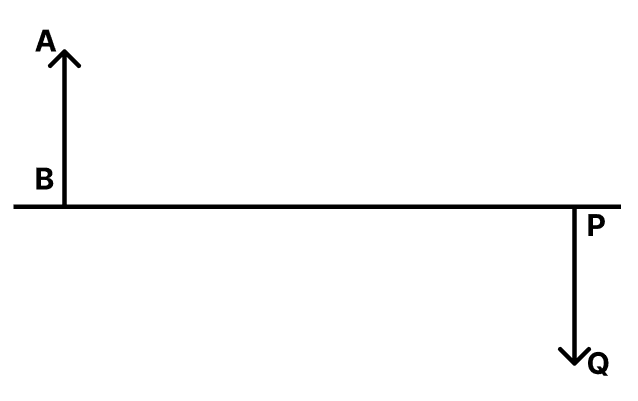
(a) What kind of lens is used here? Also, state the position of the lens and where it is to be placed.
(b) Name a device where this lens action is used.
Answer
(a) Convex lens, at the midpoint of the distance between the object and the image.
(b) Photocopier
Explanation:
(a) The diagram shows a real, inverted image (PQ) of the object (AB) with equal size, which gives us a strong clue that this behaviour is characteristic of a convex lens. When an object is placed at 2F (twice the focal length) from a convex lens : The image is also formed at 2F on the other side.So,
- Lens used : Convex lens
- Position of object : At 2F
- Position of lens : Exactly midway between the object (AB) and image (PQ), since both are at 2F from the lens.
(b) Photocopier / xerox machine / intermediate lens in a terrestrial telescope.
Related Questions
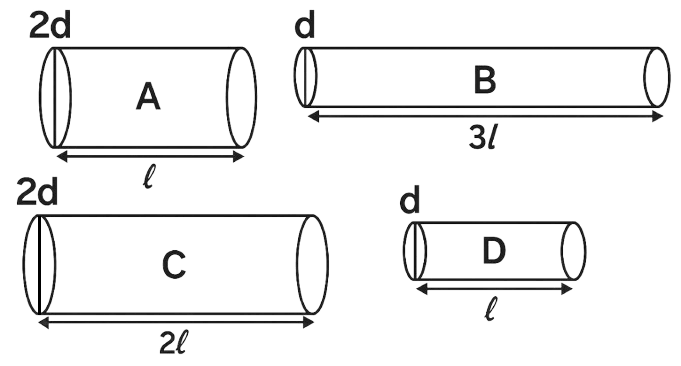
In the below diagram, calculate the ratio of the resistances A, B, C and D.
There are two copper wires of length ratio 1:2 that have their cross-sectional areas in the ratio 1:4. What will be the ratio of their:
(a) resistances?
(b) specific resistances?The two metals A and B have their specific heat capacities in the ratio 2:3. If they are supplied the same amount of heat, then
(a) which metal piece will show a greater rise in temperature if their masses are the same?
(b) calculate the ratio in which their temperatures rise, if the mass ratio of metal A and metal B is 3:5.
Soumya took two right circular cones of the same vertical height. One of the two cones is a solid one, while the other is hollow from inside. By measuring the cross-sectional areas of the cones and from the knowledge of symmetry, by using suitable formulas, he found the positions of the centre of gravity of both cones. He found that the difference is about 1.5 cm. What is the vertical height of the two cones?