
Mathematics
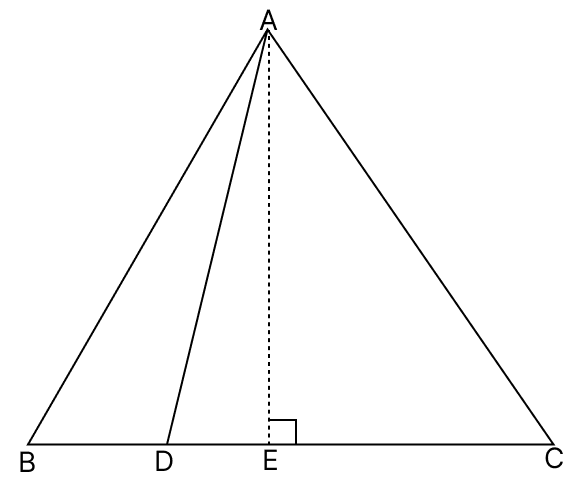
In △ABC, if AB = AC and D is a point on BC. Prove that AB2 - AD2 = BD × CD.
Pythagoras Theorem
1 Like
Answer
ABC is a triangle in which AB = AC and D is any point on BC.
In △ ABE and △ ACE,
⇒ AB = AC (Given)
⇒ AE = AE (Common)
⇒ ∠AEB = ∠AEC (both are 90°)
Using RHS congruency criterion,
△ ABE ≅ △ ACE
⇒ BE = CE (by C.P.C.T.)
In △ ABE, using Pythagorean theorem,
Hypotenuse2 = Base2 + Height2
⇒ AB2 = AE2 + BE2 ……(1)
In △ ADE, using Pythagorean theorem,
⇒ AD2 = AE2 + DE2 ……(2)
Subtracting equation (2) from (1), we get:
⇒ AB2 - AD2 = (AE2 + BE2) - (AE2 + DE2)
⇒ AB2 - AD2 = AE2 + BE2 - AE2 - DE2
⇒ AB2 - AD2 = BE2 - DE2
⇒ AB2 - AD2 = (BE - DE)(BE + DE)
⇒ AB2 - AD2 = (BE - DE)(CE + DE) [∴ BE = CE]
⇒ AB2 - AD2 = BD × CD
Hence, proved that AB2 - AD2 = BD × CD.
Answered By
1 Like
Related Questions
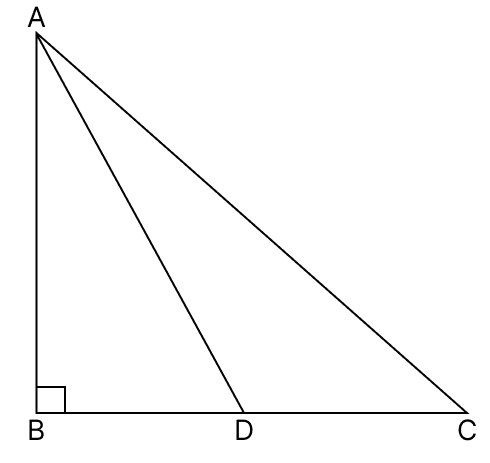
In △ABC, ∠B = 90° and D is the mid-point of BC. Prove that
(i) AC2 = AD2 + 3 CD2
(ii) BC2 = 4 (AD2 - AB2)
Two poles of height 9 m and 14 m stand vertically on a plane ground. If the distance between their feet is 12 m, find the distance between their tops.
The lengths of the sides of some triangles in some unit are given below. Which of them is a right-angled triangle?
7, 9, 13
10, 24, 26
6, 8, 12
8, 12, 16
In △ABC, ∠B is a right angle. If D is the foot of the perpendicular drawn from B on AC, then:
BC2 + CD2 = AC2
AB2 - BC2 = AD2 - CD2
BC2 - BD2 = AB2 - AD2
None of these.