
Mathematics
In ΔABC, D and E are points on AB and AC respectively such that DE ∥ BC. If AE = 2 cm, EC = 3 cm and BC = 10 cm, then DE is equal to:
4 cm
5 cm
cm
15 cm
Similarity
1 Like
Answer
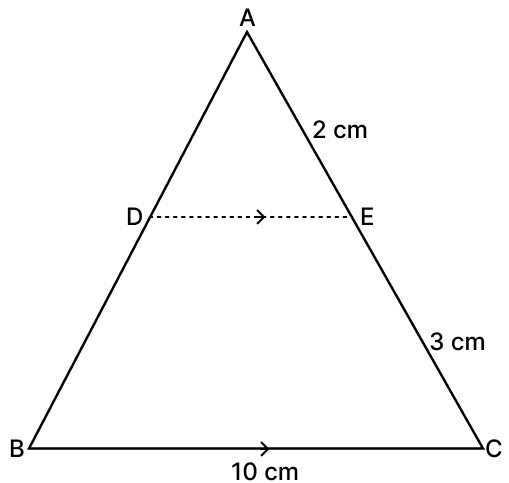
From figure,
AC = AE + EC = 2 + 3 = 5 cm.
In ΔABC and ΔADE,
∠A = ∠A [Common angle]
∠ABC = ∠ADE [Corresponding angles are equal]
∴ ΔABC ∼ ΔADE (By A.A. axiom).
In similar triangles, ratios of corresponding sides are equal.
Hence, option 1 is the correct option.
Answered By
2 Likes
Related Questions
It is given that ΔABC ∼ ΔDFE. If ∠A = 30°, ∠C = 50°, AB = 5 cm, AC = 8 cm and DF = 7.5 cm, then which of the following is true?
DE = 12 cm, ∠F = 50°
DE = 12 cm, ∠F = 100°
EF = 12 cm, ∠D = 100°
EF = 12 cm, ∠D = 30°
In ΔDEF and ΔPQR, it is given that ∠D = ∠Q and ∠R = ∠E, then which of the following is not true?
ΔABC is such that AB = 3 cm, BC = 2 cm and CA = 2.5 cm. ΔDEF ∼ ΔABC. If EF = 4 cm, then the perimeter of ΔDEF is :
7.5 cm
15 cm
22.5 cm
30 cm
In ΔABC, DE is drawn parallel to BC cutting the other two sides at D and E. If AB = 3.6 cm, AC = 2.4 cm and AD = 2.1 cm, then AE is equal to:
1.05 cm
1.2 cm
1.4 cm
1.8 cm