
Mathematics
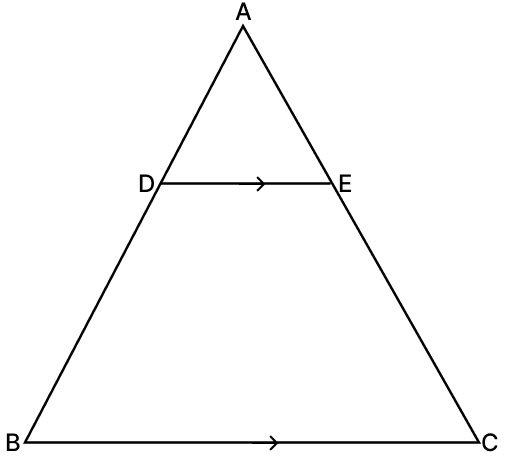
In ΔABC, DE ∥ BC so that AD = (7x − 4) cm, AE = (5x − 2) cm, DB = (3x + 4) cm and EC = (3x) cm.
Then x equals:
2.5
3
4
5
Similarity
1 Like
Answer
By basic proportionality theorem,
If a line is drawn parallel to one side of a triangle intersecting the other two sides, it divides those two sides in the same ratio.
Since DE ∥ BC in ΔABC,
x cannot be as it yields negative AD and AE values. Therefore x = 4.
Hence, option 3 is the correct option.
Answered By
3 Likes
Related Questions
D and E are points on the sides AB and AC respectively of ΔABC. In which of the following cases DE ∥ BC?
AD = 3 cm, BD = 8 cm, AC = 8 cm, AE = 3 cm
AD = 5 cm, BD = 6 cm, AE = 6 cm, CE = 5 cm
AB = 18 cm, AD = 8 cm, AE = 12 cm, EC = 15 cm
none of these
In ΔABC, DE ∥ BC such that . If AC = 5.6 cm, then AE = ?
2.1 cm
2.8 cm
3.1 cm
4.2 cm
It is given that ΔABC ∼ ΔDFE. If ∠A = 30°, ∠C = 50°, AB = 5 cm, AC = 8 cm and DF = 7.5 cm, then which of the following is true?
DE = 12 cm, ∠F = 50°
DE = 12 cm, ∠F = 100°
EF = 12 cm, ∠D = 100°
EF = 12 cm, ∠D = 30°
In ΔDEF and ΔPQR, it is given that ∠D = ∠Q and ∠R = ∠E, then which of the following is not true?