Mathematics
In ΔABC, it is given that AB = 12 cm, ∠B = 90° and AC = 15 cm. If D and E are points on AB and AC respectively such that ∠AED = 90° and DE = 3 cm, prove that :
(i) ΔABC ∼ ΔAED.
(ii) ar(ΔAED) = 6 cm2.
(iii) ar(quad BCED) : ar(ΔABC) = 8 : 9.

Similarity
1 Like
Answer
(i) Given,
∠ABC = ∠AED = 90° [Given]
∠BAC = ∠DAE [Common angle]
∴ ΔABC ∼ ΔAED (By A.A. axiom)
Hence, proved that ΔABC ∼ ΔAED.
(ii) ΔABC is right-angled triangle, applying pythagoras theorem,
⇒ AC2 = AB2 + BC2
⇒ BC2 = AC2 - AB2
⇒ BC2 = (15)2 - (12)2
⇒ BC2 = 225 - 144
⇒ BC2 = 81
⇒ BC =
⇒ BC = 9 cm
Area of ΔABC = × Base × height
= × 12 × 9
= 54 cm2
Since, ΔABC ∼ ΔAED,
We know that,
The ratio of the areas of two similar triangles is equal to the square of the ratio of their corresponding sides.
Hence, proved that ar(ΔAED) = 6 cm2.
(iii) From figure,
ar(quad. BCED) = ar(ΔABC) - ar(ΔAED)
ar(quad. BCED) = 54 - 6
ar(quad. BCED) = 48 cm2.
.
Hence, proved that ar(quad BCED) : ar(ΔABC) = 8 : 9.
Answered By
3 Likes
Related Questions
In the given figure, DE || BC. If DE = 4 cm, BC = 6 cm and ar(ΔADE) = 20 cm2, find the area of ΔABC.

In the given figure, LM ∥ BC. If AB = 6 cm, AL = 2 cm and AC = 9 cm, calculate :
(i) the length of CM,
(ii) Find the value of .

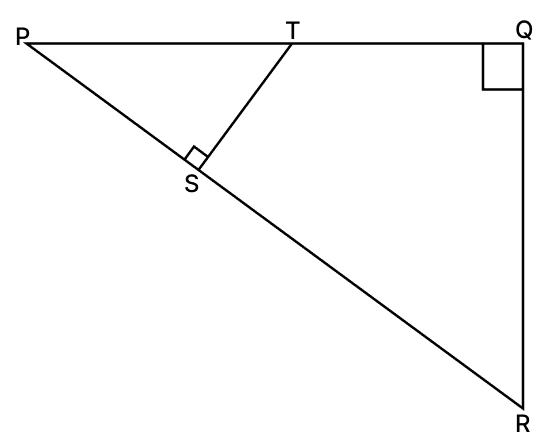
In the given figure, ∠PQR = ∠PST = 90°, PQ = 5 cm and PS = 2 cm.
(i) Prove that ΔPQR ∼ ΔPST.
(ii) Find area of ΔPQR : Area of quadrilateral SRQT.
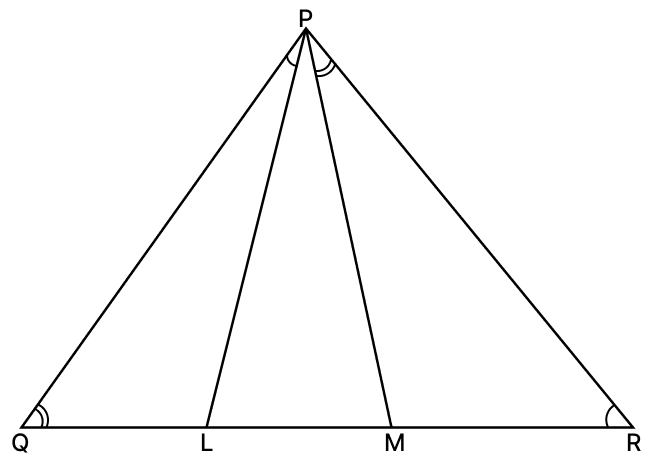
In a ΔPQR, L and M are two points on the base QR such that ∠LPQ = ∠RQP and ∠RPM = ∠RQP. Prove that
(i) ΔPQL ∼ ΔRPM.
(ii) QL × RM = PL × PM.
(iii) PQ2 = QL × QR.