Mathematics
ABCD is a cyclic quadrilateral in which AB and DC on being produced, meet at P such that PA = PD. Prove that AD is parallel to BC.
Answer
ABCD is the given cyclic quadrilateral.
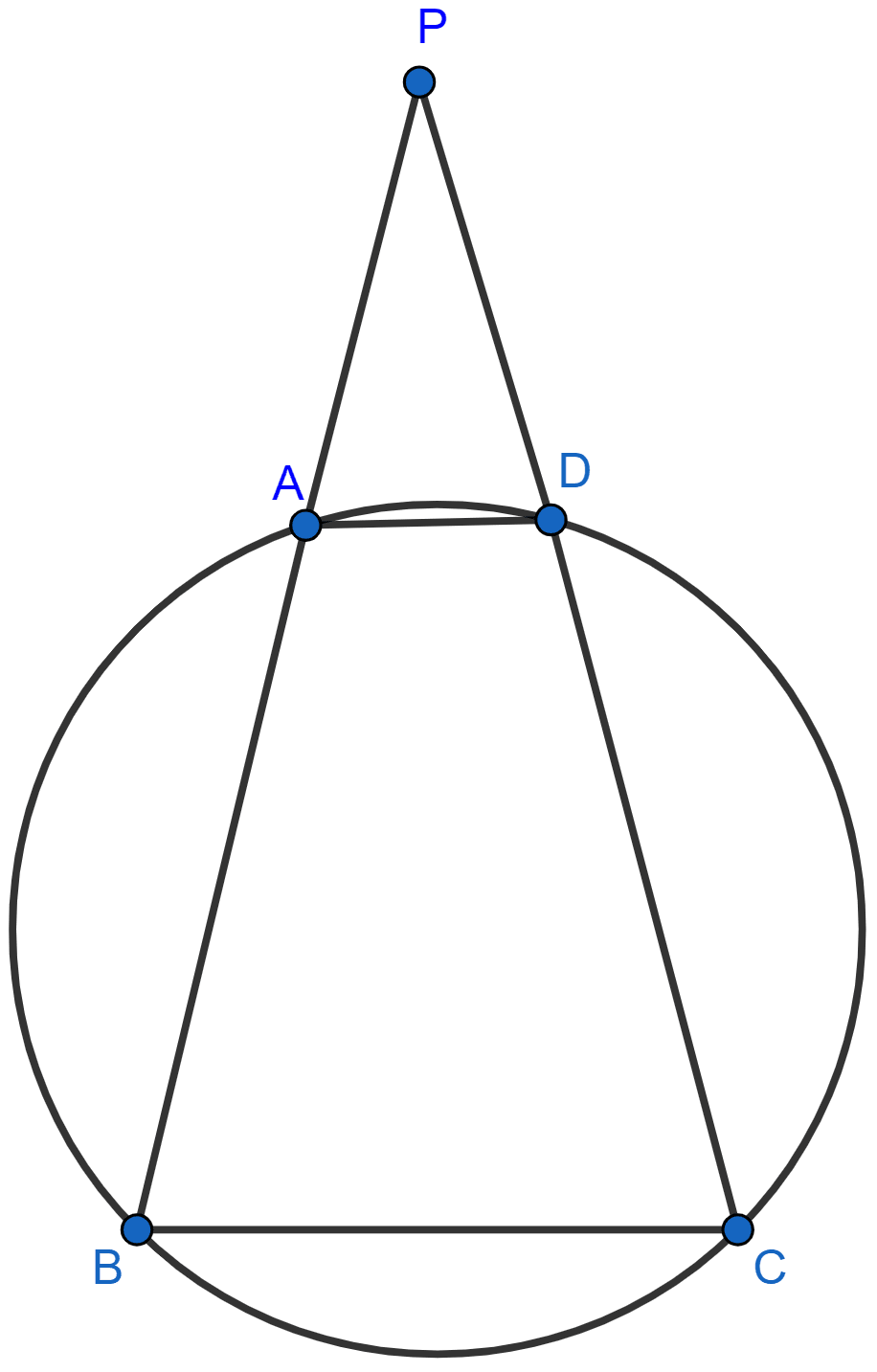
Also, PA = PD [Given]
So, ∠PAD = ∠PDA [As angles opposite to equal sides are equal.] ………. (1)
From figure,
∠BAD = 180° - ∠PAD [Linear pair of angles]
Similarly,
∠CDA = 180° - ∠PDA = 180° - ∠PAD [From (1)]
As sum of opposite angles of a cyclic quadrilateral = 180°,
∴ ∠ABC + ∠CDA = 180°
⇒ ∠ABC = 180° - ∠CDA
⇒ ∠ABC = 180° - (180° - ∠PAD) = ∠PAD
⇒ ∠ABC = ∠PAD.
Also,
⇒ ∠DCB + ∠BAD = 180°
⇒ ∠DCB = 180° - ∠BAD
⇒ ∠DCB = 180° - (180° - ∠PAD)
⇒ ∠DCB = ∠PAD
⇒ ∠DCB = ∠PDA [As ∠PAD = ∠PDA]
Since pairs, ∠DCB and ∠PDA, ∠ABC and ∠PAD are corresponding angles and are equal
Hence, proved that AD || BC.
Related Questions
In the figure, given below, CP bisects angle ACB. Show that DP bisects angle ADB.
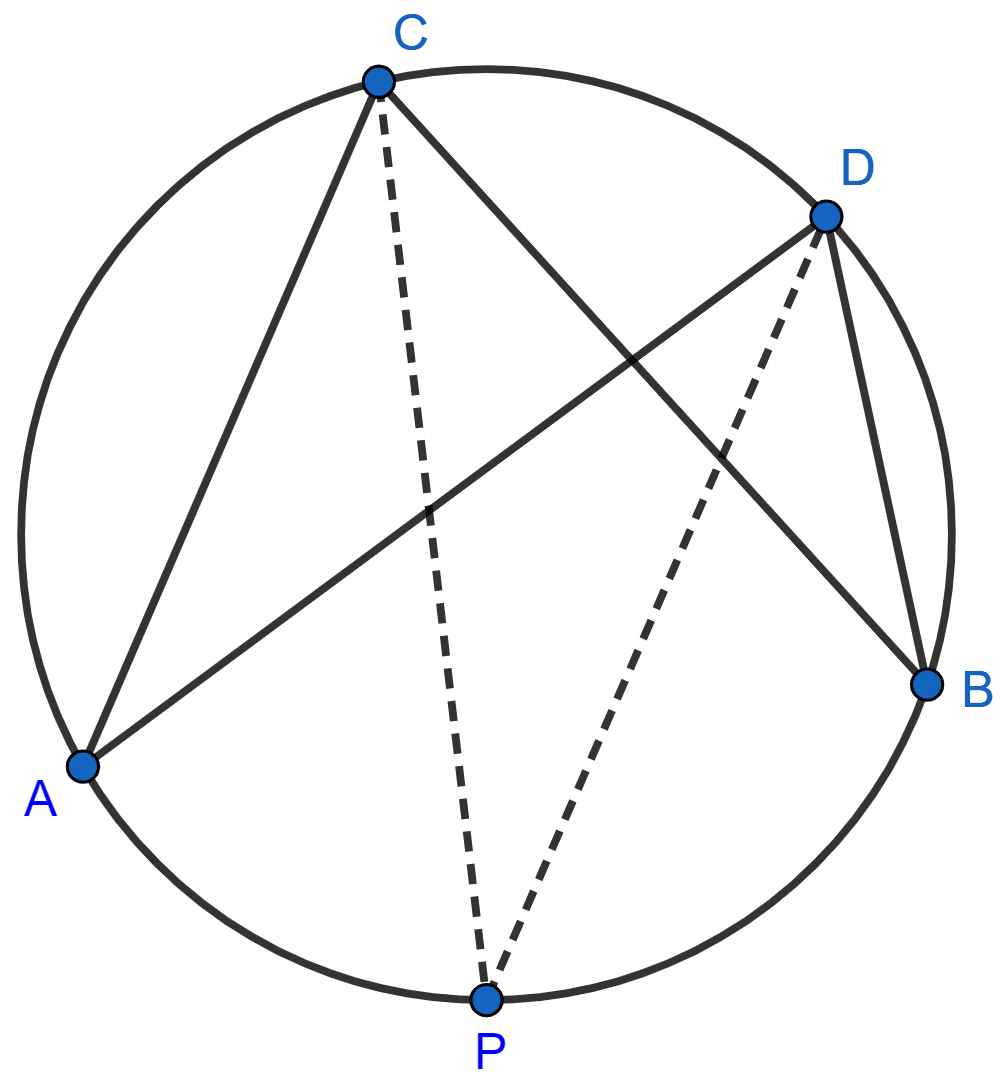
In the figure, given below, AD = BC, ∠BAC = 30° and ∠CBD = 70°. Find :
(i) ∠BCD
(ii) ∠BCA
(iii) ∠ABC
(iv) ∠ADB

In the given figure, AD is a diameter. O is the centre of the circle. AD is parallel to BC and ∠CBD = 32°. Find :
(i) ∠OBD
(ii) ∠AOB
(iii) ∠BED

In the figure given, O is the centre of the circle. ∠DAE = 70°. Find giving suitable reasons, the measure of
(i) ∠BCD
(ii) ∠BOD
(iii) ∠OBD