
Mathematics
ABCD is a parallelogram in which ∠BAD = 60° and ∠BAC = 30°, then ∠CBD =
45°
60°
70°
80°
Rectilinear Figures
3 Likes
Answer
Given,
∠BAD = 60° and ∠BAC = 30°.
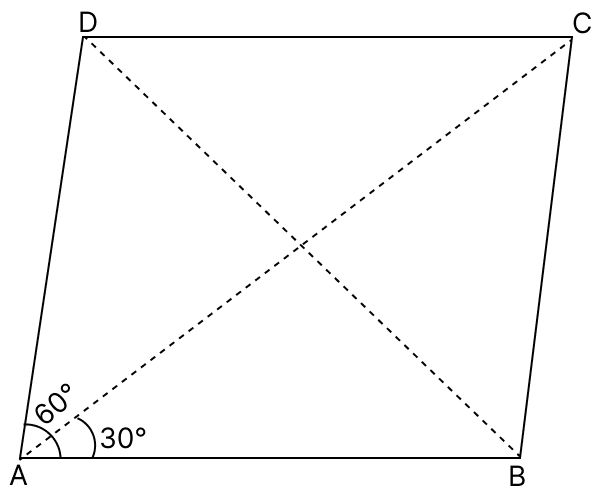
From figure,
∠CAD = ∠BAD - ∠BAC = 60° - 30° = 30°.
If diagonal of a parallelogram bisects a vertex angle, then it is a rhombus.
Thus, ABCD is a rhombus.
In rhombus adjacent angles are supplementary.
Thus,
∠BAD + ∠CBA = 180°
60° + ∠CBA = 180°
∠CBA = 180° - 60° = 120°.
Since, diagonals of rhombus bisect the vertex angle,
∴ ∠CBD = = 60°.
Hence, option 2 is the correct option.
Answered By
3 Likes
Related Questions
In a parallelogram, an angle is th of its adjacent angle, then angles of the parallelogram are :
80°, 100°, 80°, 100°
70°, 110°, 70°, 110°
60°, 120°, 60°, 120°
none of these
The lengths of diagonals of a rhombus are 24 cm and 18 cm respectively, length of each side of the rhombus is :
25 cm
15 cm
35 cm
45 cm
The diagonals of the rectangle ABCD intersect at O. If ∠OBC = 64°, then ∠OAB =
64°
32°
26°
36°
If ∠ADB of the rhombus ABCD is 30°, then ∠ACB =
30°
60°
70°
90°