
Mathematics
ABCD is a rectangle and ABQC is a parallelogram. If the area of ΔABD is 5 sq. cm, then the area of the parallelogram is :
5 sq. cm
10 sq. cm
20 sq. cm
30 sq. cm
Theorems on Area
1 Like
Answer
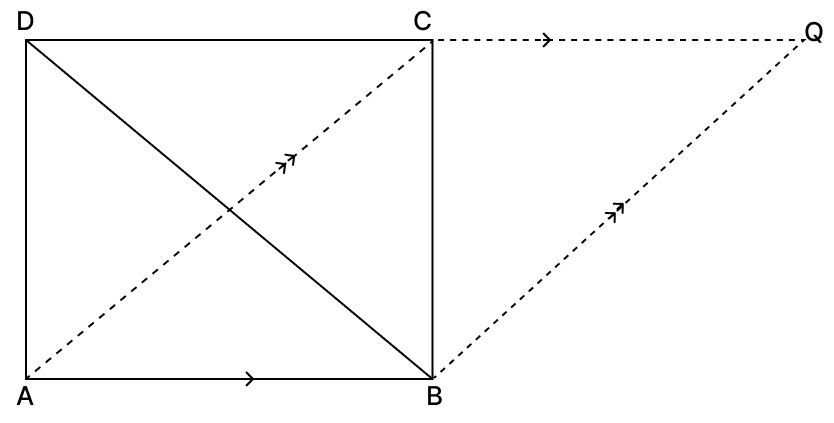
In a rectangle, a diagonal divides it into two equal triangles.
So,
Area of rectangle ABCD = 2 × Area of △ABD
= 2 × 5
= 10 cm2.
Rectangle ABCD and parallelogram ABQC are on the same base AB and between the same parallel lines AB and DQ.
Area of the parallelogram ABQC = Area of rectangle ABCD = 10 cm2.
Hence, option 2 is the correct option.
Answered By
1 Like
Related Questions
A triangle and a parallelogram, both having base 5 cm, are situated between the same parallels. If the height of the triangle is 4 cm, then the area of the parallelogram is :
20 cm2
40 cm2
10 cm2
5 cm2
The area of the parallelogram PQRS is 16 sq. units. If M is the mid-point of PQ, then the area of ΔQMR is :
16 sq. units
8 sq. units
4 sq. units
2 sq. units
P and Q are two points on the side DC of a ∥ gm ABCD. If the area of ΔPAB is 10 cm2, then the area of ΔQAB is :
5 cm2
10 cm2
15 cm2
20 cm2
Two diagonals of a parallelogram ABCD intersect at O. If the area of the parallelogram is 20 cm2, then the area of ΔAOB is :
20 cm2
15 cm2
10 cm2
5 cm2