
Mathematics
ABCD is a trapezium and P and Q are the mid-points of the diagonals of AC and BD. Then PQ is equal to :
AB
CD
(AB − CD)
(AB + CD)
Rectilinear Figures
2 Likes
Answer
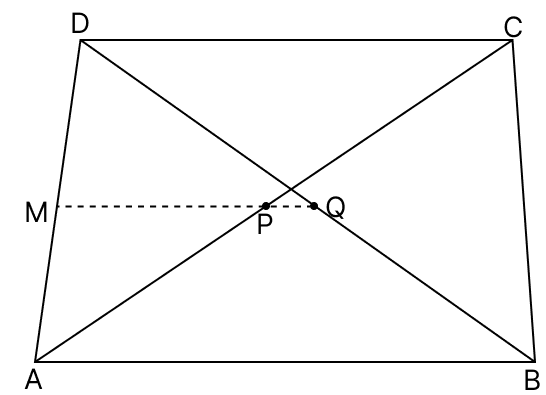
The Mid-point Theorem, which states that the line segment joining the mid-points of two sides of a triangle is parallel to the third side and is half of its length.
In triangle ADC,
M is the mid-point of AD (let)
P is the mid-point of AC
MP ∥ CD
MP = CD
In triangle ABD,
M is the mid-point of AD
Q is the mid-point of BD
MQ ∥ AB
MQ = AB
Since: MP ∥ CD, MQ ∥ AB and AB ∥ CD,
∴ MP ∥ MQ
Both pass through point M. So MP and MQ are the same straight line.
Hence, M, P and Q all lie on same line.
MQ = MP + PQ
PQ = MQ - MP
PQ = AB - CD
PQ = [AB - CD]
Hence, option 3 is the correct option.
Answered By
2 Likes
Related Questions
If bisectors of ∠A and ∠B of a parallelogram ABCD intersect each other at P, of ∠B and ∠C at Q, of ∠C and ∠D at R and of ∠D and ∠A at S, then PQRS is a :
rectangle
rhombus
parallelogram
quadrilateral whose opposite angles are supplementary
Diagonals of a quadrilateral ABCD bisect each other. If ∠A = 35°, then ∠B is equal to :
145°
135°
155°
35°
The diagonals of a quadrilateral intersect at right angles and it has exactly one axis of symmetry. The quadrilateral is a :
square
rhombus
kite
none of these
You have been given following specification regarding a quadrilateral. Measure of all the four angles and the length of one side is given. Would you be able to construct a unique quadrilateral in this case? Justify your answer.