Physics
ABCDE is a regular pentagon with its centre of gravity at O. What will be the most probable position (W, X, Y, Z or O) of the new centre of gravity:

(a) if a piece of clay is attached at point A?
(b) if the pentagon is cut along the line PQ? (Of the remaining part DCBQPE)
Answer
(a) X
(b) Z
Reason —
(a) If a piece of clay is attached at point A of the pentagon ABCDE then new centre of gravity will be shifted towards A to maintain stable equilibrium and hence, the most probable position will be X.
(b) If the pentagon is cut along the line PQ then only DCBQPE remains which has equal mass distribution on left and right portions about the point O but has greater mass distributed on the upper portion than the lower portion about the point O. So, new centre of gravity will shift towards upper portion i.e. at a point above to the point O to maintain stable equilibrium and hence, the most probable position of new centre of gravity will be Z.
Related Questions
(a) Refer to the diagram given below. A lens with two different refractive indices is shown. If the rays are coming from a distant object, then how many images will be seen?
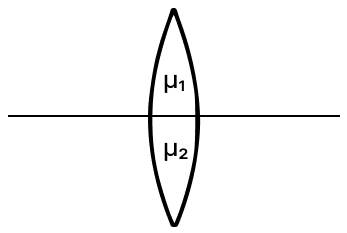
(b) A glass lens always forms a virtual, erect and diminished image of an object kept in front of it. Identify the lens.
The image given below displays kilowatt-hour meter readings recorded at two distinct points in time.

Assuming a continuously running 2000 W air conditioner as the sole electrical device in use, calculate the time interval, in hours, between these two meter readings.
A solid of mass 60 g at 100°C is placed in 150 g of water at 20°C. The final steady temperature is 25°C. Calculate the heat capacity of solid?
[sp. heat capacity of water = 4.2 J g-1 K-1 ]
The diagram given below shows a copper wire wound around a U-shape soft iron bar. An iron pin is brought near the arrangement. First Source P and then Source Q are connected across AB, each operating independently.

(a) State True or False: Source P as well as Source Q, when connected across AB, can attract the iron pin.
(b) Justify your answer to (a) with a suitable reason.