Physics
According to the principle of conservation of mechanical energy :
- Potential energy of a system is always greater than its kinetic energy
- Kinetic energy of a system is always greater than its potential energy
- Mechanical energy is always converted into heat energy
- Total mechanical energy of a system remains constant if no external force is worked on it.
Answer
Total mechanical energy of a system remains constant if no external force is worked on it.
Reason — The conservation of mechanical energy states that the total mechanical energy (sum of kinetic energy and potential energy) of a system remains constant if no external forces, such as friction or air resistance, are acting on it.
Related Questions
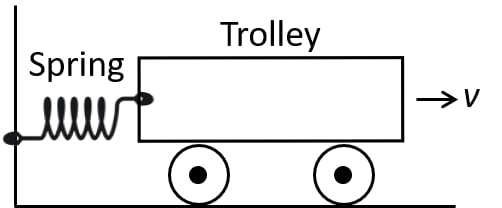
A spring is kept compressed by a small trolley of mass 0.5 kg lying on a smooth horizontal surface as shown. When the trolley is released, it is found to move at a speed of v = 2 ms-1. What potential energy did the spring possess when compressed?
Natasha is being constantly scolded by her mother for being unfit. She decides to loose weight by lifting a mass of 10 kg by 0.5 m 100 times. Assuming that the potential energy lost each time during the lowering of mass is dissipated.
Calculate :
(a) work done by her against the gravitational force.
(b) If fat stored in her body supplies 3.8 x 10⁷ J of energy per kg, and is converted to mechanical energy with 20% efficiency, how much fat is used by Natasha
A skater is gliding on a smooth ice surface. What happens to his mechanical energy as he skates?
- It increases
- It decreases
- It becomes zero
- It remains constant
A spring is compressed storing potential energy. When the spring is released it propels an object forward. What change would you notice in the total mechanical energy of the system?
- It increases
- It decreases
- It becomes zero
- It remains constant