
Mathematics
AD and BE are two medians of a ABC. F is a point on AC such that DF || BE. If AC = 12 cm, then FC =
6 cm
4 cm
3 cm
none of these
Mid-point Theorem
3 Likes
Answer
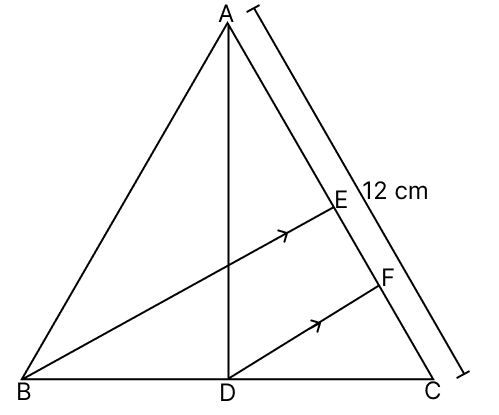
In △BCE,
D is the midpoint of BC (As AD is median)
Given,
DF || BE
By converse of mid-point theorem,
A line drawn through the midpoint of one side of a triangle, and parallel to another side, will bisect the third side.
Thus, in triangle BEC,
F is the mid-point of CE
⇒ FC = CE ….(1)
Given,
BE is median.
⇒ E is the mid-point of AC
⇒ AE = CE
⇒ CE = AC
Substituting value of CE in eq.(1), we get:
⇒ FC =
⇒ FC =
⇒ FC = 3 cm.
Hence, option 3 is the correct option.
Answered By
1 Like
Related Questions
ABC is a right angled isosceles triangle in which ∠A = 90°. If D and E are the mid-points of AB and AC respectively, then ∠ADE =
30°
45°
60°
90°
On the sides AB and AC of a △ABC, D and E are two points such that AD : AB = AE : AC = 1 : 2. If BC = 7 cm, then DE =
3.5 cm
7 cm
14 cm
15 cm
D, E and F are respectively the mid-points of the sides BC, CA and AB of a ABC. If BC = 10 cm, CA = 12 cm and AB = 17 cm, then the perimeter of the DEF is :
13 cm
19.5 cm
39 cm
None of these
D, E and F are respectively the mid-points of the sides BC, CA and AB of a ABC. If BC = 12 cm, CA = 15 cm and AB = 18 cm, then the perimeter of the quadrilateral DEAF is :
45 cm
27 cm
30 cm
33 cm