Mathematics
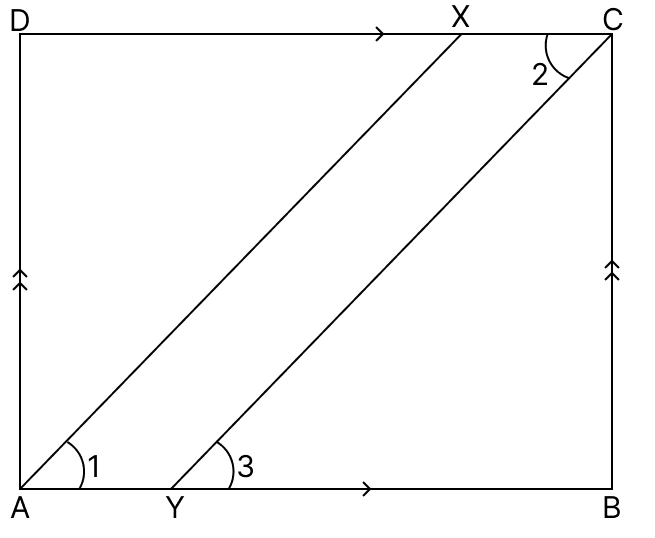
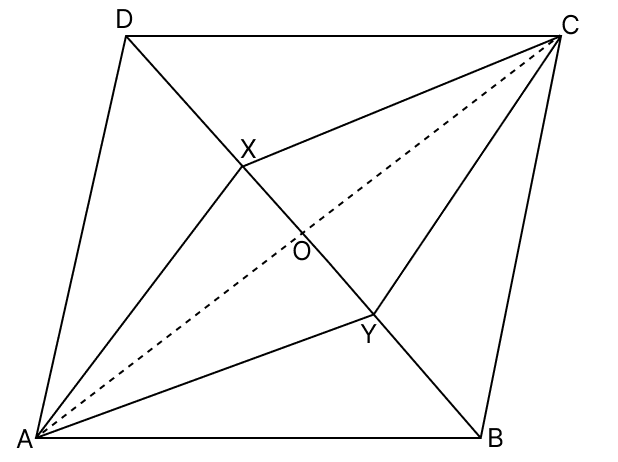
In the adjoining figure, ABCD is a parallelogram. Line segments AX and CY bisect ∠A and ∠C respectively. Prove that :
(i) ΔADX ≅ ΔCBY
(ii) AX = CY
(iii) AX ∥ CY
(iv) AYCX is a parallelogram
Rectilinear Figures
2 Likes
Answer
Given,
ABCD is a parallelogram.
AX bisects ∠A
CY bisects ∠C
(i) In a parallelogram opposite angles are equal, thus ∠A = ∠C.
In ΔADX and ΔCBY,
∠D = ∠B [Opposite angles of a parallelogram are equal]
∠DAX = ∠BCY
AD = BC [Opposite sides of a parallelogram are equal]
∴ ΔADX ≅ ΔCBY [By A.S.A. rule]
Hence, proved that ΔADX ≅ ΔCBY.
(ii) We know that,
ΔADX ≅ ΔCBY
AX = CY [By C.P.C.T.C.]
Hence, proved that AX = CY.
(iii) ∠DCY = ∠CYB [Alternate interior angles, AB ∥ DC, CY is transversal]
∠BAX = ∠DCY ()
∴ ∠BAX = ∠CYB
These are corresponding angles formed by lines AX and CY with the transversal AB.
Since corresponding angles are equal, the lines AX and CY are parallel.
Hence, proved that AX ∥ CY.
(iv) We know that,
AX ∥ CY and AX = CY.
If one pair of opposite sides of a quadrilateral are equal and parallel, then the quadrilateral is a parallelogram.
Thus, AYCX is a parallelogram.
Hence, proved that AYCX is a parallelogram.
Answered By
1 Like
Related Questions
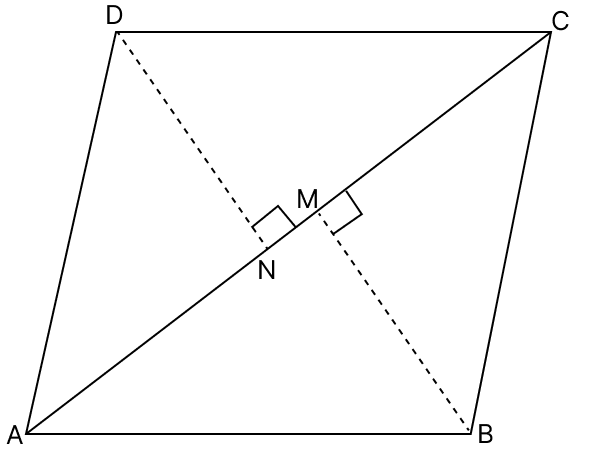
In the adjoining figure, ABCD is a parallelogram. BM ⟂ AC and DN ⟂ AC. Prove that :
(i) ΔBMC ≅ ΔDNA.
(ii) BM = DN.
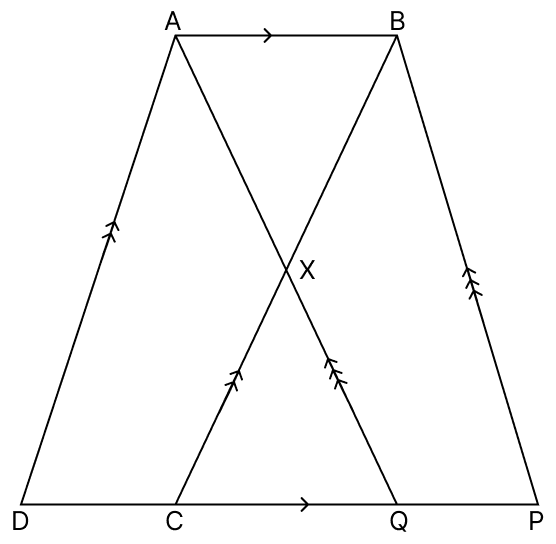
In the adjoining figure, ABCD is a parallelogram and X is the mid-point of BC. The line AX produced meets DC produced at Q. The parallelogram AQPB is completed. Prove that :
(i) ΔABX ≅ ΔQCX.
(ii) DC = CQ = QP.
In the given figure, ABCD is a parallelogram and X, Y are points on diagonal BD such that DX = BY. Prove that CXAY is a parallelogram.
Show that the bisectors of the angles of a parallelogram enclose a rectangle.