Mathematics
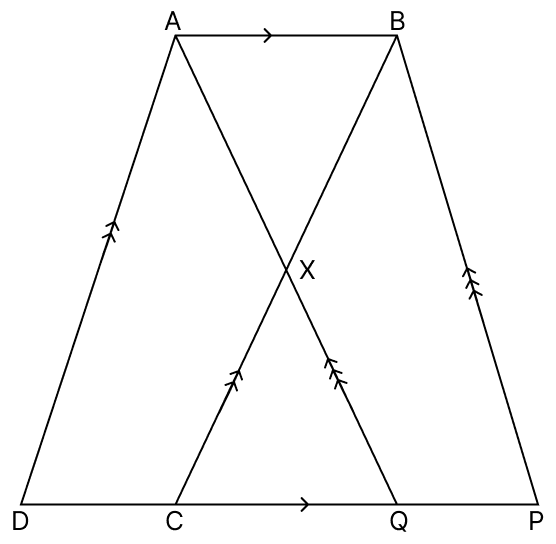
In the adjoining figure, ABCD is a parallelogram and X is the mid-point of BC. The line AX produced meets DC produced at Q. The parallelogram AQPB is completed. Prove that :
(i) ΔABX ≅ ΔQCX.
(ii) DC = CQ = QP.
Answer
(i) Considering △ABX and △QCX we have,
⇒ ∠XBA = ∠XCQ (Alternate angles are equal)
⇒ XB = XC (As X is mid-point of BC)
⇒ ∠AXB = ∠CXQ (Vertically opposite angles are equal)
Hence, △ABX ≅ △QCX by ASA axiom.
(ii) Since, △ABX ≅ △QCX
∴ AB = CQ (By C.P.C.T.C.) …….(1)
AB = CD and AB = QP (Opposite sides of parallelogram are equal) ……..(2)
From (i) and (ii) we get,
⇒ AB = DC = CQ = QP
⇒ DC = CQ = QP
Hence, proved that DC = CQ = QP.
Related Questions
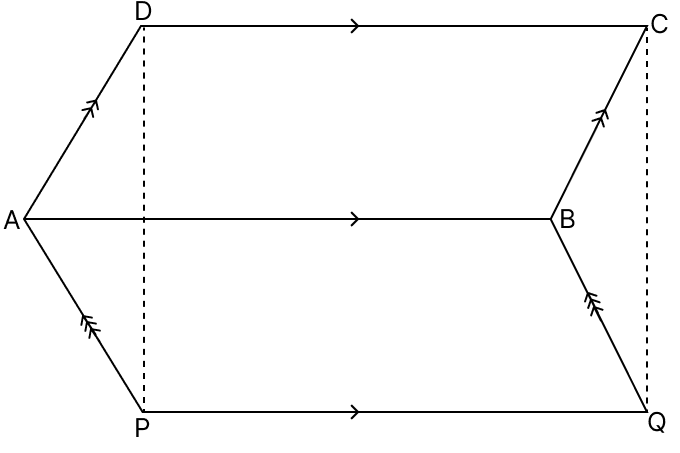
In the adjoining figure, ABCD and PQBA are two parallelograms. Prove that :
(i) DPQC is a parallelogram.
(ii) DP = CQ.
(iii) ΔDAP ≅ ΔCBQ.
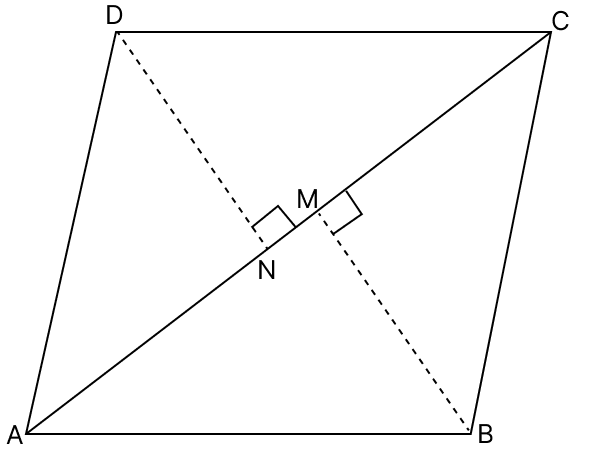
In the adjoining figure, ABCD is a parallelogram. BM ⟂ AC and DN ⟂ AC. Prove that :
(i) ΔBMC ≅ ΔDNA.
(ii) BM = DN.
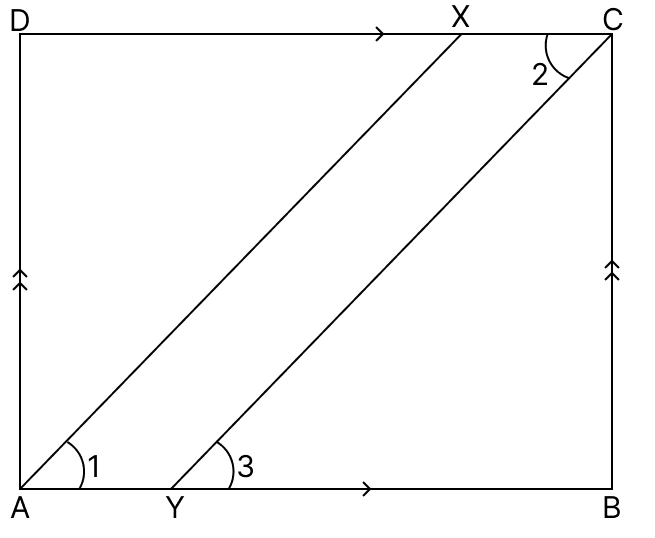
In the adjoining figure, ABCD is a parallelogram. Line segments AX and CY bisect ∠A and ∠C respectively. Prove that :
(i) ΔADX ≅ ΔCBY
(ii) AX = CY
(iii) AX ∥ CY
(iv) AYCX is a parallelogram
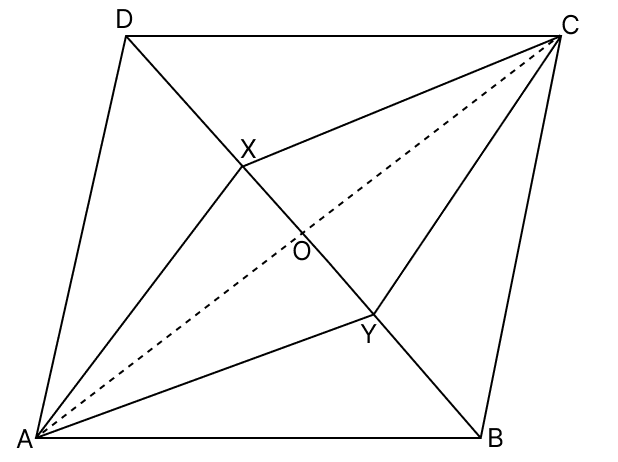
In the given figure, ABCD is a parallelogram and X, Y are points on diagonal BD such that DX = BY. Prove that CXAY is a parallelogram.