Mathematics
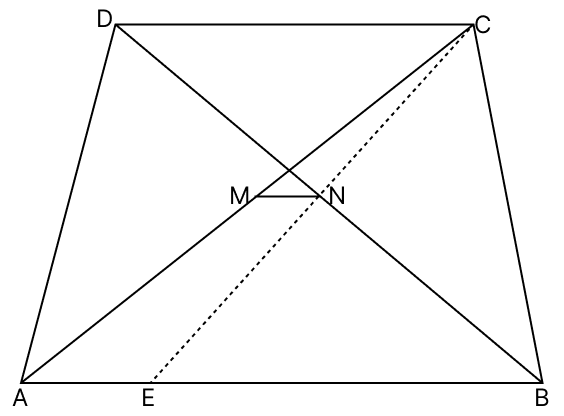
In the adjoining figure, ABCD is a trapezium in which AB || DC. If M and N are the mid-points of AC and BD respectively. Prove that MN = (AB - CD).
Mid-point Theorem
3 Likes
Answer
From figure,
AB // DC
EB // DC
In △BNE and △CND,
⇒ ∠BNE = ∠CND (Vertically opposite angles are equal)
⇒ ∠BEN = ∠NCD (Alternate angles are equal)
⇒ BN = DN (N is the mid-point of BD)
∴ △BNE ≅ △CND
⇒ BE = CD (Corresponding parts of congruent triangles are equal)
⇒ NE = CN (Corresponding parts of congruent triangles are equal)
∴ N is the mid-point of CE.
By mid-point theorem,
The line segment joining the mid points of any two sides of a triangle is parallel to the third side and is equal to half of it.
Since, M and N are the mid-points of AC and CE respectively.
MN || AE
⇒ MN = AE
⇒ MN = (AB - BE)
⇒ MN = (AB - CD) (∵ BE = CD)
Hence, proved that MN = (AB - CD).
Answered By
2 Likes
Related Questions
Show that the quadrilateral formed by joining the mid-points of the pairs of adjacent sides of a rhombus is a rectangle.
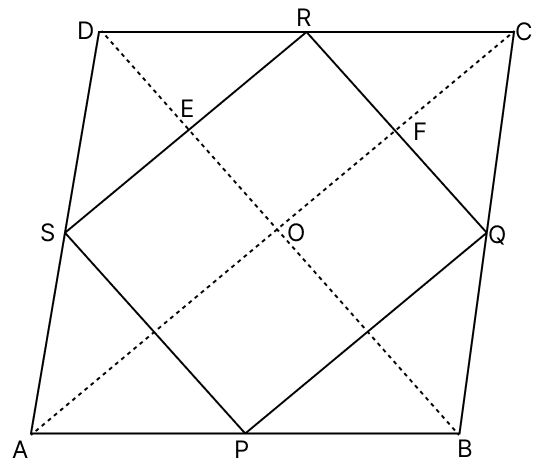
Show that the quadrilateral formed by joining the mid-points of the pairs of adjacent sides of a square is a square.
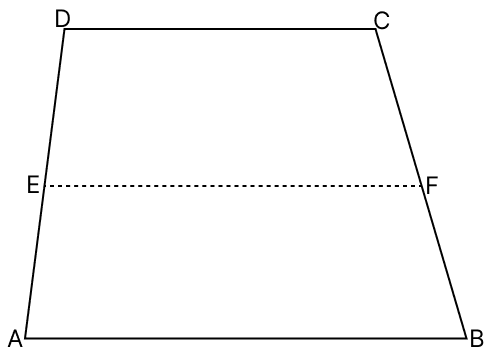
In the adjoining figure, ABCD is a trapezium in which AB || DC and E is the mid-point of AD. If EF || AB meets BC at F, show that F is the mid-point of BC.
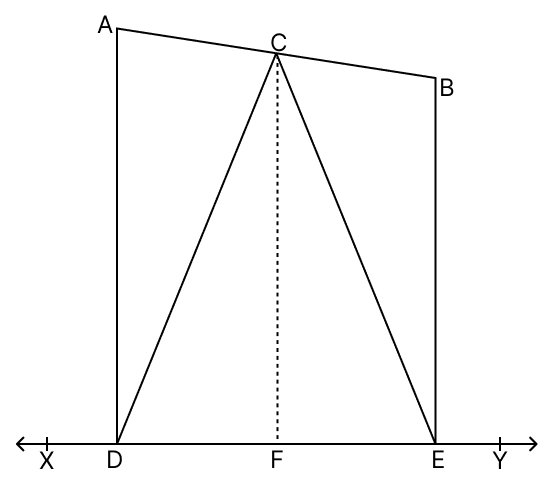
Two points A and B lie on the same side of a line XY. If AD ⊥ XY and BE ⊥ XY meet XY in D and E respectively and C is the mid-point of AB, show that CD = CE.