
Mathematics
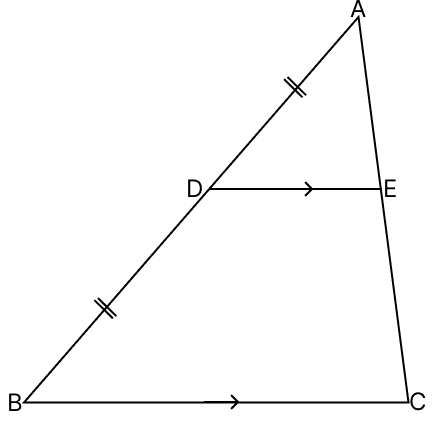
In the adjoining figure, AD = BD and DE || BC. If AC = 6 cm and DE = 4 cm, then the length of BC is :
4 cm
5 cm
6 cm
8 cm
Mid-point Theorem
2 Likes
Answer
Given,
D is the mid-point of AB.
By converse of mid-point theorem,
A line drawn through the midpoint of one side of a triangle, and parallel to another side, will bisect the third side.
In △ABC,
Since, D is the mid-point of AB and DE // BC, thus :
E is mid-point of AC.
By mid-point theorem,
The line segment joining the mid points of any two sides of a triangle is parallel to the third side and is equal to half of it.
Since, D and E are the mid-points of AB and AC respectively.
DE || BC
⇒ DE = BC
⇒ BC = 2 DE
⇒ BC = 2 × 4
⇒ BC = 8 cm.
Hence, option 4 is the correct option.
Answered By
1 Like
Related Questions
D, E and F are respectively the mid-points of the sides BC, CA and AB of a ABC. If BC = 10 cm, CA = 12 cm and AB = 17 cm, then the perimeter of the DEF is :
13 cm
19.5 cm
39 cm
None of these
D, E and F are respectively the mid-points of the sides BC, CA and AB of a ABC. If BC = 12 cm, CA = 15 cm and AB = 18 cm, then the perimeter of the quadrilateral DEAF is :
45 cm
27 cm
30 cm
33 cm
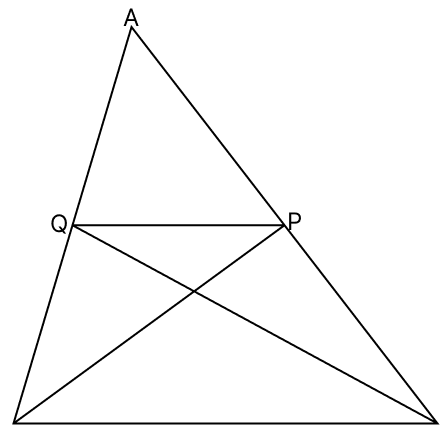
In the given figure, BP and CQ are two medians of the △ABC. If BC = 12 cm, the length of QP =
4 cm
6 cm
8 cm
10 cm
In △ABC, E is the mid-point of the median AD. BE is joined and produced to meet AC at F. Then, AF = ….AC.
3
2