
Mathematics
The adjoining figure represents the preferences of the students during breakfast in a hostel mess. If the total number of students in the mess is 540, then with reference to the given figure, answer the following questions:
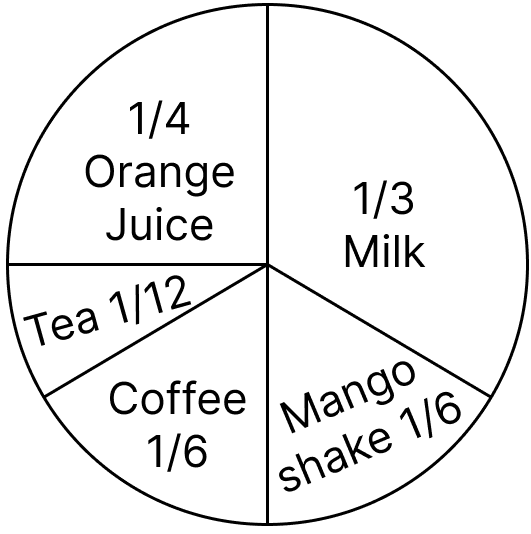
(i) What is the number of students who prefer coffee?
(ii) Whose number is greater, milk drinkers or orange juice drinkers and by what number?
(iii) What is the total number of students who drink mango shake or coffee? Is it equal to milk drinker?
(iv) Is the sum of all fractions in the given figure equal to 1?
Fractions
3 Likes
Answer
Total number of students = 540.
From the figure, the fractions are:
Orange juice = , Milk = , Tea = , Coffee = , Mango shake = .
(i) Number of students who prefer coffee =
Hence, the number of students who prefer coffee = 90.
(ii) Number of milk drinkers = .
Number of orange juice drinkers = .
Since 180 > 135, milk drinkers are more than orange juice drinkers.
Difference = 180 - 135 = 45.
Hence, milk drinkers are greater than orange juice drinkers by 45.
(iii) Number of mango shake drinkers = .
Number of coffee drinkers = 90.
Total = 90 + 90 = 180.
Number of milk drinkers = 180.
Yes, total of mango shake and coffee drinkers (180) is equal to milk drinkers (180).
Hence, the total number of students who drink mango shake or coffee = 180, which is equal to the number of milk drinkers.
(iv) Sum of all fractions =
LCM of 4, 3, 12, 6 = 12.
Hence, yes, the sum of all fractions in the given figure is equal to 1.
Answered By
1 Like
Related Questions
A rectangle is divided into a certain number of equal parts. If 16 of the parts so formed represents the fraction , find the number of parts in which the rectangle has been divided.
Find the value of the following:
(i) 55
(ii)
Write all proper fractions whose sum of numerator and denominator is 12.
Find the value of if