
Mathematics
An aeroplane leaves an airport and flies due North at 300 km/h. At the same time, another plane leaves the same airport and flies due West at 400 km/h. After 90 minutes, the distance between the two planes would be:
1000 km
900 km
800 km
750 km
Pythagoras Theorem
1 Like
Answer
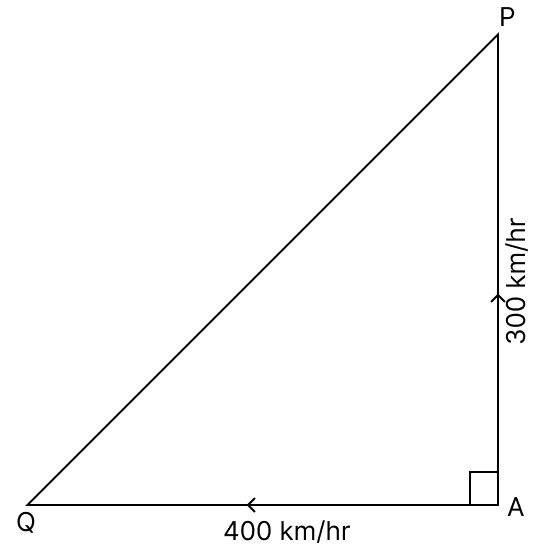
Let aeroplane flying in north direction at 300 km/h be at point P after 1.5 hours and aeroplane flying in west direction at 400 km/h be at point Q after 1.5 hours.
Given, 90 minutes = 1.5 hours
Speed of aeroplane P = 300 km/h
As we know,
Distance traveled = Speed × Time taken
AP = 300 × 1.5 = 450 km.
Speed of aeroplane Q = 400 km/h
As we know,
Distance traveled = Speed × Time taken
AQ = 400 × 1.5 = 600 km.
From figure,
Let ∠A = 90°
By Pythagoras theorem,
Hypotenuse2 = Perpendicular2 + Base2
In triangle APQ,
⇒ PQ2 = AP2 + AQ2
⇒ PQ2 = 4502 + 6002
⇒ PQ2 = 202500 + 360000
⇒ PQ2 = 562500
⇒ PQ =
⇒ PQ = 750 km.
Hence, Option 4 is the correct option.
Answered By
2 Likes
Related Questions
Assertion (A): In a right angled triangle, the longest side is called hypotenuse and the other two sides are called its legs. Also, the sum of lengths of legs is less than the length of the hypotenuse.
Reason (R): In a right angled triangle, the side opposite to the right angle is called its hypotenuse.
A is true, R is false
A is false, R is true
Both A and R are true
Both A and R are false.
The hypotenuse of a right triangle is 25 cm. If out of the two legs, one is longer than the other by 5 cm, then the sum of the lengths of the legs is:
30 cm
35 cm
40 cm
45 cm
For going to city B from city A, there is a route via city C such that AC ⟂ CB, AC = 2x km and CB = 2(x + 7) km.
It is proposed to construct a 26 km highway which directly connects the two cities A and B. Find how much distance will be saved in reaching city B from city A after the construction of the highway.
A 5 m long ladder is placed leaning towards a vertical wall such that it reaches the wall at a point 4 m high. If the foot of the ladder is moved 1.6 m towards the wall, then find the distance by which the top of the ladder would slide upwards on the wall.