
Mathematics
An aeroplane (P) leaves an Airport (A) and flies towards north at 400 km/h. At the same time another aeroplane (Q) leaves the same airport and flies towards west at 300 km/h.
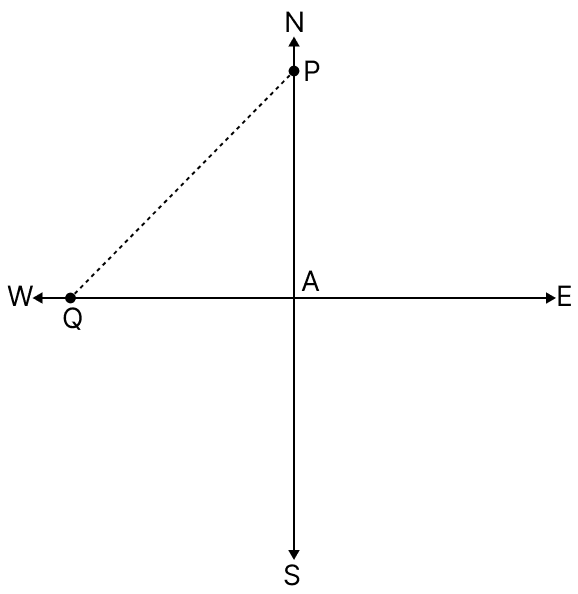
Based on this information, answer the following questions:
Distance covered by aeroplane P in 1.5 hours is :
(a) 600 km
(b) 650 km
(c) 700 km
(d) 800 kmDistance covered by aeroplane Q in 1.5 hours is :
(a) 600 km
(b) 550 km
(c) 500 km
(d) 450 kmThe distance between the two aeroplanes after a certain period of time is represented by the line segment :
(a) AP
(b) AQ
(c) PQ
(d) ASAfter 1.5 hours, which aeroplane travelled longer distance and by how much?
(a) P, 150 km
(b) Q, 150 km
(c) P, 600 km
(d) Q, 450 kmAfter 1.5 hours, the distance between the two aeroplanes is :
(a) 600 km
(b) 650 km
(c) 700 km
(d) 750 km
Pythagoras Theorem
1 Like
Answer
1. Given, Speed of aeroplane P = 400 km/h
As we know,
Distance traveled = Speed × Time taken
= 400 × 1.5
= 600 km.
Hence, Option (a) is the correct option.
2. Given, Speed of aeroplane Q = 300 km/h
As we know,
Distance traveled = Speed × Time taken
= 300 × 1.5
= 450 km.
Hence, Option (d) is the correct option.
3. From figure,
Distance between the two aeroplanes after a certain period of time is represented by the line segment PQ.
Hence, Option (c) is the correct option.
4. From above,
Distance traveled by aeroplane P in 1.5 hours = 600 km
Distance traveled by aeroplane Q in 1.5 hours = 450 km
600 - 450 = 150 km
⇒ Aeroplane P traveled longer distance by 150 km.
Hence, Option (a) is the correct option.
5. Distance traveled by aeroplane P in 1.5 hours = 600 km
⇒ AP = 600 km
Distance traveled by aeroplane Q in 1.5 hours = 450 km
⇒ AQ = 450 km
From figure,
Let ∠A = 90°
By Pythagoras theorem,
Hypotenuse2 = Perpendicular2 + Base2
In triangle APQ,
⇒ PQ2 = AP2 + AQ2
⇒ PQ2 = 6002 + 4502
⇒ PQ2 = 360000 + 202500
⇒ PQ2 = 562500
⇒ PQ =
⇒ PQ = 750 km.
Hence, Option (d) is the correct option.
Answered By
1 Like
Related Questions
ABD is a right-angled triangle, whose ∠D is the right angle. C is any point on the side BD. If AB = 8 cm, BC = 6 cm and AC = 3 cm, then the length of CD is :
cm
cm
cm
cm
There are two buildings in two sides of a road. Keeping the foot of a ladder fixed at a point on the road, when it is placed on two buildings, then its top touches the buidings respectively at a height of 48 ft and 14 ft. If the length of the ladder is 50 ft, then the width of the road is :
56 ft
62 ft
66 ft
70 ft
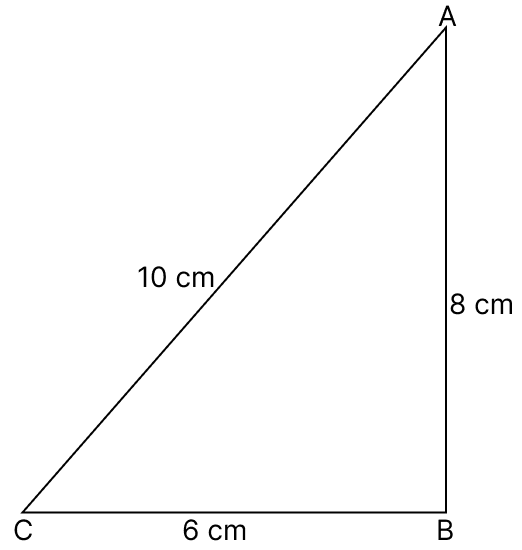
Assertion (A): In the figure, △ ABC is right angled at B.
Reason (R): In a right angled triangle, the square on the hypotenuse is equal to the sum of the other two sides.
A is true, R is false
A is false, R is true
Both A and R are true
Both A and R are false.
Assertion (A): In a right angled triangle, the longest side is called hypotenuse and the other two sides are called its legs. Also, the sum of lengths of legs is less than the length of the hypotenuse.
Reason (R): In a right angled triangle, the side opposite to the right angle is called its hypotenuse.
A is true, R is false
A is false, R is true
Both A and R are true
Both A and R are false.