
Mathematics
The altitude drawn to the base of an isosceles triangle is 8 cm and the perimeter is 32 cm. Find the area of the triangle.
Mensuration
1 Like
Answer
Let ABC be an isosceles triangle with AB = AC = a cm and BC = b cm.
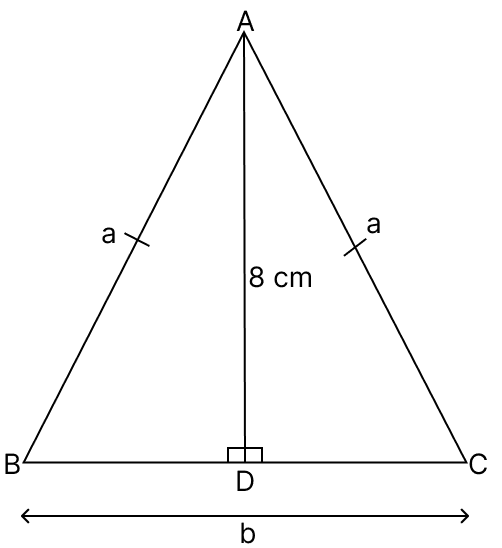
Altitude (AD) = 8 cm
Perimeter = 32 cm
Perimeter = sum of all sides of a triangle
⇒ 32 = a + a + b
⇒ 32 = 2a + b
⇒ b = 32 - 2a ………(1)
In an isosceles triangle, the altitude drawn from the common vertex bisects the base.
Thus, AD bisects BC.
So, BD = DC =
∴ ∠ADC = ∠ADB = 90°.
In triangle ADB,
By pythagorean theorem,
Substituting the value of b from equation (1) in above equation, we get :
∴ b = 32 - 2(10)
⇒ b = 32 - 20
⇒ b = 12 cm.
Area of triangle ABC = × Base × Height
= × BC × AD
= × 12 × 8
= 6 × 8 = 48 cm2.
Hence, area of triangle = 48 cm2.
Answered By
2 Likes
Related Questions
If the area of an equilateral triangle is cm2, find its perimeter.
The base of a right-angled triangle is 24 cm and its hypotenuse is 25 cm. Find the area of the triangle.
The area of a triangle is 216 cm2 and its sides are in the ratio 3 : 4 : 5. Find the perimeter of the triangle.
Find the area of a quadrilateral one of whose diagonals is 25 cm and the lengths of perpendiculars from the other two vertices are 16.4 cm and 11.6 cm respectively.