Physics
An aluminium rod of length 50 cm whose mass per unit length is 0.15 kg/m is joined with a steel rod of length 50 cm whose mass per unit length is 0.45 kg/m as shown in the figure below.
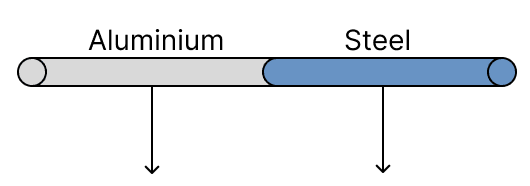
At what point should the rod be supported so that it remains in equilibrium horizontally?
Force
76 Likes
Answer
Given,
- Length of aluminium rod = 50 cm = 0.5 m
- Length of steel rod = 50 cm = 0.5 m
- Mass per unit length of aluminium rod = 0.15 kg m-1
- Mass per unit length of steel rod = 0.45 kg m-1
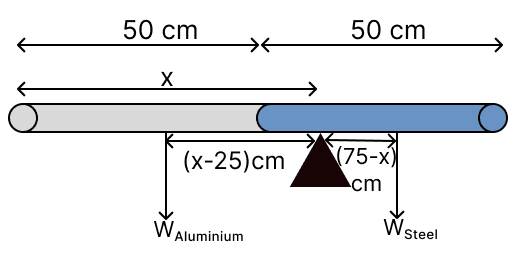
Let, the rod is balanced at point which is at a distance of x cm from aluminium rod's end as shown below.
Then,
Mass of aluminium rod = 0.15 x 0.5 = 0.075 kg
And
Mass of steel rod = 0.45 x 0.5 = 0.225 kg
Since mass of steel rod is greater than the mass of aluminium rod which means the equilibrium point must be towards steel end.
Also, weight of each rod is situated at its mid point i.e., at 25 cm of each rod.
So,
Perpendicular distance for aluminium rod = (x - 25) cm
and
Perpendicular distance for steel rod = (75 - x) cm
Now,
Anticlockwise moment of force due to aluminium rod = 0.075 x (x - 25) kg cm
and
Clockwise moment of force due to steel rod = 0.225 x (75 - x) kg cm
For equilibrium,
Anticlockwise moment of force due to aluminium rod = Clockwise moment of force due to steel rod
Hence, the rod should be supported at 62.5 cm mark from aluminium end so that it remains in equilibrium horizontally.
Answered By
41 Likes
Related Questions
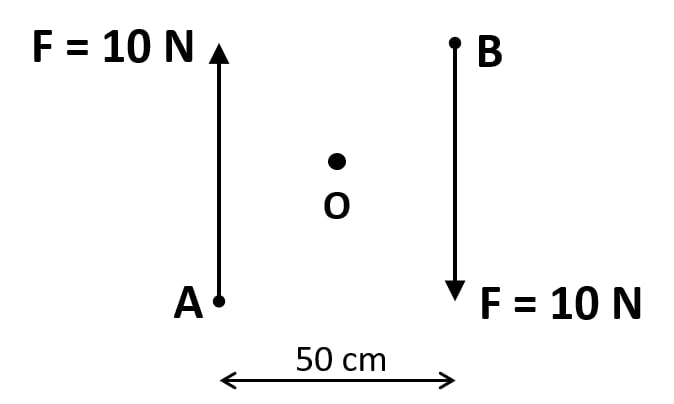
Figure shows two forces each of magnitude 10N acting at the points A and B at a separation of 50 cm, in opposite directions. Calculate the resultant moment of the two forces about the point (i) A, (ii) B and (iii) O, situated exactly at the middle of the two forces.
A 55 kg student is climbing a rope ladder hanging from a helicopter. While climbing, the student leans 0.35 m backward from the vertical line of the ladder.
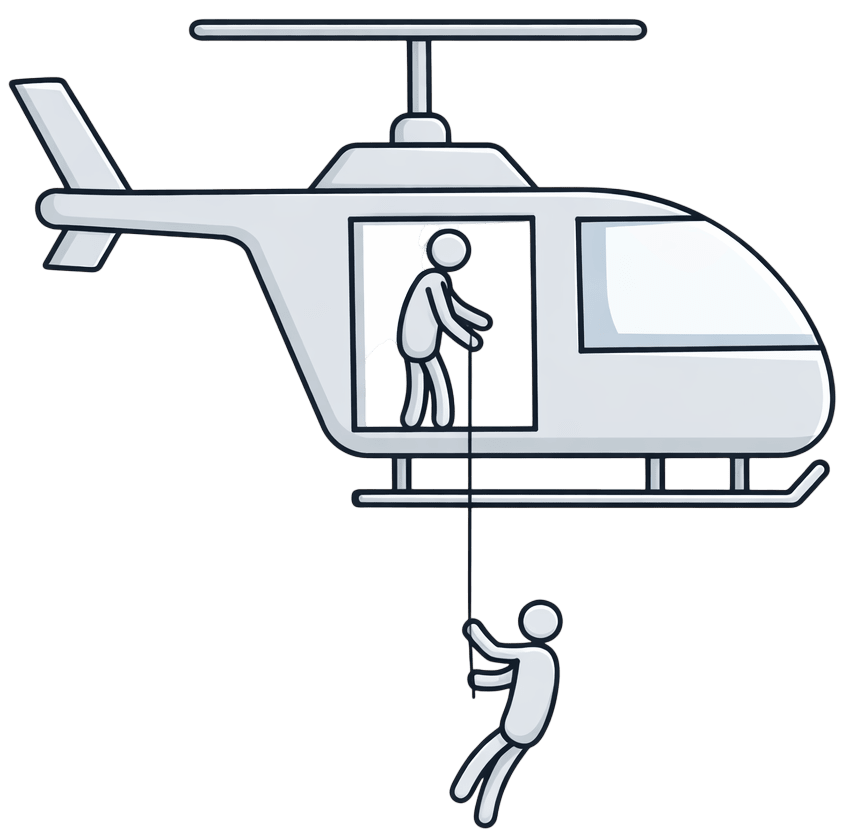
(i) Calculate the torque produced about the top support point of the rope ladder due to the student's weight. [Take g = 10 m s-2]
(ii) Explain why the ladder starts swinging when the student leans backward and how the student should climb to minimize the swinging.
The diagram shows a uniform bar supported at the middle point O. A weight of 40 gf is placed at a distance 40cm to the left of the point O. How can you balance the bar with a weight of 80 gf?
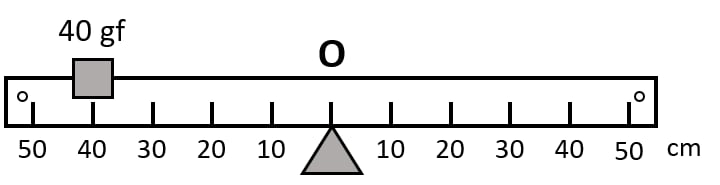
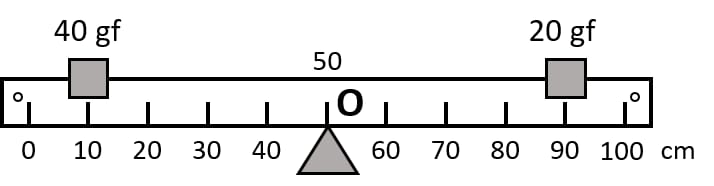
Figure shows a uniform metre rule placed on a fulcrum at its mid-point O and having a weight 40gf at the 10 cm mark and a weight of 20 gf at the 90 cm mark.
(i) Is the metre rule in equilibrium? If not, how will the rule turn?
(ii) How can the rule be brought in equilibrium by using an additional weight of 40gf?