
Mathematics
An exhibition tent is in the form of a cylinder surmounted by a cone. The height of the tent above the ground is 85 m and the height of the cylindrical part is 50 m. If the diameter of the base is 168 m, find the quantity of canvas required to make the tent. Allow 20% extra for folds and stitching. Give your answers to the nearest m2.
Mensuration
98 Likes
Answer
Total height of the tent = 85 m.
Height of the cylindrical part (h1) = 50 m.
From figure,
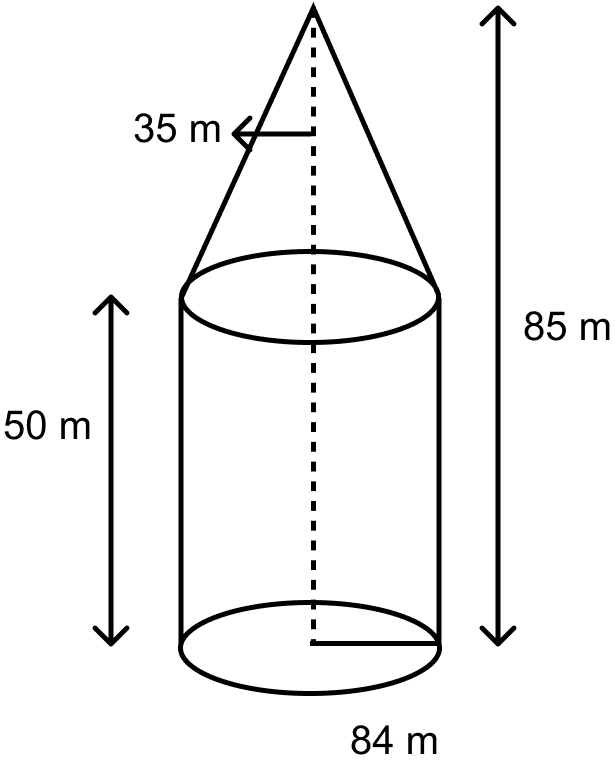
Height of cone (h2) = 85 - 50 = 35 m.
Diameter of the base, d = 168 m.
Radius of the base of cylindrical part, r = m.
Slant height of the cone, l = .
l = m.
Surface area of tent (S) = Curved surface area of cylinder + Curved surface area of cone
Putting values we get,
Adding 20% for folds and stitches,
Area of canvas = 50424 + 20% of 50424
Hence, the quantity of canvas required to make the tent is 60509 m2.
Answered By
50 Likes
Related Questions
A toy is in the form of a cone of radius 3.5 cm mounted on a hemisphere of same radius. If the total height of the toy is 15.5 cm, find the total surface area of the toy.
A circus tent is in the shape of a cylinder surmounted by a cone. The diameter of the cylindrical portion is 24 m and its height is 11 m. If the vertex of the cone is 16 m above the ground, find the area of the canvas used to make the tent.
From a solid cylinder of height 30 cm and radius 7 cm, a conical cavity of height 24 cm and of base radius 7 cm is drilled out. Find the volume and the total surface of the remaining solid.
A buoy is made in the form of a hemisphere surmounted by a right cone whose circular base coincides with the plane surface of the hemisphere. The radius of the base of the cone is 3.5 metres and its volume is of the hemisphere. Calculate the height of the cone and the surface area of the buoy correct to 2 places of decimal.