Mathematics
Assertion (A): If ΔABC ≅ ΔPQR and AB = 4 units, then AB2 + PQ2 = 32.
Reason (R): When two triangles are congruent to each other, then their corresponding responding sides are equal in length.
Assertion (A) is true, Reason (R) is false.
Assertion (A) is false, Reason (R) is true.
Both Assertion (A) and Reason (R) are true, and Reason (R) is the correct reason for Assertion (A).
Both Assertion (A) and Reason (R) are true, but Reason (R) is not the correct reason (or explanation) for Assertion (A).
Answer
When two triangles are congruent to each other, then their corresponding sides are equal in length.
It is a fundamental property of congruent triangles, better known as C.P.C.T.C.
∴ Reason (R) is true.
△ABC ≅ △PQR, this means triangle ABC is congruent to triangle PQR.
So, corresponding sides are equal.
This means AB corresponds to PQ, BC corresponds to QR, and AC corresponds to PR.
Therefore, AB = PQ.
Given AB = 4 units: Since AB = PQ, it implies PQ = 4 units.
AB2 + PQ2 = 42 + 42
= 16 + 16
= 32.
∴ Assertion (A) is true.
∴ Both Assertion (A) and Reason (R) are true, and Reason (R) is the correct reason (or explanation) for Assertion (A).
Hence, option 3 is the correct option.
Related Questions
Assertion (A): In the adjoining figure, Δ ABC ≅ Δ PQR.
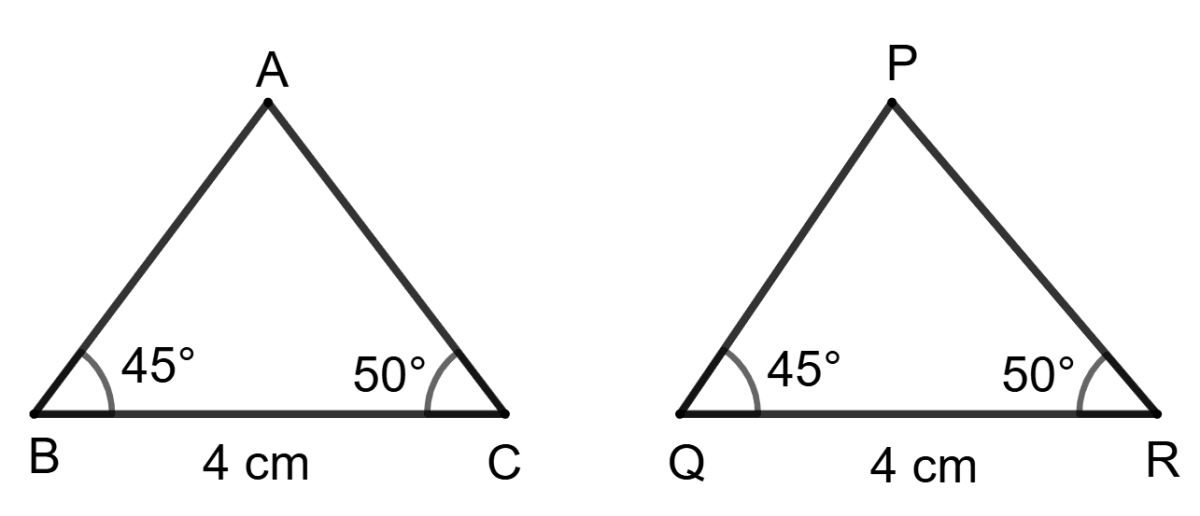
Reason (R): Two triangles are congruent if two angles and included side of One triangle are equal to two angles and the included side of other triangle.
Assertion (A) is true, Reason (R) is false.
Assertion (A) is false, Reason (R) is true.
Both Assertion (A) and Reason (R) are true, and Reason (R) is the correct reason for Assertion (A).
Both Assertion (A) and Reason (R) are true, but Reason (R) is not the correct reason (or explanation) for Assertion (A).
Assertion (A): Two triangles are congruent to each other by RHS rule of congruency. The base of the one triangle is 6 cm and the height is 4 cm. The sum of area of two triangle is 24 cm2.
Reason (R): Two triangles are congruent if they have same shape and size. Congruent triangles have equal area.
Assertion (A) is true, Reason (R) is false.
Assertion (A) is false, Reason (R) is true.
Both Assertion (A) and Reason (R) are true, and Reason (R) is the correct reason for Assertion (A).
Both Assertion (A) and Reason (R) are true, but Reason (R) is not the correct reason (or explanation) for Assertion (A).
Assertion (A): Δ ABC ≅ Δ PQR
If 2AB = 3BC = 4CA = 12 cm, then the sum of perimeter of both triangle is 26 cm.
Reason (R): If two triangles are congruent to each other, then their corresponding sides are equal in length.
Assertion (A) is true, Reason (R) is false.
Assertion (A) is false, Reason (R) is true.
Both Assertion (A) and Reason (R) are true, and Reason (R) is the correct reason for Assertion (A).
Both Assertion (A) and Reason (R) are true, but Reason (R) is not the correct reason (or explanation) for Assertion (A).
In triangles ABC and DEF, ∠A = ∠D, ∠B = ∠E and AB = EF. Will the two triangles be congruent? Give reasons for your answer.