
Mathematics
Assertion (A): In the adjoining figure, Δ ABC ≅ Δ PQR.
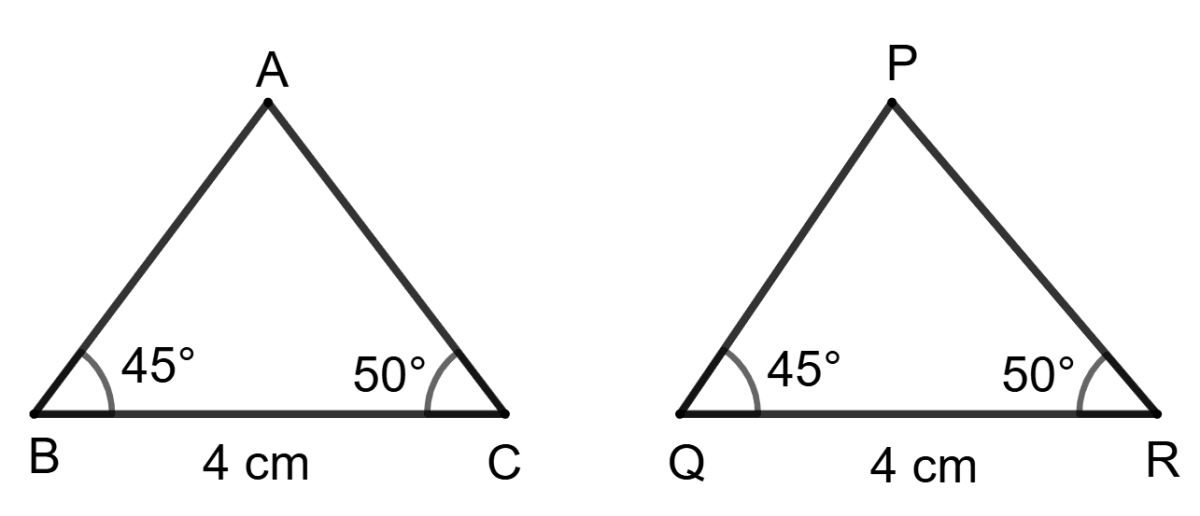
Reason (R): Two triangles are congruent if two angles and included side of One triangle are equal to two angles and the included side of other triangle.
Assertion (A) is true, Reason (R) is false.
Assertion (A) is false, Reason (R) is true.
Both Assertion (A) and Reason (R) are true, and Reason (R) is the correct reason for Assertion (A).
Both Assertion (A) and Reason (R) are true, but Reason (R) is not the correct reason (or explanation) for Assertion (A).
Triangles
2 Likes
Answer
The ASA (Angle-Side-Angle) Congruence rule states that if two angles and the included side (the side between those two angles) of one triangle are equal to the corresponding two angles and the included side of another triangle, then the two triangles are congruent.
∴ Reason (R) is true.
In △ABC and △PQR,
⇒ ∠B = ∠Q (Both equal to 45°)
⇒ BC = QR
⇒ ∠C = ∠R (Both equal to 50°)
∴ △ABC ≅ △PQR (By A.S.A. axiom)
∴ Assertion (A) is true.
∴ Both Assertion (A) and Reason (R) are true, and Reason (R) is the correct reason (or explanation) for Assertion (A).
Hence, option 3 is the correct option.
Answered By
3 Likes
Related Questions
Consider the following two statements :
Statement 1: If two angles and one side of a triangle is equal to two angles and one side of an other triangle then the two triangles are congruent.
Statement 2: The angle opposite to equal sides of an isosceles triangle are equal.
Which of the following is valid?
Both the statements are true.
Both the statements are false.
Statement 1 is true, and Statement 2 is false.
Statement 1 is false, and Statement 2 is true.
Assertion (A): If two triangles are congruent to each other then the ratio of corresponding side is 1 : 1.
Reason (R): Two triangles are congruent if and only if they have same shape and size.
Assertion (A) is true, Reason (R) is false.
Assertion (A) is false, Reason (R) is true.
Both Assertion (A) and Reason (R) are true, and Reason (R) is the correct reason for Assertion (A).
Both Assertion (A) and Reason (R) are true, but Reason (R) is not the correct reason (or explanation) for Assertion (A).
Assertion (A): Two triangles are congruent to each other by RHS rule of congruency. The base of the one triangle is 6 cm and the height is 4 cm. The sum of area of two triangle is 24 cm2.
Reason (R): Two triangles are congruent if they have same shape and size. Congruent triangles have equal area.
Assertion (A) is true, Reason (R) is false.
Assertion (A) is false, Reason (R) is true.
Both Assertion (A) and Reason (R) are true, and Reason (R) is the correct reason for Assertion (A).
Both Assertion (A) and Reason (R) are true, but Reason (R) is not the correct reason (or explanation) for Assertion (A).
Assertion (A): If ΔABC ≅ ΔPQR and AB = 4 units, then AB2 + PQ2 = 32.
Reason (R): When two triangles are congruent to each other, then their corresponding responding sides are equal in length.
Assertion (A) is true, Reason (R) is false.
Assertion (A) is false, Reason (R) is true.
Both Assertion (A) and Reason (R) are true, and Reason (R) is the correct reason for Assertion (A).
Both Assertion (A) and Reason (R) are true, but Reason (R) is not the correct reason (or explanation) for Assertion (A).