
Mathematics
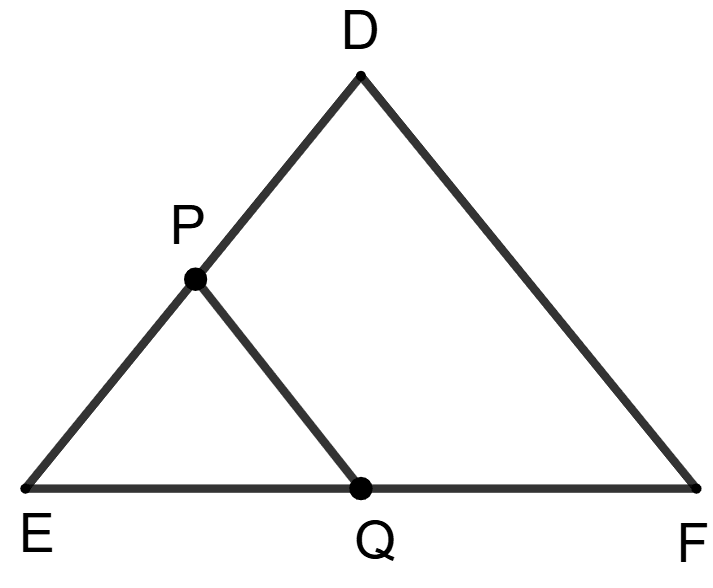
Assertion (A): In a Δ DEF, we have DE = EF = DF = 6 cm. A line segment PQ is drawn parallel to DF such that EP = 3 cm. Then we can conclude that PQ = 3 cm.
Reason (R): Any line segment drawn inside a triangle parallel to the base of the triangle cuts the removing two sides in half.
Assertion (A) is true, Reason (R) is false.
Assertion (A) is false, Reason (R) is true.
Both Assertion (A) and Reason (R) are true, and Reason (R) is the correct reason for Assertion (A).
Both Assertion (A) and Reason (R) are true, but Reason (R) is not the correct reason (or explanation) for Assertion (A).
Mid-point Theorem
2 Likes
Answer
According to converse of mid-point theorem, the straight line drawn through the mid-point of one side of a triangle parallel to another bisects the third side.
It is given that PQ is drawn parallel to DF. And, EP = 3 cm.
∴ P is midpoint of ED.
Therefore, Q will also be mid-point of EF.
According to Midpoint Theorem states that the line segment joining the midpoints of any two sides of a triangle is parallel to the third side and is equal to half of it.
PQ = x DF = x 6 cm
Thus, PQ = 3 cm.
∴ Assertion (A) is true.
A line segment parallel to the base does not necessarily cut the other two sides in half unless it passes through the midpoints.
∴ Reason (R) is false.
∴ Assertion (A) is true, Reason (R) is false.
Hence, option 1 is the correct option.
Answered By
1 Like
Related Questions
Consider the following two statements:
Statement 1: The line segment joining the mid-points of any two sides of a triangle is parallel to the third side and is equal to half of it.
Statement 2: The line through the mid-point of one side of a triangle and parallel to another side bisects the third side.
Which of the following is valid?
Both the statements are true.
Both the statements are false.
Statement 1 is true, and Statement 2 is false.
Statement 1 is false, and Statement 2 is true.
Assertion (A): For a Δ ABC, line segment EF is drawn such that E is the midpoint of AB and F is a midpoint of AC. Then the quadrilateral formed EFCB is a trapezium.
Reason (R): The line segment joining the midpoint of two sides of a triangle is parallel to the third side.
Assertion (A) is true, Reason (R) is false.
Assertion (A) is false, Reason (R) is true.
Both Assertion (A) and Reason (R) are true, and Reason (R) is the correct reason for Assertion (A).
Both Assertion (A) and Reason (R) are true, but Reason (R) is not the correct reason (or explanation) for Assertion (A).
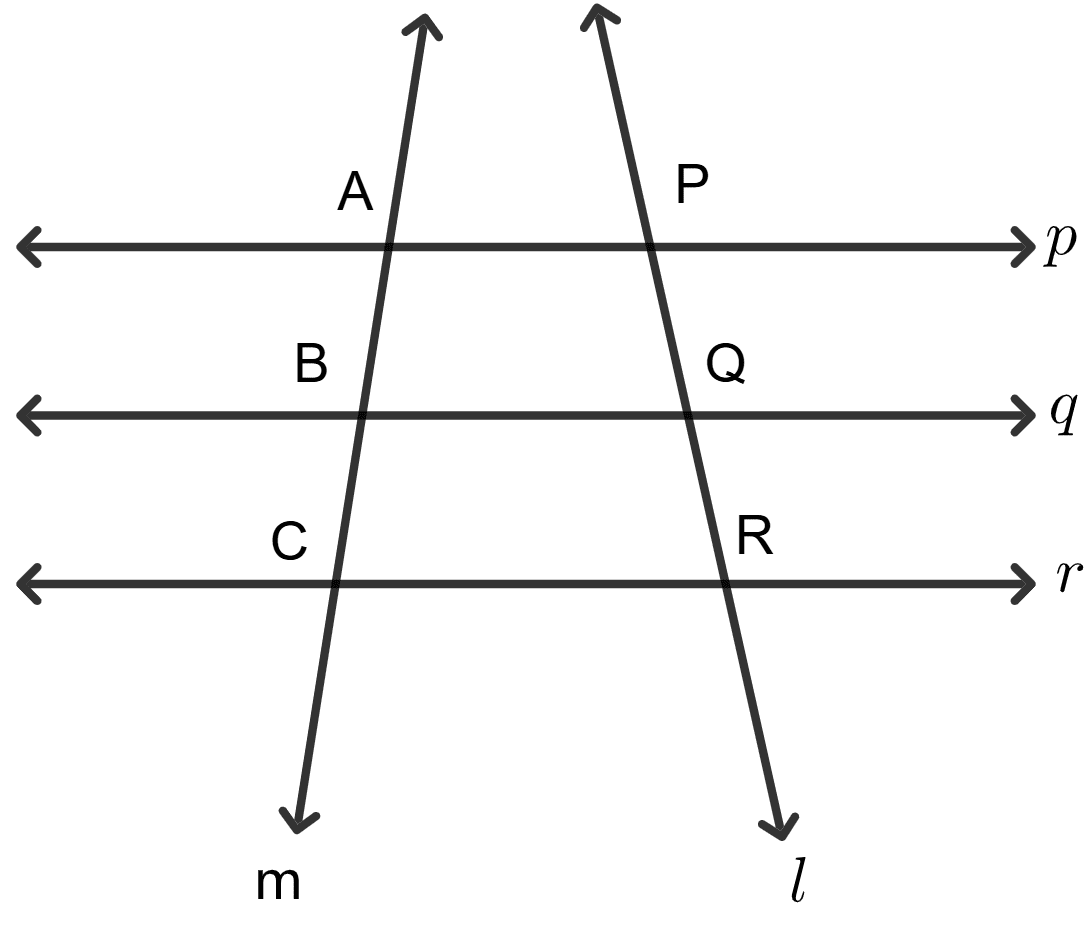
Assertion (A): Refer to the adjoining figure. Three lines p, q, r are parallel to each other and PQ = QR = 1 cm. Then we conclude that AB = AC.
Reason (R): If a tranversal makes equal intercepts on three parallel lines, then another transversal will also make equal intercepts.
Assertion (A) is true, Reason (R) is false.
Assertion (A) is false, Reason (R) is true.
Both Assertion (A) and Reason (R) are true, and Reason (R) is the correct reason for Assertion (A).
Both Assertion (A) and Reason (R) are true, but Reason (R) is not the correct reason (or explanation) for Assertion (A).
ABCD is a rhombus with P, Q and R as mid-points of AB, BC and CD respectively. Prove that PQ ⊥ QR.