
Physics
Assertion (A): When the displacement is normal to the direction of force, the work done is zero.
Reason (R): Work done depends on the angle between force and displacement.
- Both A and R are true and R is the correct explanation of A
- Both A and R are true but R is not the correct explanation of A
- assertion is false but reason is true
- assertion is true but reason is false
Work, Energy & Power
16 Likes
Answer
Both A and R are true and R is the correct explanation of A.
Explanation
Assertion (A) is true.
As,
Work done (𝑊) =⋅= Fdcosθ ………….(i)
Where
F = magnitude of force
d = displacement
θ = angle between force and displacement
If displacement is normal (perpendicular) to the force, then 𝜃 =
cos = 0 W = 0
Reason (R) is true.
From (i) it is clearly visible that work done depends upon angle between force vector and displacement vector.
Hence, R is the correct explanation of A.
Answered By
5 Likes
Related Questions
A block of mass 20 kg is pulled up a slope as shown in the figure given below with a constant speed by applying a force of 200 N parallel to the slope from the initial position A to the final position B. Work done in moving the block from A to B is:
- 600 J
- 500 J
- 60 J
- 200 J

The graph given below shows a force-displacement graph. What is the total work done by force on the body in displacement from x = 0 to x = 6 m ?
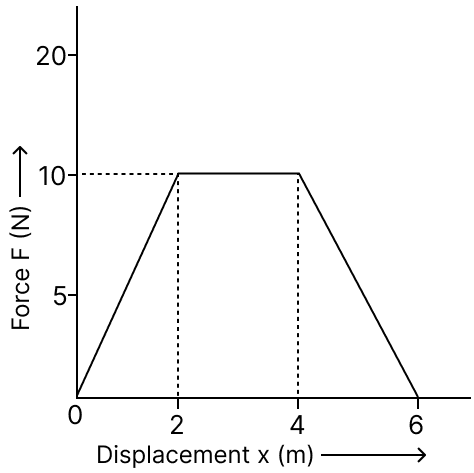
- 20 J
- 40 J
- 60 J
- 80 J
Assertion (A): Work done by frictional force is negative.
Reason (R): This is because frictional force acts along the direction of motion.
- Both A and R are true and R is the correct explanation of A
- Both A and R are true and R is not the correct explanation of A
- Assertion is false but reason is true
- Assertion is true but reason is false
A force F acts on a body and displaces it by a distance S in a direction at an angle θ with the direction of force.
(a) Write the expression for the work done by the force.
(b) What should be the angle between force and displacement so that the work done is (i) zero, (ii) maximum?