
Mathematics
Assertion (A): Equal chords of a circle are equidistant from centre.
Reason (R): Chords of a circle that are equidistant from the centre of a circle are equal.
Assertion (A) is true, Reason (R) is false.
Assertion (A) is false, Reason (R) is true.
Both Assertion (A) and Reason (R) are true, and Reason (R) is the correct reason for Assertion (A).
Both Assertion (A) and Reason (R) are true, but Reason (R) is not the correct reason (or explanation) for Assertion (A).
Circles
3 Likes
Answer
We know that,
Chords of equal length are equidistant from centre.
∴ Assertion (A) is true.
Also,
The chords which are equidistant from the centre of a circle are equal in length.
∴ Reason (R) is true.
Assertion is just the converse of reason.
∴ Both Assertion (A) and Reason (R) are true, and Reason (R) is the correct reason for Assertion (A).
Hence, option 3 is the correct option.
Answered By
2 Likes
Related Questions
In the adjoining figure, O is the center of the circle. If OA = 5 cm, AB = 8 cm and OD ⊥ AB, then length of CD is equal to
2 cm
3 cm
4 cm
5 cm

Consider the following two statements.
Statement 1: A line which meets a circle in two points is called a secant of the circle.
Statement 2: All radii of a circle are equal.
Which of the following is valid?
Both the statements are true.
Both the statements are false.
Statement 1 is true, and Statement 2 is false.
Statement 1 is false, and Statement 2 is true.
Assertion (A): In a circle, equal arcs suspend equal angles at the centre.
Reason (R): In the same circle, equal chords cuts off equal arc.
Assertion (A) is true, Reason (R) is false.
Assertion (A) is false, Reason (R) is true.
Both Assertion (A) and Reason (R) are true, and Reason (R) is the correct reason for Assertion (A).
Both Assertion (A) and Reason (R) are true, but Reason (R) is not the correct reason (or explanation) for Assertion (A).
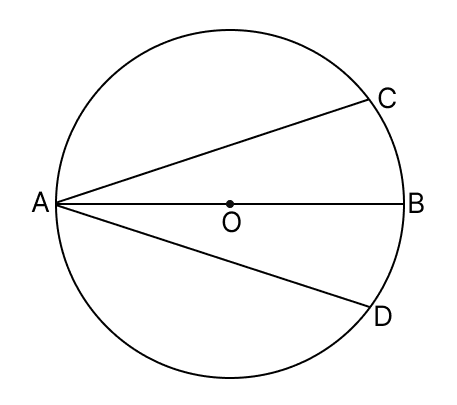
Assertion (A): In adjoining figure, AB is diameter of the circle with centre O.
If chord AC = chord AD, then we can conclude that ars BC = arc DB.
Reason (R): In adjoining figure, we can conclude that if chord AC = chord AD, then arc AC = arc AD.
Assertion (A) is true, Reason (R) is false.
Assertion (A) is false, Reason (R) is true.
Both Assertion (A) and Reason (R) are true, and Reason (R) is the correct reason for Assertion (A).
Both Assertion (A) and Reason (R) are true, but Reason (R) is not the correct reason (or explanation) for Assertion (A).