
Mathematics
Assertion (A): Equal chords of a circle subtend equal angles at the centre of the circle.
Reason (R): One and only one circle can be drawn passing through three points.
A is true, R is false
A is false, R is true
Both A and R are true
Both A and R are false
Circles
2 Likes
Answer
Let AB and CD are two equal chords of a circle with center O.
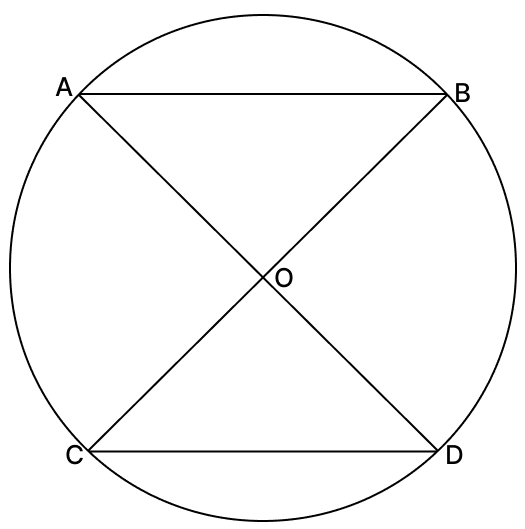
In Δ AOB and Δ COD,
OA = OC (Radii of a circle)
OB = OD (Radii of a circle)
AB = CD (Given)
By SSS congruency criterion,
Δ AOB ≅ Δ COD
Using corresponding parts of congruent triangles,
∠AOB = ∠COD
Assertion (A) is true.
Through three non-collinear points, exactly one circle can pass.
Through three collinear points, no circle can be drawn.
Reason (R) is false.
A is true, R is false.
Hence, option 1 is the correct option.
Answered By
1 Like
Related Questions
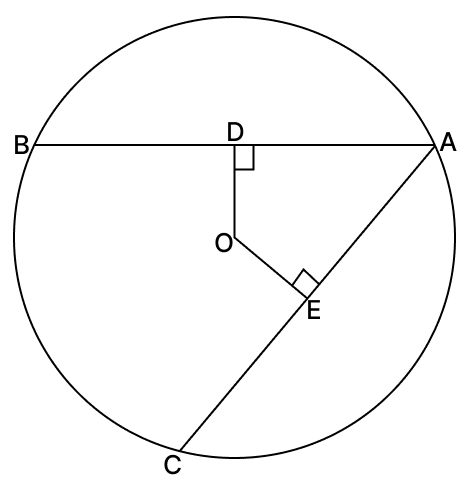
Assertion (A): In the figure, AB and AC are equal chords of a circle with centre O. If OD = 4 cm, then OE is also 4 cm.
Reason (R): Equal chords of a circle are equidistant from the centre.
A is true, R is false
A is false, R is true
Both A and R are true
Both A and R are false
Assertion (A): Longer is the chord, longer is its distance from the centre.
Reason (R): Chords of a circle that are equidistant from the centre of the circle are parallel to each other.
A is true, R is false
A is false, R is true
Both A and R are true
Both A and R are false
Two chords of a circle of lengths 10 cm and 8 cm are at the distances of 6 cm and 5 cm respectively from the centre. This statement is :
True
False
Can't say anything
Data inadequate
The radius of a circle is 13 cm and length of chord is 10 cm. The shortest distance between chord and the centre is:
12 cm
15 cm
16 cm
18 cm