Mathematics
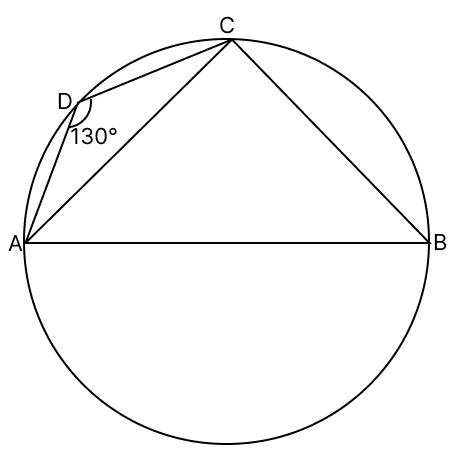
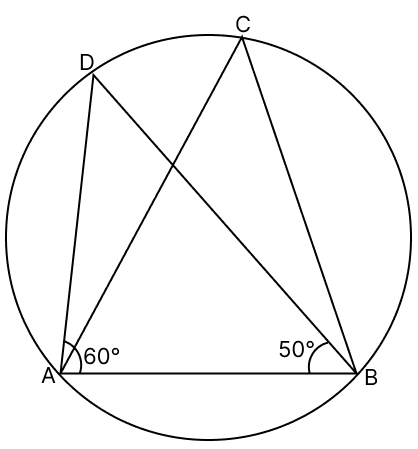
Assertion (A): In the figure, if AB is a diameter of the circle, then ∠BAC = 50°.
Reason (R): Sum of two angles of a cyclic quadrilateral is always 180°.
A is true, R is false
A is false, R is true
Both A and R are true
Both A and R are false
Circles
1 Like
Answer
In △ABC,
∠BCA = 90° [Angle in the semicircle]
Since ABCD is cyclic quadrilateral the sum of opposite angles is 180°,
∠ADC + ∠ABC = 180°
∠ABC = 180° - 130°
∠ABC = 50°
In triangle ABC,
∠ABC + ∠BAC + ∠ACB = 180°
∠BAC = 180° - (∠ABC + ∠ACB)
∠BAC = 180° - (50° + 90°)
∠BAC = 40°.
So, assertion (A) is false.
We know that,
Sum of opposite angles of a cyclic quadrilateral is always 180°. But the sum of two angles of a cyclic quadrilateral is not always 180°.
So, reason (R) is false.
A is false, R is false.
Hence, option 4 is the correct option.
Answered By
3 Likes
Related Questions
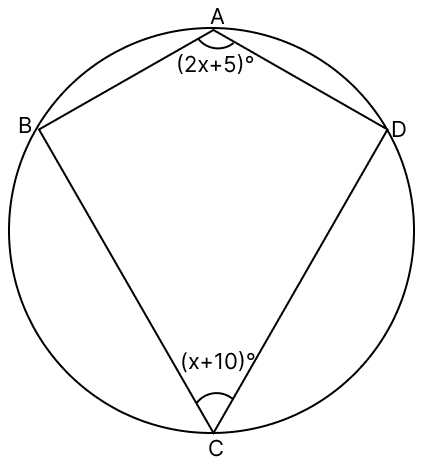
ABCD is a cyclic quadrilateral. If ∠BAD = (2x + 5)° and ∠BCD = (x + 10)°, then x is equal to :
65°
45°
55°
5°
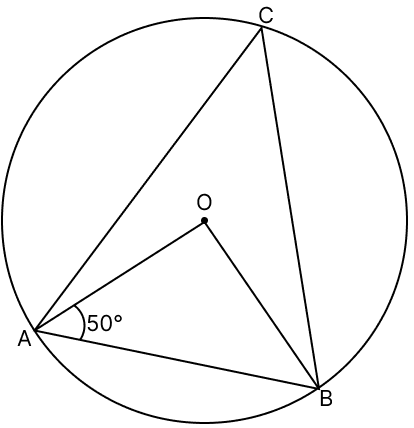
Assertion (A): In the given figure, if O is the centre of the circle, then ∠ACB = 40°.
Reason (R): Angle at the centre is double the angle at the remaining part of the circle.
A is true, R is false
A is false, R is true
Both A and R are true
Both A and R are false
Assertion (A): In the figure, ∠ACB = 70°.
Reason (R): Opposite angles of a cyclic quadrilateral are equal.
A is true, R is false
A is false, R is true
Both A and R are true
Both A and R are false
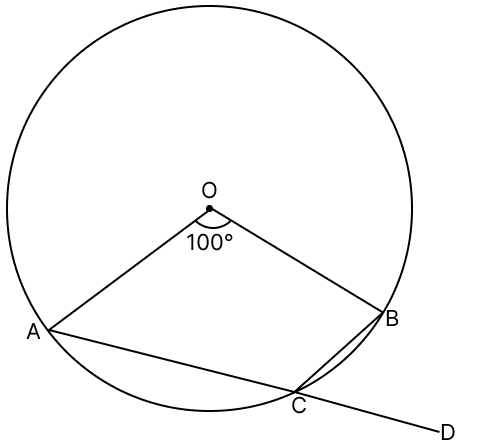
Assertion (A): In the figure, if O is the centre of the circle, then ∠BCD = 80°.
Reason (R): Exterior angle of a cyclic quadrilateral is equal to the interior opposite angle.
A is true, R is false
A is false, R is true
Both A and R are true
Both A and R are false