History & Civics
Assertion (A): Gandhiji called off the Non-Cooperation Movement in 1922.
Reason (R): An unruly crowd burnt down a police station at Chauri-Chaura in 1922.
- Both A and R are true, and R is the correct explanation of A.
- Both A and R are true, but R is not the correct explanation of A.
- A is true, but R is false.
- A is false, but R is true.
Answer
Both A and R are true, and R is the correct explanation of A.
Explanation — Gandhiji believed in 'Ahimsa' or Non-violence and this violent turn of events went against the principles of 'Satyagraha' (non-violent resistance based on truth). He felt that the people were not yet ready for a non-violent struggle, so he suspended the movement to prevent further violence.
Related Questions
Analysing the picture given below, identify the statement that does NOT align with its content.
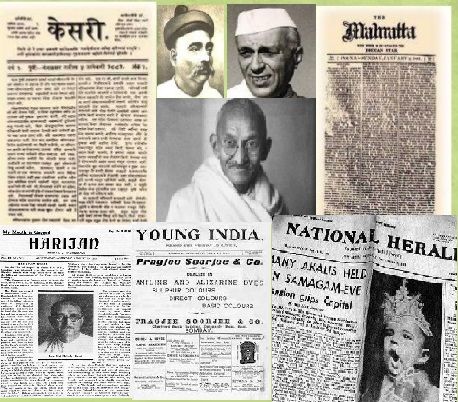
- The press spread modern liberal ideals such as liberty, freedom, and equality among the populace.
- The press provided a platform for various social groups from different regions of the country to exchange their views.
- The press played an important role in organising political movements.
- The press regularly praised the policies of the British Government in India.
Choose the options that DO NOT apply to the immediate objectives of the Indian National Congress.
P : To prevent national workers from all parts of India from becoming personally known to each other.
Q : To end all racial, religious, and provincial prejudices to promote national unity.
R : To formulate popular demands on vital Indian problems and their presentation before the government.
S : To manipulate the public opinion.
- P and Q
- Q and R
- P and S
- R and S
The issue on which the Civil Disobedience Movement of 1930 was launched was
- equal employment opportunities for Indians
- the proposed execution of Bhagat Singh.
- salt monopoly exercised by the British Government.
- complete freedom.
The statement, "We shall either free India or die in the attempt", is associated with which of the following?
- Non-Cooperation Movement
- Civil Disobedience Movement
- Individual Satyagraha
- Quit India Movement