
History & Civics
Assertion (A): India has a parliamentary form of government.
Reason (R): Indian Parliament comprises of two Houses.
- Both Assertion (A) and Reason (R) are correct and Reason (R) is the correct explanation of Assertion (A).
- Both Assertion (A) and Reason (R) are correct but Reason (R) is not the correct explanation of Assertion (A).
- Assertion (A) is true, but Reason (R) is false.
- Assertion (A) is false, but Reason (R) is true.
Union Parliament
3 Likes
Answer
Both Assertion (A) and Reason (R) are correct but Reason (R) is not the correct explanation of Assertion (A).
Explanation — India has a parliamentary government, where the executive is accountable to the legislature. The Parliament is bicameral, with the Lok Sabha and Rajya Sabha. Though both statements are true, having two Houses does not explain why India follows a parliamentary system.
Answered By
2 Likes
Related Questions
Describe the law making functions of the Parliament.
How does the Parliament exercise control over the Government?
Assertion (A): Indian President is the head of state.
Reason (R): Indian Parliament consists of the President, Lok Sabha and Rajya Sabha.
- Both Assertion (A) and Reason (R) are correct and Reason (R) is the correct explanation of Assertion (A).
- Both Assertion (A) and Reason (R) are correct but Reason (R) is not the correct explanation of Assertion (A).
- Assertion (A) is true, but Reason (R) is false.
- Assertion (A) is false, but Reason (R) is true.
On the basis of the given picture answer the following questions.
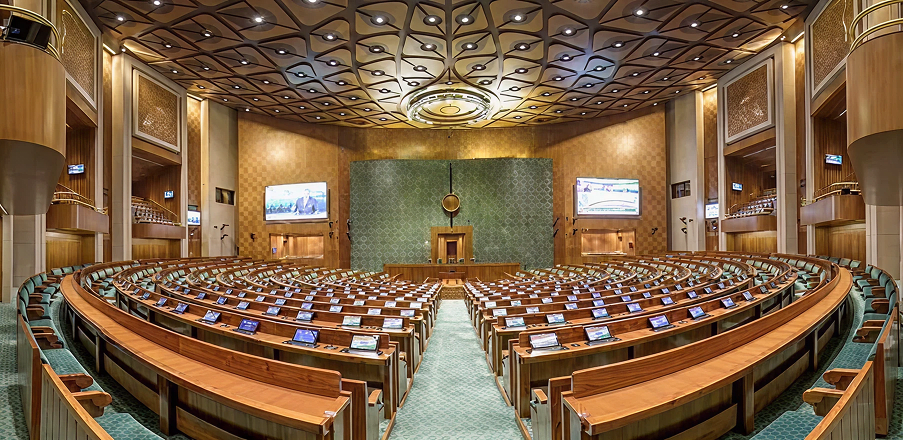
(i) What is the strength of the House?
(ii) How many members represent the States?
(iii) How many representatives come from Union Territories?