
Biology
Assertion (A): Leukoplasts are colourless plastids as they have no pigments.
Reason (R): Leukoplasts are normally found in the non-photosynthetic parts of a plant.
- Both A and R are true and R is the correct explanation of A.
- Both A and R are true but R is not the correct explanation of A.
- A is true but R is false.
- A is false but R is true.
Cell
25 Likes
Answer
Both A and R are true and R is the correct explanation of A.
Reason — A is true as leukoplasts are colourless plastids because they lack pigments.
R is true as leukoplasts are found in the non-photosynthetic parts of a plant. These parts do not perform photosynthesis. Therefore, leukoplasts in these parts lack pigments, making them colourless.
Therefore, Both A and R are true and R is the correct explanation of A is the correct option.
Answered By
16 Likes
Related Questions
Study the diagram given below and answer the questions that follow:
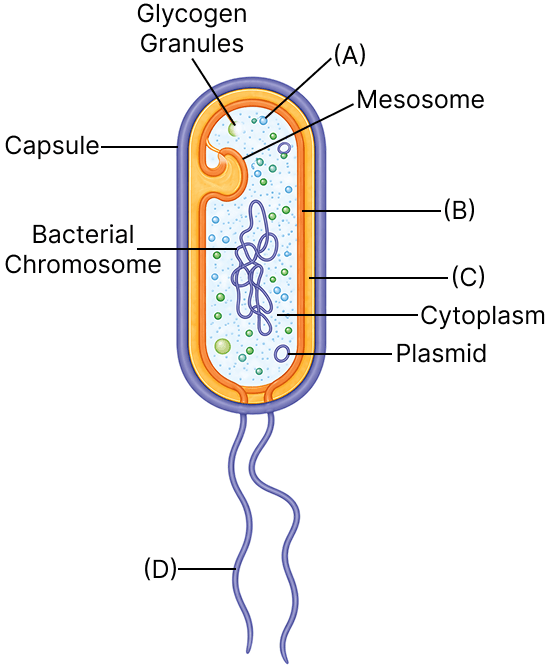
(a) Identify the unicellular organism shown above.
(b) Is it a prokaryotic or eukaryotic cell ?
(c) Name the spherical bodies composed mainly of RNA, shown by (A).
(d) Mention one difference between the cellular structures shown by (B) and (C) with respect to permeability.
(e) Write one important role of the structure shown by (D).
Assertion (A): Ribosomes are considered as the 'delivery system of the cell'.
Reason (R): Delivery system is concerned with the secretions of the cell including enzymes, hormones, etc.
- Both A and R are true and R is the correct explanation of A.
- Both A and R are true but R is not the correct explanation of A.
- A is true but R is false.
- A is false but R is true.
Assertion (A): Cristae are the finger-like projections arising from the inner walls of mitochondria.
Reason (R): These projections increase the surface area of the inner membrane and help in the production of ATP.
- Both A and R are true and R is the correct explanation of A.
- Both A and R are true but R is not the correct explanation of A.
- A is true but R is false.
- A is false but R is true.
Assertion (A): Euglena is an example of a unicellular, eukaryotic organism.
Reason (R): This organism is microscopic and has a well-defined nucleus.
- Both A and R are true and R is the correct explanation of A.
- Both A and R are true but R is not the correct explanation of A.
- A is true but R is false.
- A is false but R is true.