
Mathematics
Assertion (A): The mid-points of the sides of a quadrilateral ABCD are joined in order to get quadrilateral PQRS. PQRS is a rhombus.
Reason (R): Adjacent sides of a rhombus are equal and perpendicular to each other.
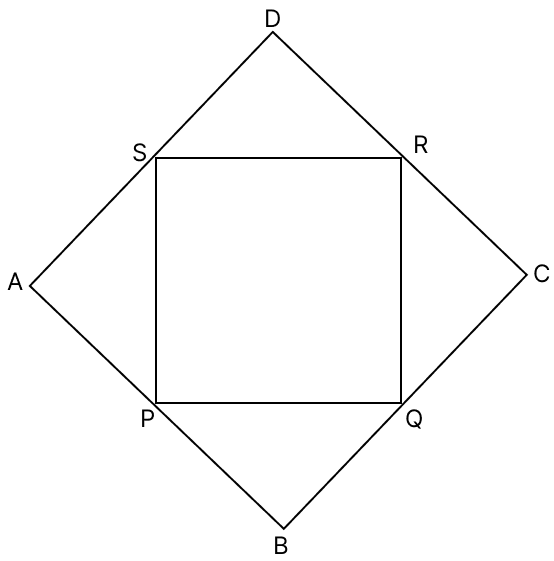
A is true, R is false
A is false, R is true
Both A and R are true
Both A and R are false
Mid-point Theorem
4 Likes
Answer
Join AC and BD.
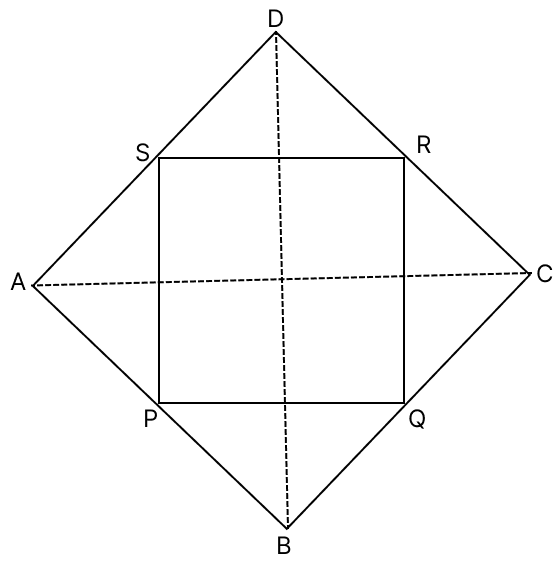
By mid-point theorem,
The line segment joining the mid points of any two sides of a triangle is parallel to the third side and is equal to half of it.
In △ABC,
P and Q are midpoints of AB and BC respectively.
∴ PQ || AC and PQ = AC (By midpoint theorem) …..(1)
Similarly in △ADC,
S and R are midpoints of AD and CD respectively.
∴ RS || AC and RS = AC (By midpoint theorem) …..(2)
In △ABD,
P and S are midpoints of AB and AD respectively.
∴ PS || BD and PS = BD (By midpoint theorem) …..(3)
Similarly in △BCD,
Q and R are midpoints of BC and CD respectively.
∴ QR || BD and QR = BD (By midpoint theorem) …..(4)
From (1) and (2) we get,
PQ = RS and PQ || RS
From (3) and (4) we get,
PS = QR and PS || QR
Since, opposite sides are parallel and equal.
Thus, PQRS is a parallelogram.
∴ Assertion (A) is false.
In rhombus, adjacent sides are equal and adjacent angles are supplementary.
∴ Reason (R) is false.
Hence, option 4 is the correct option.
Answered By
1 Like
Related Questions
Case Study
Ankita took part in a Rangoli Competition. She made a beautiful Rangoli in the shape of a triangle ABC as shown. In the triangle, P, Q and R are mid-points of the sides AB, BC and CA respectively. She decorated it by putting a garland along the sides of △PQR. The lengths of the sides of the triangle are AB = 20 cm, BC = 26 cm and AC = 24 cm.
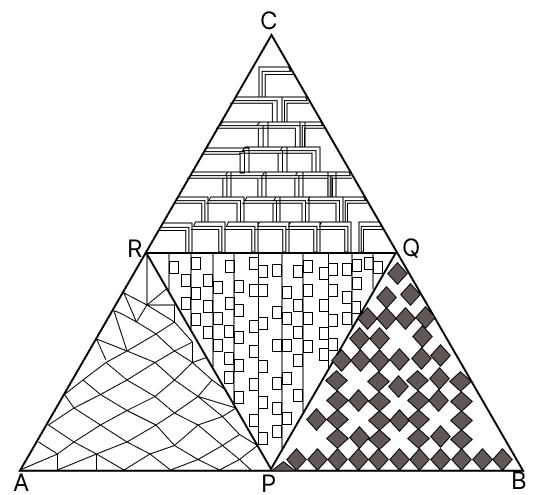
Based on this information, answer the following questions:
The length of AP is :
(a) QB
(b) QR
(c) AR
(d) RPThe length of PQ is :
(a) 12 cm
(b) 13 cm
(c) 10 cm
(d) 15 cmThe length of the garland is :
(a) 30 cm
(b) 32 cm
(c) 35 cm
(d) 40 cmArea of △PQR is :
(a) area of △ABC
(b) area of △ABC
(c) area of △ABC
(d) area of △ABCAPQR is a :
(a) Rectangle
(b) Parallelogram
(c) Square
(d) Rhombus
Assertion (A): In the figure, if AD = DC = 4 cm, EC = 10 cm and DE || AB, then CE = 5 cm.
Reason (R): The straight line drawn through the mid-point of one side of a triangle parallel to other, bisects the third side.
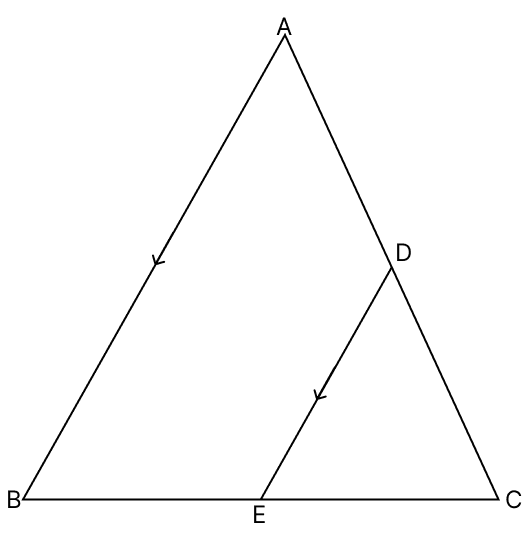
A is true, R is false
A is false, R is true
Both A and R are true
Both A and R are false
The figure formed by joining the mid-points of the sides of a quadrilateral ABCD, taken in order is a square only, if :
ABCD is a rhombus
Diagonals of ABCD are equal
Diagonals of ABCD are equal and perpendicular
Diagonals of ABCD are perpendicular
D and E are the mid-points of the sides AB and AC respectively of △ABC. DE is produced to F. To show that CF is equal and parallel to DA, we need an additional information, which is :
DE = EF
AE = EF
∠DAE = ∠EFC
∠ADE = ∠ECF