Physics
Assertion (A) : The rate of flow of electrons in a direction is called electronic current in that direction.
Reason (R) : The conventional current is in a direction opposite to direction of motion of electrons.
- both A and R are true and R is the correct explanation of A
- both A and R are true and R is not the correct explanation of A
- assertion is false but reason is true
- assertion is true but reason is false
Answer
both A and R are true and R is the correct explanation of A
Explanation
Assertion (A) is true because electronic current refers to the actual flow of electrons, which move from the negative terminal to the positive terminal of a power source and the rate at which electrons flow defines the magnitude of current.
Reason (R) is true because conventional current is defined as the flow of positive charge, which is taken to be from positive to negative terminal of a cell opposite to the direction of electron flow.
The reason correctly explains the difference between electronic current (actual flow of electrons) and conventional current (assumed flow of positive charge).
Related Questions
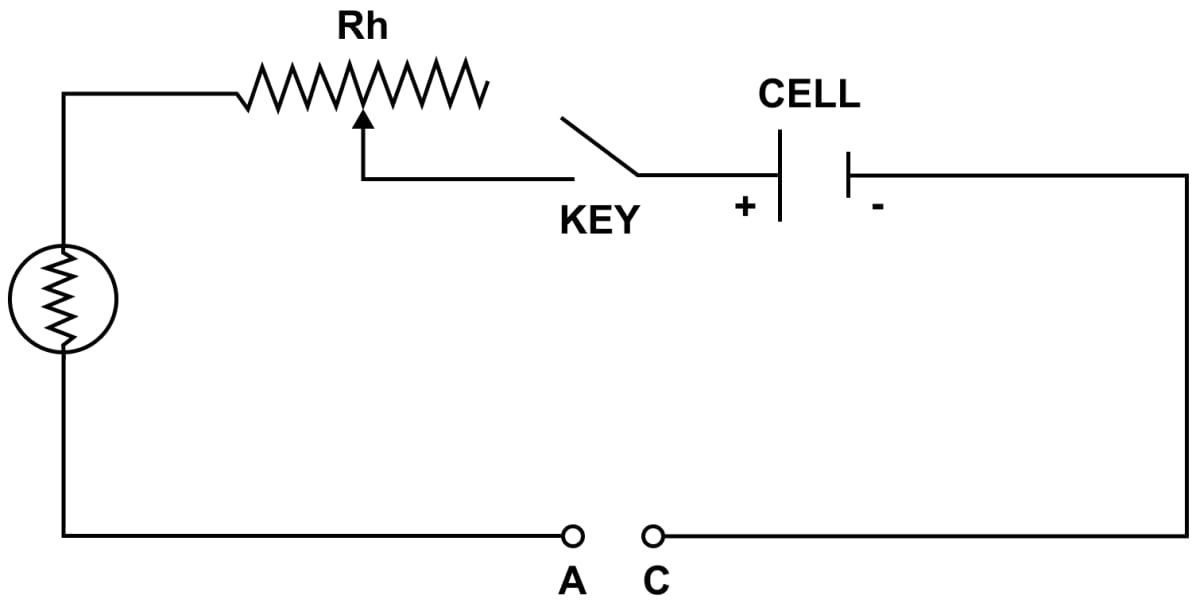
(a) Complete the circuit given in figure by inserting between the terminals A and C, an ammeter. (b) In the diagram mark the polarity at the terminals of ammeter and indicate clearly the direction of flow of current in the circuit, when the circuit is complete. (c) Name and state the purpose of Rh in the circuit.
Assertion (A) : Primary cells are use and throw types.
Reason (R) : Primary cells provide current as a result of irreversible chemical reaction.
- both A and R are true and R is the correct explanation of A
- both A and R are true and R is not the correct explanation of A
- assertion is false but reason is true
- assertion is true but reason is false
Assertion (A) : An ammeter is used to measure potential difference between two points of circuit.
Reason (R) : An ammeter must have a very low resistance.
- both A and R are true and R is the correct explanation of A
- both A and R are true and R is not the correct explanation of A
- assertion is false but reason is true
- assertion is true but reason is false
Assertion (A) : Cotton and rubber are examples of insulators.
Reason (R) : These materials have a large number of free electrons and they offer less resistance to flow of current.
- both A and R are true and R is the correct explanation of A
- both A and R are true and R is not the correct explanation of A
- assertion is false but reason is true
- assertion is true but reason is false