
Mathematics
Assertion (A): If the sides of a rectangular plot are 80 m and 60 m, then the length of its diagonal is 100 m.
Reason (R): In a rectangle, all angles are 90°.
Assertion (A) is true, Reason (R) is false.
Assertion (A) is false, Reason (R) is true.
Both Assertion (A) and Reason (R) are true, and Reason (R) is the correct reason for Assertion (A).
Both Assertion (A) and Reason (R) are true, but Reason (R) is not the correct reason (or explanation) for Assertion (A).
Pythagoras Theorem
2 Likes
Answer
A rectangle is a quadrilateral with four right angles.
Let ABCD be the rectangular plot.
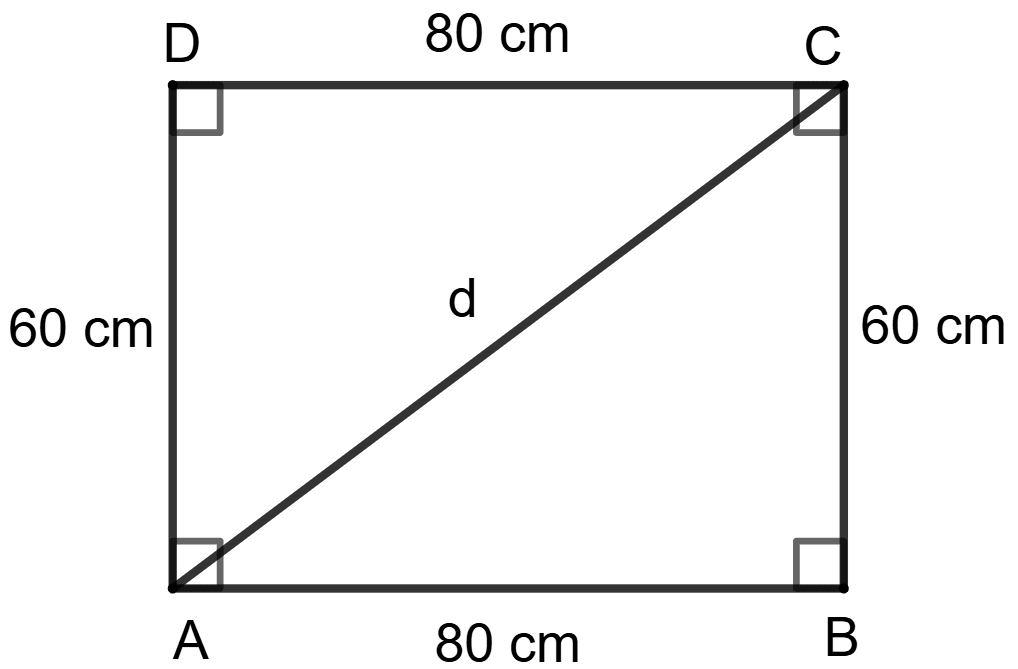
Thus, in a rectangle, all angles are 90°.
∴ Reason (R) is true.
Given:
Side 1 (AB) = 80 m
Side 2 (BC) = 60 m
Let d be the length of the diagonal (AC). Using pythagoras theorem in triangle ABC,
⇒ AC2 = AB2 + BC2
⇒ d2 = 802 + 602
⇒ d2 = 6400 + 3600
⇒ d2 = 10000
⇒ d =
⇒ d = ± 100 m
Since, length cannot be negative, so, diagonal = 100 m.
∴ Assertion (A) is true.
∴ Both Assertion (A) and Reason (R) are true, and Reason (R) is the correct reason (or explanation) for Assertion (A).
Hence, option 3 is the correct option.
Answered By
2 Likes
Related Questions
A ladder reaches a window 12 m above the ground on one side of the street. Keeping its foot at the same point, the ladder is turned to the other side of the street to reach a window 9 m high. If the length of the ladder is 15 m, then the width of the street is
30 m
24 m
21 m
18 m
Consider the following two statements:
Statement 1: The area of a square whose diagonal is 6 cm is 36 cm2.
Statement 2: A diagonal of a square divides it into two right angled isosceles triangle.
Which of the following is valid?
Both the statements are true.
Both the statements are false.
Statement 1 is true, and Statement 2 is false.
Statement 1 is false, and Statement 2 is true.
Assertion (A): If triangle ABC is isosceles with AC = BC and AB2 = 2AC2, then triangle ABC is right angled.
Reason (R): If in a triangle ABC, we have AB2 = 2AC2 then we can conclude that it is right angled triangle.
Assertion (A) is true, Reason (R) is false.
Assertion (A) is false, Reason (R) is true.
Both Assertion (A) and Reason (R) are true, and Reason (R) is the correct reason for Assertion (A).
Both Assertion (A) and Reason (R) are true, but Reason (R) is not the correct reason (or explanation) for Assertion (A).
Assertion (A): A triangle with sides 2 cm, 3 cm, 4 cm is not a right angled triangle.
Reason (R): A triangle with sides 2 cm, 3 cm, 4 cm is a scalene triangle.
Assertion (A) is true, Reason (R) is false.
Assertion (A) is false, Reason (R) is true.
Both Assertion (A) and Reason (R) are true, and Reason (R) is the correct reason for Assertion (A).
Both Assertion (A) and Reason (R) are true, but Reason (R) is not the correct reason (or explanation) for Assertion (A).