
Mathematics
Assertion (A) : The two diagonals of a rectangle are equal and bisect each other at right angles.
Reason (R) : Every rectangle is a square.
A is true, R is false
A is false, R is true
Both A and R are true
Both A and R are false
Rectilinear Figures
2 Likes
Answer
The diagonals of a rectangle are equal in length and bisect eah other, but not necessarily at right angles.
∴ Assertion (A) is false.
A square is a special type of rectangle where all sides are equal, but a rectangle is not necessarily a square.
A rectangle only requires four right angles; it does not require all four sides to be equal.
Every square is a rectangle, but not every rectangle is a square.
∴ Reason (R) is false.
Both A and R are false.
Hence, option 4 is the correct option.
Answered By
2 Likes
Related Questions
PQRS is a rhombus in which PQ = 6 cm and ∠PQR = 120°. The length of the diagonal QS is :
6 cm
7 cm
8 cm
11 cm
Rajbeer is a farmer. He has a plot of land in the shape of a quadrilateral ABCD as shown in the figure. In ABCD, AB ∥ CD and AD ∥ BC. He divided the field into two parts, viz, triangle BCE and trapezium CDAE by making an embankment CE such that CE = AD.
Based on the above information, answer the following questions :
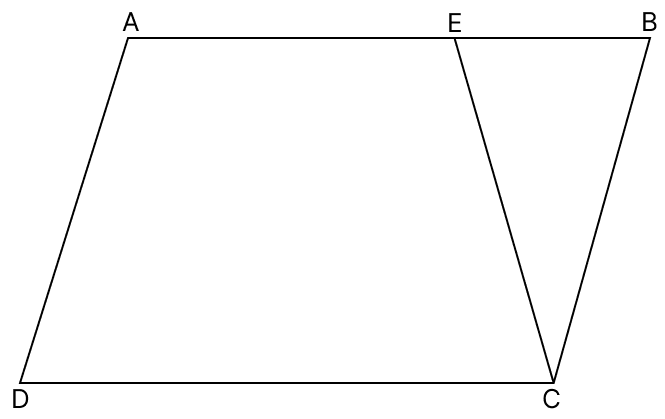
1. ABCD is a :
(a) Rectangle
(b) Parallelogram
(c) Square
(d) Trapezium2. ∠A is equal to :
(a) ∠D
(b) ∠B
(c) ∠C
(d) ∠E3. ∠DCE is equal to :
(a) ∠E
(b) ∠A
(c) ∠D
(d) ∠B4. Which of the following is correct?
(a) ΔAEC ≅ ΔEAD
(b) ΔACE ≅ ΔAED
(c) ΔCEA ≅ ΔEAD
(d) none of these5. Diagonal DE is equal to :
(a) diagonal DB
(b) diagonal AC
(c) DC
(d) BCAssertion (A) : If diagonals of a quadrilateral are equal, then it must be a rectangle.
Reason (R) : The diagonals of a rectangle are equal.
A is true, R is false
A is false, R is true
Both A and R are true
Both A and R are false
Assertion (A) : Every square is a parallelogram.
Reason (R) : In a square as well as in a parallelogram, the diagonals are equal in length.
A is true, R is false
A is false, R is true
Both A and R are true
Both A and R are false