
Physics
A ball of mass 20 g falls from a height of 45 m. It rebounds from the ground to a height of 40 m. Calculate :
(a) initial potential energy of the ball.
(b) the speed of the ball at which it hits the ground.
(c) the loss in kinetic energy on striking the ground.
[g = 10 m s-2]
Work, Energy & Power
2 Likes
Answer
(a) Given,
- Mass of the ball (m) = 20 g = 0.02 kg
- Initial height (h1) = 45 m
- Final height (h2) = 40 m
- g = 10 m s-2
(a) Initial potential energy of the ball is given by,
PE = mgh1
= 0.02 x 10 x 45
= 9 J
So, the initial potential energy is 9 J.
(b) Due to law of conservation of mechanical energy, just before hitting the ground, the initial potential energy converts into kinetic energy.
Let speed of the ball be v.
So,
So, the speed of the ball on hitting the ground = 30 m s-1.
(c) Final kinetic energy after rebound is equal to potential energy at 40 m which is given by,
Final kinetic energy = mgh2
= 0.02 x 10 x 40
= 8 J
Loss in KE = Initial kinetic energy - Final kinetic energy = 9 − 8 = 1 J
So, the loss in kinetic energy = 1 J.
Answered By
1 Like
Related Questions
The diagram shows a wheel with a handle. Two forces, F1 and F2 of equal magnitudes are acting on the handle as shown in the diagram.
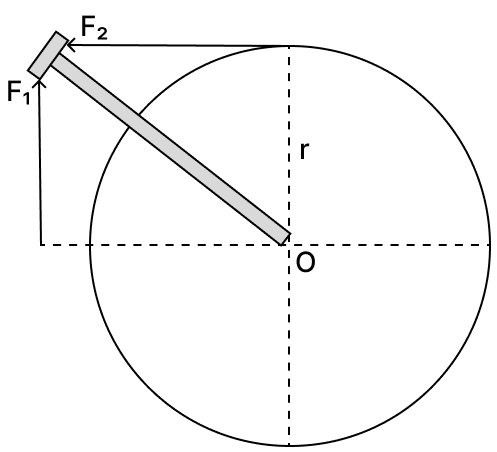
(a) Which force produces negative moment?
(b) Is the wheel in equilibrium? (Yes or No)
(c) Justify your answer stated in (b).
(a) Name the unit of work done, used in subatomic scale.
(b) To which class of lever does a pair of scissors belong?
(c) A stone is tied to a string and displaced from A to B by application of constant force F in three different ways as shown in the diagram below.
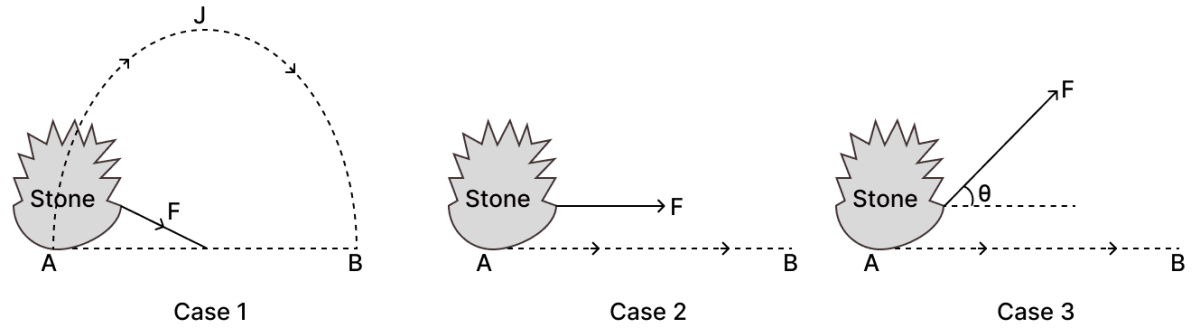
Arrange the three cases in ascending order of the work done by the force. (Given AJB is a semi-circle, θ < 90° and AB = 20 m)
To lift a load of 30 kgf, Suhas uses a single fixed pulley while Radha uses a single movable pulley. The displacement of efforts in both the cases are equal. In an ideal situation calculate the ratio of :
(a) the efforts in the two cases.
(b) the potential energy gained by the loads in the two cases.
(c) the efficiencies in the two cases.
(a) One end of a plastic foot ruler is held tightly at the edge of a table and the other end is plucked. Name the vibrations produced in the ruler.
(b) Now the ruler is pushed inside partially and plucked again from its freе end. State with a reason whether the frequency of vibration increases or decreases.